Most procurement delays don’t happen because vendors fail.
They happen because procurement decisions are disconnected from build reality .
Items are ordered too early and sit idle.
Or worse, ordered too late and block progress.
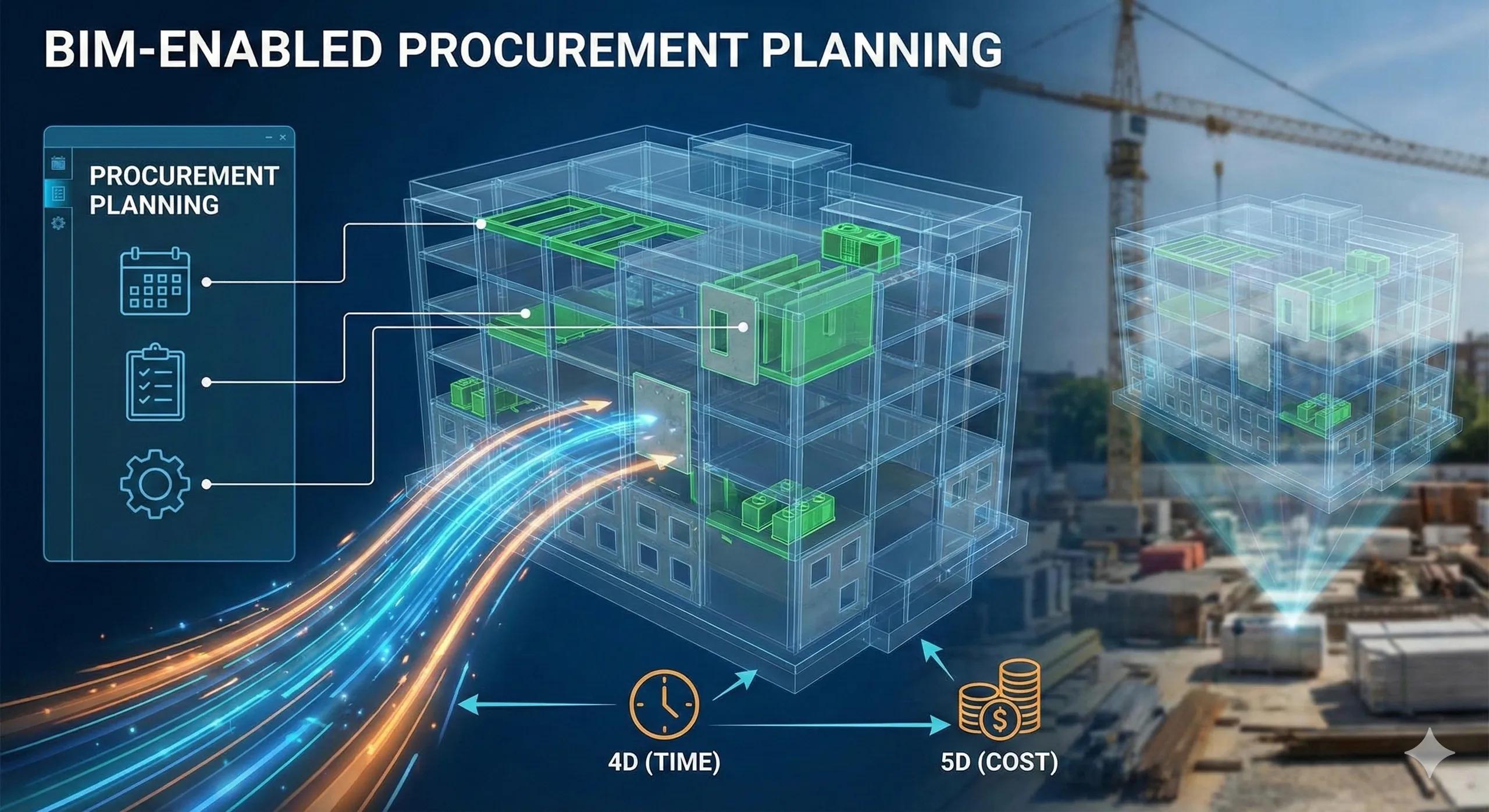
BIM-enabled procurement planning bridges this gap by linking what needs to be bought , when it is needed , and where it will be installed .
1. Why Traditional Procurement Planning Breaks Down
Conventional procurement relies on:
Static BOQs
Long lead-time lists
Experience-based timing
But projects evolve:
Designs change
Sequences shift
Access constraints appear
Storage capacity fluctuates
Static procurement plans cannot keep pace.
2. What BIM Adds to Procurement Intelligence
BIM enables procurement teams to:
Visualize installation sequences
Understand zone-by-zone demand
Align material delivery with access and storage
Detect procurement-driven bottlenecks early
Procurement stops being a checklist activity and becomes execution-aware .
3. Linking Procurement to 4D and 5D
Effective procurement planning connects:
4D → When items are needed on site
5D → Cost and cash-flow implications
BIM geometry → Where items are installed
This alignment helps answer critical questions:
What must be ordered now?
What can wait?
What creates storage or congestion risk?
4. Long-Lead Items: The Real Risk Drivers
Items like:
MEP equipment
Facade systems
Elevators
Specialized finishes
drive schedules disproportionately.
BIM helps:
Identify exact installation windows
Test alternative sequences
Align manufacturing timelines with site readiness
This reduces panic-driven expediting.
5. Avoiding the “Warehouse on Site” Problem
Early procurement often leads to:
Congested laydown areas
Material damage
Theft and loss
Inefficient handling
BIM-based logistics visibility allows:
Just-in-time delivery planning
Zone-wise material release
Temporary storage optimization
6. Procurement Is a Spatial Decision
Ordering materials without spatial context ignores:
Access constraints
Crane reach
Floor load limits
Temporary works
BIM ensures procurement decisions respect site physics , not just contracts.
7. India Context: Why BIM-Led Procurement Matters
In Indian projects:
Sites are space-constrained
Lead times are volatile
Cash flow timing is critical
Vendor ecosystems vary widely
BIM-enabled procurement:
Improves predictability
Reduces working capital strain
Supports transparent coordination with vendors
8. From Reactive Buying to Planned Supply
When procurement is BIM-driven:
Buying aligns with execution
Fewer emergency orders occur
Site teams gain confidence
Claims and disputes reduce
Procurement becomes proactive, not firefighting.
9. Common Pitfalls to Avoid
BIM-led procurement fails when:
Models are not construction-ready
Schedules are unrealistic
Procurement teams are not involved early
Data updates are infrequent
Discipline matters more than tools.
10. A Simple Procurement Rule
If a material arrives before the site is ready, or after it is needed, planning has already failed.
Conclusion
Procurement is not a finance function alone.
It is a time-space coordination problem .
When BIM informs procurement:
Orders align with reality
Storage risk reduces
Cash flow improves
Execution becomes smoother
Without BIM, procurement reacts.
With BIM, procurement anticipates.