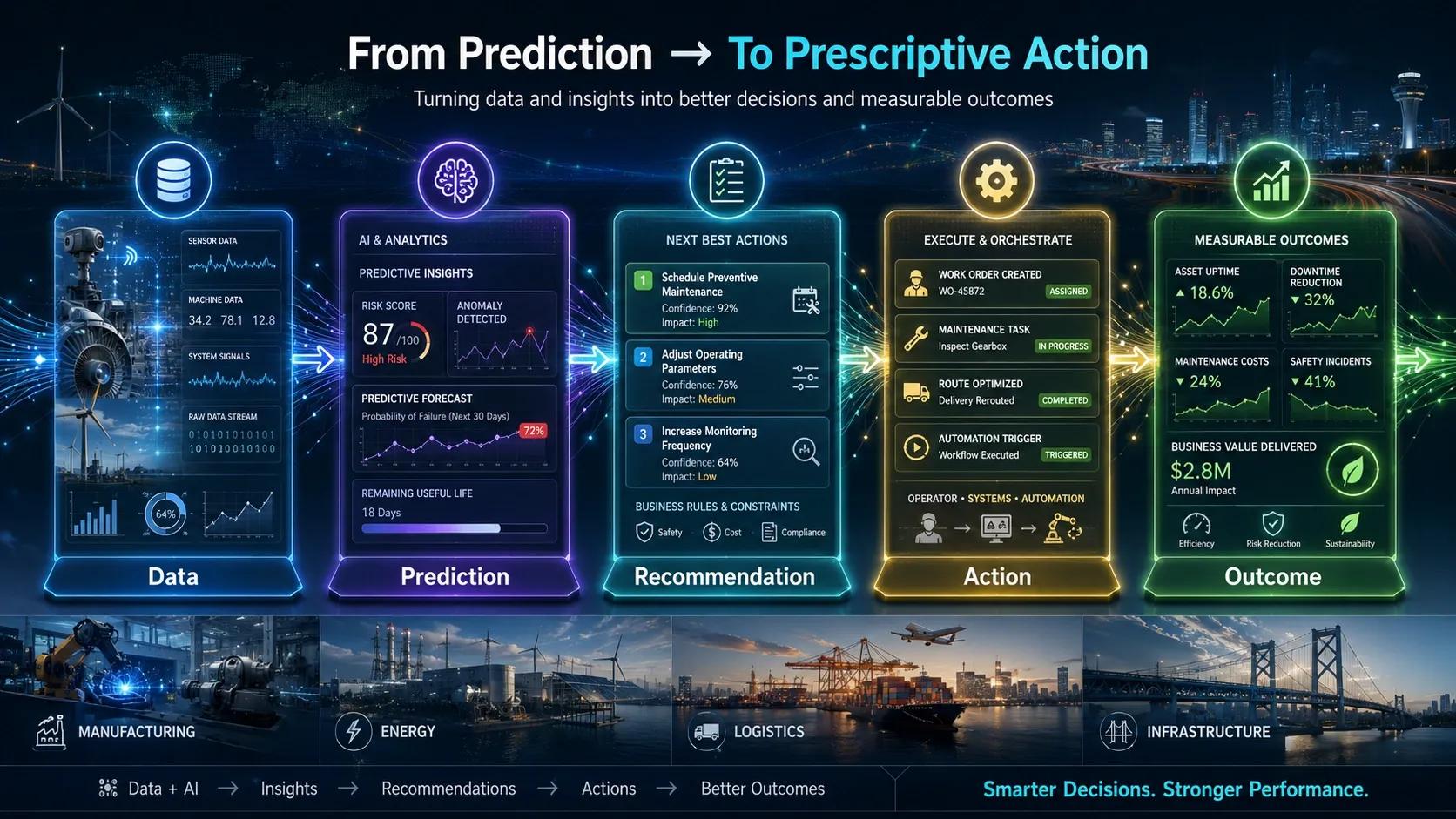
Prediction tells you what might happen.
Prescriptive decision-making tells you what should be done next.
That difference defines whether a Digital Twin is only intelligent or operationally useful.
Introduction: Phase 4 Continuation
In Phase 4, we are focusing on:
👉 Operations, KPIs & ROI
So far, we discussed:
how to define KPIs
how to measure ROI
why projects stall after pilots
how Digital Twins must enter daily workflows
Now we move to one of the most important maturity shifts:
👉 Predictive vs Prescriptive Decision-Making
Many Digital Twin systems today can predict risks, delays, failures, and demand patterns.
But the real question is:
👉 What happens after the prediction?
Because prediction alone does not create value.
Value comes when prediction leads to:
a decision
an action
an outcome
and a measurable improvement
The Core Problem: Prediction Without Action
Many systems today can say:
this asset may fail
this road may flood
this machine may slow down
this facility may consume more energy
this supply chain route may face delays
But then the organization still asks:
👉 So what should we do now?
This is where many Digital Twin systems stop.
They predict.
But they do not prescribe.
What is Predictive Decision-Making?
Predictive decision-making focuses on:
👉 what is likely to happen
It uses:
historical data
real-time inputs
AI/ML models
simulation
pattern recognition
Examples
predicting equipment failure
forecasting traffic congestion
estimating flood risk
predicting energy demand
identifying future maintenance needs
Prediction improves awareness.
But it still requires humans to interpret and act.
What is Prescriptive Decision-Making?
Prescriptive decision-making goes one step further.
It asks:
👉 what should be done next?
It combines:
prediction
rules
constraints
priorities
operational workflows
risk thresholds
Examples
recommending a maintenance action
rerouting logistics automatically
adjusting energy usage
triggering a field inspection
changing production schedules
prioritizing emergency response
Prediction identifies the possible problem.
Prescription defines the best response.
The Difference in Simple Terms
Predictive systems say:
👉 “This may happen.”
Prescriptive systems say:
👉 “This is what you should do about it.”
That is the difference between:
intelligence and
operational value
Practical Example: Smart Manufacturing
A predictive Digital Twin detects:
👉 machine failure risk within 48 hours.
That is useful.
But a prescriptive Digital Twin goes further:
checks production schedule
identifies available maintenance window
checks spare part availability
assigns technician
updates workflow
tracks completion
Now the system is not just predicting failure.
It is helping prevent it.
Why Prescriptive Systems Are Harder
Prescriptive decision-making is more difficult because it must understand:
operational constraints
resource availability
business priorities
safety rules
compliance limits
human approval requirements
Prediction can work with data.
Prescription needs decision logic.
That is why many systems remain predictive but not truly prescriptive.
Where Most Organizations Get Stuck
1. Prediction Is Treated as the End Goal
Dashboards show risk scores, but no action follows.
2. Decision Rules Are Not Defined
The system knows something is wrong, but not what should happen next.
3. Workflows Are Not Integrated
Recommendations do not convert into tasks, approvals, or work orders.
4. Constraints Are Missing
The system recommends actions that are not practical in the real world.
5. Accountability Is Unclear
Even when a recommendation exists, no one owns the next step.
The Role of Digital Twins
A mature Digital Twin should connect:
👉 prediction → recommendation → action → feedback
This creates a closed decision loop.
Without this loop:
👉 prediction remains insight.
With this loop:
👉 prediction becomes operational intelligence.
Ask Yourself
Is your Digital Twin only predicting what may happen, or is it helping decide what should happen next?
Indian Context
In India, many Digital Twin initiatives are moving toward predictive capabilities in:
infrastructure maintenance
energy systems
smart cities
manufacturing
disaster management
But the next maturity step is prescriptive decision-making.
This means:
linking insights to workflows
embedding decision rules
defining ownership
tracking outcomes
That is where ROI becomes measurable.
Benefits of Prescriptive Decision-Making
faster response
reduced decision latency
better resource allocation
fewer operational failures
measurable ROI
improved accountability
Conclusion
Prediction improves awareness.
Prescription improves action.
A Digital Twin becomes truly valuable when it does not just tell us:
👉 what might happen
but helps us decide:
👉 what should be done next
That is the shift from predictive intelligence to prescriptive operations.
And that is where Digital Twins begin to deliver real business value.