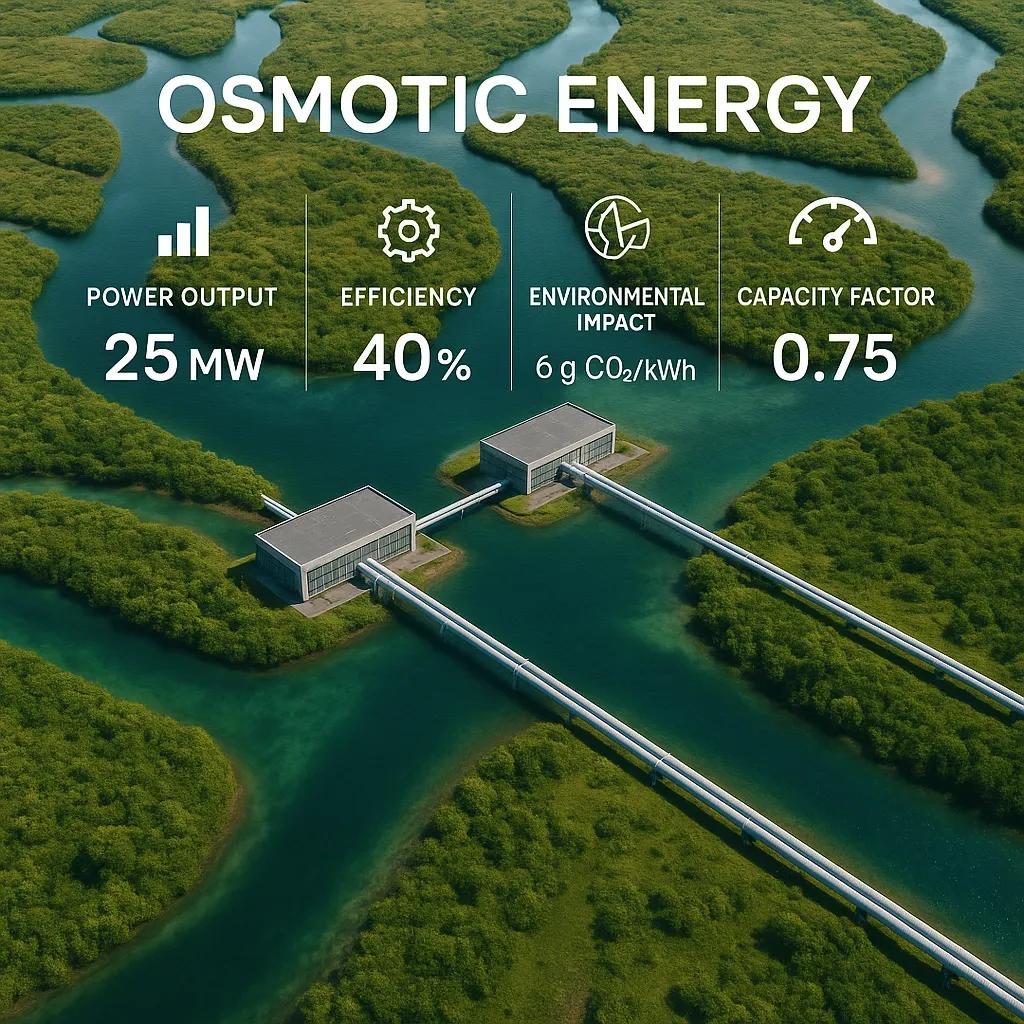
The convergence of freshwater rivers and saltwater seas has been occurring for millennia, yet only recently has humanity begun to recognize the immense energy potential locked within these natural meeting points. The World Economic Forum 's 2025 Emerging Technologies report has identified osmotic power systems as one of the ten breakthrough technologies poised to transform our energy landscape. This revolutionary "blue energy" technology promises to harness the natural salinity gradient where rivers meet the sea, potentially generating 5,177 terawatt-hours (TWh) annually, equivalent to powering 20% of global electricity demand.
The Science Behind Blue Energy
Osmotic power, also known as salinity gradient power or blue energy, operates on a fundamental principle of physics: osmosis. When freshwater encounters saltwater, nature seeks equilibrium through the movement of water molecules across specialized membranes from areas of low salt concentration to high salt concentration. This natural process, which occurs in every river delta, estuary, and coastal region worldwide, releases enormous amounts of energy that has been largely untapped until recent technological breakthroughs.
Technology employs two primary methods for energy conversion. Pressure Retarded Osmosis (PRO) uses semi-permeable membranes to allow water movement from freshwater to pressurized saltwater, creating pressure differentials that drive turbines to generate electricity. Reverse Electrodialysis (RED) utilizes ion-exchange membranes that enable the selective movement of positively and negatively charged ions, directly creating electrical current. Both approaches represent significant advances over early attempts in the 1970s, when membrane limitations severely constrained power output and commercial viability.
Revolutionary Technological Breakthroughs
The resurrection of osmotic energy as a viable renewable source stems from dramatic improvements in membrane technology and system design. French startup Sweetch Energy, recognized as a World Economic Forum 2025 Technology Pioneer, has developed revolutionary INOD (Ionic Nano Osmotic Diffusion) membranes made from abundant natural materials. These advanced membranes achieve 20-25 watts per square meter, a twenty-fold improvement over earlier technologies, while dramatically reducing production costs.
Recent pilot projects demonstrate the technology's commercial readiness. Japan launched Asia's first osmotic power plant in Fukuoka in 2025, generating 880,000 kilowatt-hours annually to support local desalination operations and power approximately 220 homes. Denmark's pioneering facility, operational since 2023, produces around 100 kilowatts using concentrated brine from salt production. These installations prove that osmotic energy can deliver consistent, weather-independent power generation 24 hours daily, 365 days annually.
Global Energy Potential and Geographic Distribution
The worldwide potential for osmotic energy is staggering. Conservative estimates suggest that fully developed osmotic power systems could supply 10-20% of global electricity demand, with theoretical calculations indicating available capacity of 5,177 TWh annually. This renewable energy source surpasses many traditional alternatives in both scale and reliability, offering baseload power generation that operates independently of weather conditions, seasonal variations, or time of day.
Geographic distribution analysis reveals extensive opportunities across all continents. North America possesses approximately 49 GW of osmotic potential, while South America offers 51 GW. Europe presents 40 GW of capacity, Africa 43 GW, and Asia leads with 86 GW of available resources. Oceania contributes an additional 19 GW, bringing total global potential to nearly 300 GW of installable capacity.
River deltas and estuaries worldwide represent prime locations for osmotic energy development. Major river systems including the Amazon, Mississippi, Nile, Ganges, Yangtze, and Rhine deltas offer exceptional salinity gradients and consistent freshwater flows necessary for optimal power generation. Coastal regions with significant freshwater discharge, particularly in Asia, Europe, and North America, present the most immediate commercial opportunities.
Economic Viability and Market Development
Economic analysis indicates increasingly favorable conditions for osmotic energy commercialization. Current projections suggest electricity production costs of approximately £30 per megawatt-hour (MWh) when utilizing advanced membrane systems with osmotic pressure differentials exceeding 25 bar, conditions readily available at numerous global locations. The global osmotic energy market, valued at $1.2 billion in 2024, is projected to reach $5.5 billion by 2033, representing an impressive compound annual growth rate of 18.5%.
Membrane technology represents 50-80% of total plant costs, making continued advances in membrane performance and manufacturing crucial for widespread adoption. However, recent breakthroughs in biomaterials and nanofluidic design are rapidly reducing these expenses while improving system efficiency. Companies like Sweetch Energy are successfully transitioning from laboratory prototypes to commercial installations, with France's Rhône delta projects potentially delivering up to 500 MW of carbon-free electricity by 2030.
Infrastructure Integration and Coastal Transformation
Osmotic energy systems offer unique advantages for coastal infrastructure development and integration with existing renewable energy portfolios. Unlike intermittent solar and wind power, osmotic installations provide consistent baseload generation that can complement variable renewable sources while enhancing grid stability. The technology's modular design enables flexible scaling, from small community-scale installations to large industrial facilities serving metropolitan areas.
Integration opportunities extend beyond electricity generation. Advanced osmotic systems can simultaneously produce purified water, recover valuable minerals including lithium, and process industrial wastewater streams. This multi-purpose functionality transforms traditional linear infrastructure into adaptive, value-creating ecosystems that generate energy, clean water, and recoverable materials from single installations.
Coastal communities particularly benefit from decentralized osmotic energy solutions that enhance local energy resilience while creating economic opportunities. River deltas and estuarine regions, often economically disadvantaged despite their strategic locations, can leverage osmotic infrastructure to attract investment, create employment, and develop sustainable industries based on their unique geographic advantages.
Environmental Impact and Sustainability Credentials
Osmotic energy offers exceptional environmental performance compared to traditional power generation methods. The technology produces zero carbon emissions during operation, utilizing only the natural water cycle for energy production. Water used in osmotic systems returns to original salinity levels after power generation, minimizing ecological disruption to marine and riverine environments.
Unlike hydroelectric dams that significantly alter river ecosystems, osmotic installations require minimal environmental modification while preserving natural water flows and habitat connectivity. The technology's low environmental footprint, combined with renewable resource utilization, qualifies osmotic energy for green certificates and supportive policy measures designed to accelerate clean energy adoption.
Future Prospects and Global Implementation
Despite promising technological advances and growing commercial interest, osmotic energy faces implementation challenges that must be addressed for widespread adoption. Membrane fouling, caused by biological and chemical contaminants in source water, requires ongoing maintenance and cleaning protocols. However, advanced pre-treatment systems and anti-fouling membrane designs are actively addressing these issues.
The path forward requires continued technological innovation, supportive policy frameworks, and strategic investments in demonstration projects. International cooperation through organizations like the European Alliance for Osmotic Energy facilitates knowledge sharing, standards development, and coordinated research efforts that accelerate commercial viability.
Conclusion: The Dawn of Blue Energy Revolution
Osmotic energy represents a paradigm shift in renewable energy development, transforming the simple act of mixing freshwater and saltwater into a reliable, scalable power source capable of meeting significant portions of global electricity demand. The technology's inclusion in the World Economic Forum's 2025 Emerging Technologies report signals growing recognition of its transformative potential.
As membrane technology continues improving and operational experience accumulates from pioneer installations in Japan, Denmark, and France, osmotic energy is transitioning from theoretical possibility to commercial reality. The next decade will likely witness accelerated deployment across suitable coastal regions worldwide, establishing blue energy as a cornerstone of sustainable electricity generation.
For coastal nations and communities, osmotic energy offers unprecedented opportunities to leverage geographic advantages for economic development while contributing to global decarbonization efforts. The convergence of advancing technology, supportive policies, and growing climate awareness creates favorable conditions for osmotic energy's emergence as a major renewable energy source.