Introduction & Strategic Pivot
Niantic, long known as a pioneer in location-based augmented-reality games, has made a dramatic strategic shift. In 2025, the company sold its core games business, including marquee titles like Pokémon GO, Pikmin Bloom, and Monster Hunter Now, to Scopely for roughly USD 3.5 billion.
Simultaneously, Niantic spun off its geospatial technology and AI assets into a new entity: Niantic Spatial Inc. , backed by USD 250 million in initial funding (USD 200 million from Niantic’s balance sheet and USD 50 million from Scopely).
This repositioning signals a clear reorientation from consumer games to deep infrastructure in spatial computing + geospatial AI . The new focus is on building mapping, visual positioning, large-scale 3D reconstruction, and models that let machines “situate themselves” in the physical world.
Core Technical Pillars of Niantic Spatial
To understand Niantic Spatial’s direction, one must look at its foundational technology blocks: Reconstruction , Localization , and Semantic Understanding , all built into what they call the Large Geospatial Model (LGM) .
1. Reconstruction: Building 3D Spatial Fabric
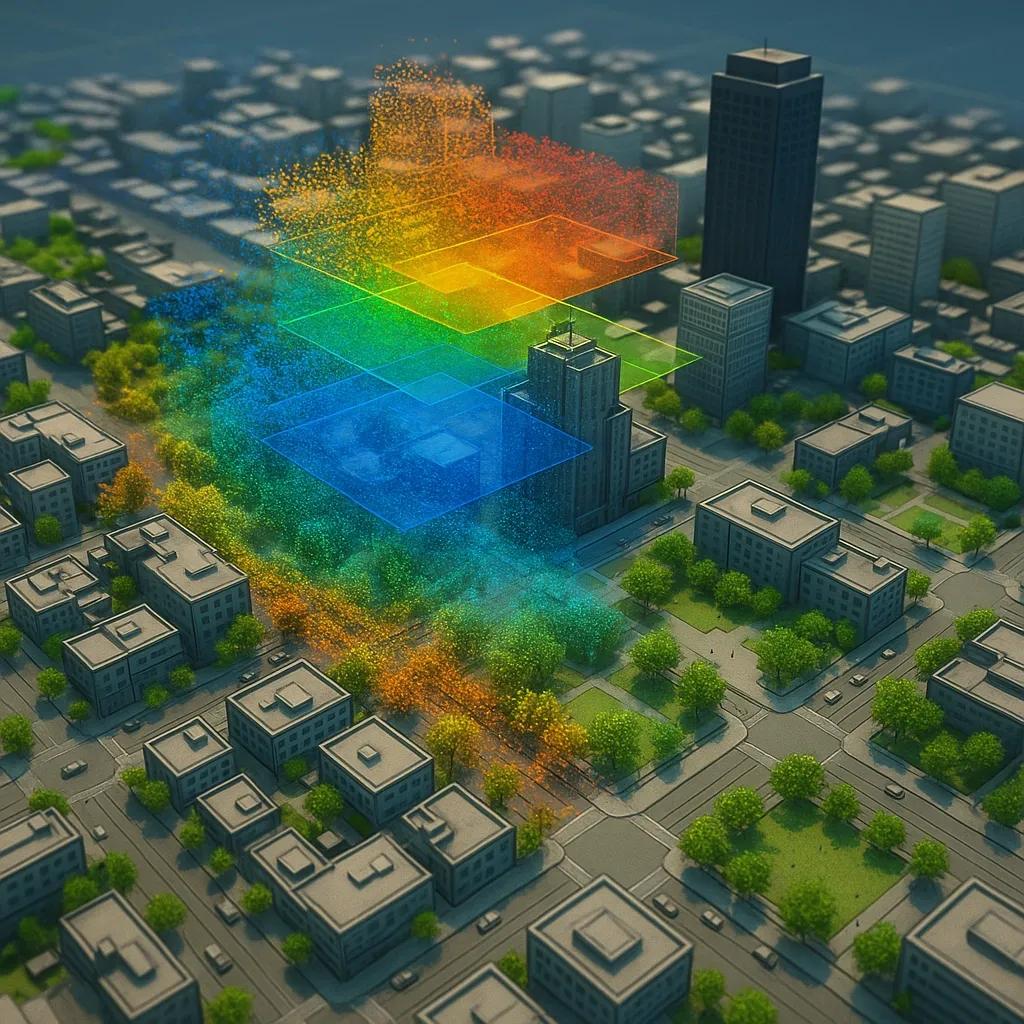
Niantic Spatial aims to ingest data from ground-level scans, overhead imagery, and other sensors, and fuse them into consistent 3D reconstructions. These reconstructions include both geometry (meshes, point clouds, “splats”) and textures/semantics aligned to real-world coordinate systems.
One novel technique they highlight is the use of Gaussian splatting (or “splats”), a volumetric representation that lets them render highly detailed scenes efficiently. This can reduce the latency or bandwidth demands compared to classical mesh + texture pipelines.
For large-scale areas, they support on-demand mapping (field scanning, drivable / walkable mapping) and capture pipelines. For example, Niantic claims reconstructing the San Francisco Ferry Building took ~25 minutes of field scan, generating meshes, VPS anchors, etc.
The end goal: build a “living map” of the world at pedestrian-level fidelity, with updates to reflect changes over time.
2. Localization: Visual Positioning System (VPS)
Localization is the problem of determining device pose (position + orientation) in the real world, especially in GPS-denied or GPS-ambiguous settings. Niantic’s existing Visual Positioning System (VPS) is central to their technology stack.
VPS works by comparing live camera imagery (or sensor capture) to stored scene features (anchors or keypoints) in the world model. It matches visual features, estimates geometric alignment, and yields centimeter- to decimeter-level pose estimates.
Because Niantic has been collecting scans and visual data via its prior mapping within games, it has a large corpus of anchor data already in its system (millions of VPS‐activated locations).
Localization enables persistent AR experiences (shared across users and sessions), spatial anchoring, and intelligent agents or AR glasses to understand where they are in the physical world.
3. Semantic Understanding & World Modeling
Beyond pure geometry and pose, Niantic Spatial layers semantic understanding onto the map. That means labeling components (ground, vegetation, building facades, trees, sidewalks, street furniture) and associating semantics or “what is this” information to the reconstructed geometry.
These semantics are critical for downstream AI applications: decision-making (robotic navigation, path planning), AR object occlusion, scene reasoning, and enabling higher-level agents to “understand” context. The LGM framework is intended to unify the geometry, pose, and semantics into one cohesive model.
As the system evolves, temporal changes (updates, additions, removals) will need to be incorporated so the maps stay fresh and reflect real-world transformations.
Strategic Partnerships & Capital Leverage
Niantic Spatial is not operating in isolation. They are leveraging partnerships and capital to accelerate development and adoption.
Snap (Snap Inc.) : Niantic signed a multi-year strategic partnership with Snap to co-develop an AI-powered map that supports AR glasses and AI agents interacting with the world. Snap is also making a direct investment in Niantic Spatial.
Scopely : As part of the spin-out, Scopely invested USD 50 million and holds a stake, aligning its gaming business with access to geospatial infrastructure.
Enterprise domains : Niantic is positioning toward enterprise use cases, logistics, construction, tourism, remote collaboration, robotics.
Developer outreach & demos : At AWE USA 2025, Niantic Spatial is pushing demos, public displays, and inviting developers to experiment with their platform.
This combination of financial capital and strategic alignment gives Niantic Spatial a runway to scale infrastructure, map coverage, and developer adoption.
Opportunities, Challenges & Risks
Opportunities
Infrastructure for the spatial computing era : As AR glasses, autonomous agents, and AI assistants proliferate, demand will grow for accurate spatial context. Niantic’s asset base (visual data, scan infrastructure) gives it a head start.
Verticals across industries : Logistics (robot routing, last-mile verification), construction (site scans, planning), retail (indoor/outdoor mapping), and urban planning are potential verticals.
Agent-aware world models : AI agents interacting in real space need mapping + understanding. Niantic Spatial is aiming to build exactly that: models where machines can reason about physical world.
Monetization of map data services : Licensing, API access, SDKs, enterprise SLAs, and value-added spatial AI services.
Challenges & Risks
Scale & freshness : Building a global, up-to-date map is resource-intensive. Real-world changes (construction, demolition, foliage, seasonal changes) create continuous drift.
Privacy, data compliance & user trust : Since Niantic historically collected imagery and spatial scans via user devices (games), managing IP, privacy, user consent, and regulatory compliance is critical.
Competition : Giants like Google, Apple, Microsoft (with Azure Maps & Semantic Kernel) or Mapbox may ramp spatial AI efforts.
Compute, storage, and latency demands : Rendering, indexing, and querying large-scale 3D + semantic maps for real-time use is nontrivial.
Monetization vs. public good balance : Striking the right business model (free vs paid tiers, open vs closed) is tricky in foundational infrastructure.
Outlook & Implications
Niantic’s pivot is a bold bet: that the next frontier is spatial intelligence rather than mobile gaming. The company is repositioning itself as an infrastructure provider, not just an app studio.
If successful, Niantic Spatial could emerge as a core layer in the “spatial stack”, analogous to how Google Maps or OpenStreetMap are foundational for 2D mapping. A well-trained LGM can become the backbone for AR agents, intelligent drones, robots, and next-gen location services.
The spin-off structure, substantial initial capital, and partnerships (especially with Snap) provide strong support. But the journey from prototype demos to pervasive, real-world, reliable coverage is full of technical and operational hurdles.
In summary, Niantic’s reorientation toward geospatial AI is a strategic reinvention, moving from user-facing AR games to foundational spatial infrastructure. Its success will depend on delivering accurate, scalable, real-time spatial models, while navigating privacy, competition, and the immense costs of mapping the world.