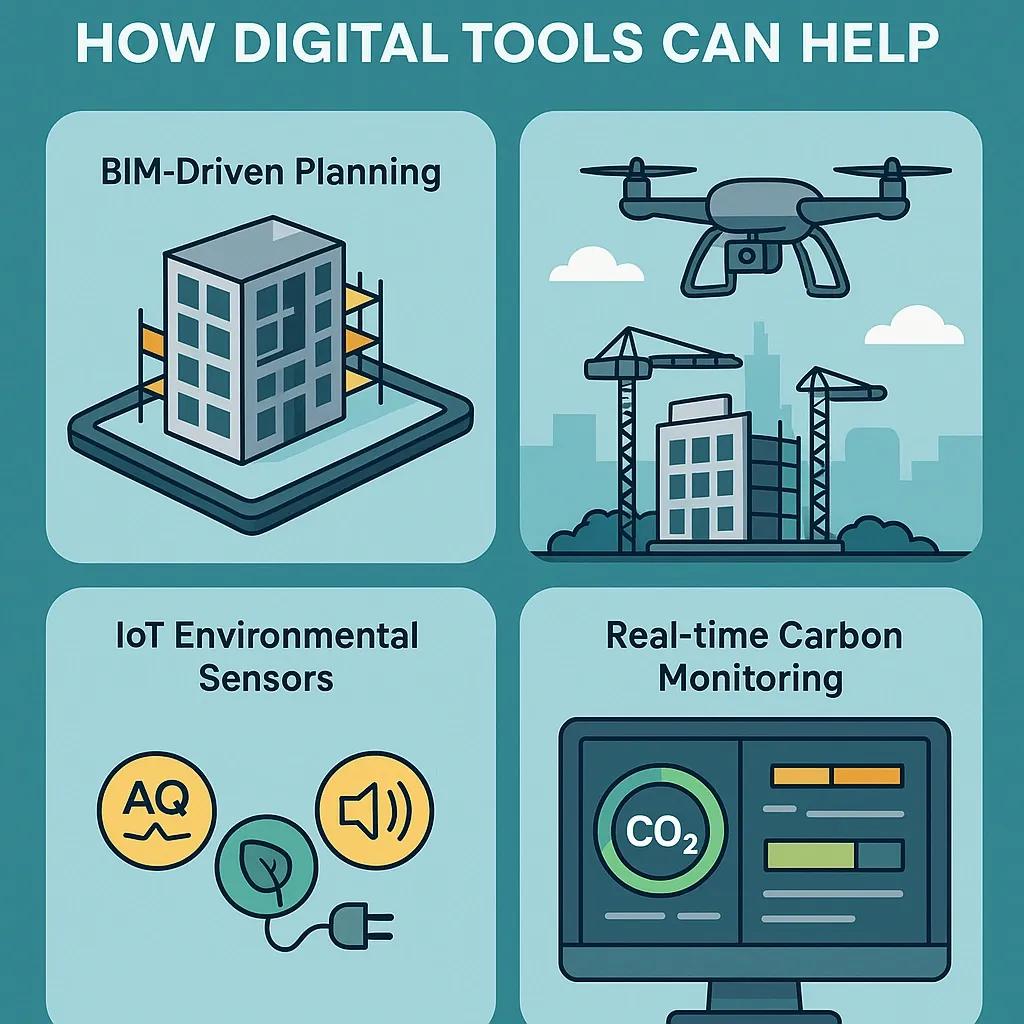
Achieving net-zero emissions has become a central objective in the construction industry’s response to climate change. Construction sites are historically major sources of greenhouse gas emissions, contributing through heavy equipment usage, energy consumption, material waste, and inefficient logistics. However, with the integration of digital tools like Building Information Modeling (BIM), Unmanned Aerial Vehicles (UAVs), and site-level environmental monitoring systems, it is now possible to design, manage, and operate construction sites with minimal emissions.
This article explores how these digital technologies can be applied to systematically reduce the carbon footprint of construction activities, contributing to net-zero goals across the project lifecycle.
1. Understanding Net-Zero in Construction
Net-zero construction refers to practices that result in zero net carbon emissions on-site. This doesn’t mean zero emissions at all, but that any carbon emitted is either avoided, reduced, or offset. Net-zero principles apply to:
Energy use: Clean energy sources and energy-efficient equipment.
Material use: Sustainable procurement and waste minimization.
Logistics: Optimized transportation and reduced idle time.
Operations: Smart monitoring for real-time emission tracking.
Achieving these targets requires an ecosystem of data-driven technologies that support informed decision-making and continuous optimization.
2. Role of BIM in Emission Reduction
Building Information Modeling (BIM) serves as the foundation for sustainable design and construction planning. As a digital representation of physical and functional characteristics of a facility, BIM enables:
a. Carbon Estimation During Design Phase
BIM platforms integrate embodied carbon calculators, allowing designers to compare material options based on lifecycle emissions.
Simulations within BIM help evaluate thermal performance, daylighting, and HVAC loads, leading to more energy-efficient designs.
b. Construction Planning and Clash Detection
Detailed 4D BIM schedules visualize the construction sequence, enabling coordination that reduces on-site rework, idle machinery, and wastage.
Clash detection tools reduce material overuse and construction errors, which contribute to avoidable emissions.
c. Material Optimization
By integrating BIM with procurement and inventory systems, construction managers can plan just-in-time deliveries, reducing excess storage and unnecessary trips.
d. Digital Twin Integration
During construction, a real-time digital twin updated from BIM provides insights into current energy use and emissions, enabling quick adjustments.
Example: A UK-based contractor used BIM-based carbon modeling to reduce material use by 20%, achieving a 15% reduction in embodied carbon during a hospital expansion project.
3. UAVs (Drones) for Monitoring and Optimization
Unmanned Aerial Vehicles (UAVs) are transforming construction site oversight. Their role in reducing emissions is less direct but highly impactful through data-driven process improvement.
a. Progress Tracking and Site Mapping
UAVs capture high-resolution ortho-mosaic images and 3D point clouds for remote site inspections.
Frequent aerial surveys reduce the need for physical site visits by engineers and managers, lowering transportation-related emissions.
b. Cut-and-Fill Analysis
UAV-based topographic surveys are used to optimize earthwork operations, reducing unnecessary movement of soil and machinery usage.
c. Equipment Utilization Monitoring
Combining UAV imagery with AI allows for automated detection of idle equipment, supporting corrective action and reduced fuel waste.
d. Logistics Planning
Drone data supports dynamic route planning for material movement, minimizing machine runtime and streamlining workflow.
Example: A large infrastructure contractor in the UAE reduced fuel use by 12% over six months by using UAV data to monitor and optimize equipment operations on a 500-acre highway construction project.
4. Real-Time Site-Level Environmental Monitoring
To effectively manage emissions, construction sites require sensor-based systems that provide real-time feedback on energy use, emissions, and environmental parameters.
a. Air Quality Sensors
Sensors deployed around the site can monitor PM2.5, PM10, CO₂, and NOx levels, providing direct measurements of pollution levels.
b. Fuel Consumption Tracking
IoT devices attached to machinery track real-time fuel usage, helping identify inefficient equipment or operators.
c. Noise and Vibration Monitoring
Reducing noise and vibration not only improves compliance but also signals excessive machine use, which correlates with higher emissions.
d. Energy Use Dashboards
Smart meters and IoT systems offer dashboards showing electricity, diesel, and generator usage, helping shift usage to off-peak times or cleaner sources.
These systems allow for corrective action in real-time, enabling the site to stay aligned with net-zero objectives without waiting for post-project audits.
Example: A smart construction site pilot in Singapore used sensor platforms to reduce electricity and diesel use by 18% through automated alerts and dynamic scheduling.
5. Interoperability and Data Integration
The true value emerges when BIM, UAVs, and sensors are interconnected. A centralized construction management platform aggregates inputs from all tools, enabling:
Carbon dashboards with predictive analytics.
AI-based recommendations for reducing fuel or material use.
Smart alerts for exceeding emission thresholds.
Cross-platform analysis (e.g., comparing drone-detected activity with sensor-based energy data).
Such integration supports proactive rather than reactive sustainability decisions.
6. Challenges and Considerations
Despite the promise of digital tools, adoption faces several challenges:
Fragmented data systems : Disparate tools often lack standardized interfaces.
Lack of skills : On-ground teams may struggle to interpret or act on data.
Upfront costs : Investment in drones, sensors, and BIM software can deter smaller firms.
Regulatory gaps : Many regions lack clear emission standards for construction sites.
Overcoming these hurdles requires training, policy support, and clear ROI models that emphasize long-term savings and compliance benefits.
7. Conclusion: Toward Digitally Driven Net-Zero Sites
Net-zero construction is not a future ideal but an achievable reality with the right digital strategy. Tools like BIM, UAVs, and real-time monitoring provide a feedback-rich environment that allows construction companies to measure, manage, and minimize emissions at every stage.
By integrating these systems, companies not only comply with environmental targets but also benefit from reduced operational costs, improved efficiency, and enhanced stakeholder confidence.
The way forward is clear : sustainable construction needs to be digital-first.