Meta’s six-year, ~$10B deal to expand on Google Cloud is the clearest market signal yet: even the biggest AI builders won’t bet everything on one cloud. For GeoAI leaders, this shift isn’t hype; it’s a blueprint for cutting GPU wait times, reducing egress risk, and standing up a “second home” for inference when demand spikes.
Why the Meta→GCP move matters for GeoAI
1) Capacity relief when it counts GPU supply remains tight relative to demand, and clusters sell out in waves. A deliberate multi-cloud stance lets you burst training or inference to alternate pools when your primary cloud is saturated. That means shorter queues and faster time-to-value for models powering flood mapping, vegetation encroachment, or road-condition analytics.
2) Multi-cloud is now a mainstream operating model Enterprises increasingly want one platform view across data centers, multiple clouds, and the edge, driven by data privacy and operational simplicity. For GeoAI, that translates to consistent pipelines from ingestion (imagery, LiDAR, IoT) to inference everywhere you operate.
3) Interop on models and platforms Google already hosts Llama models on Vertex AI; Meta’s deal underscores a pragmatic mix of in-house, open, and partner ecosystems. That’s a template for GeoAI: standardize on portable formats (ONNX, TorchScript, TFX pipelines) and keep deployment targets flexible.
The two big risks to fix: GPU queues and egress
GPU queues slow rollouts and stall pilots. A second home for inference (and burst training) helps you:
Keep SLAs when seasonal workloads spike (monsoon flood mapping, wildfire detection).
Run A/B deployments across regions for latency and cost.
Avoid single-provider quota ceilings.
Egress can silently dominate TCO, especially when moving raster tiles, embeddings, or event streams between clouds. Recent steps (e.g., revised switching policies and regulatory pressure) help, but ongoing data movement still bites unless you architect for locality and caching.
“Would you adopt a second-home inference pattern now, or wait until your first major outage or GPU bottleneck?”
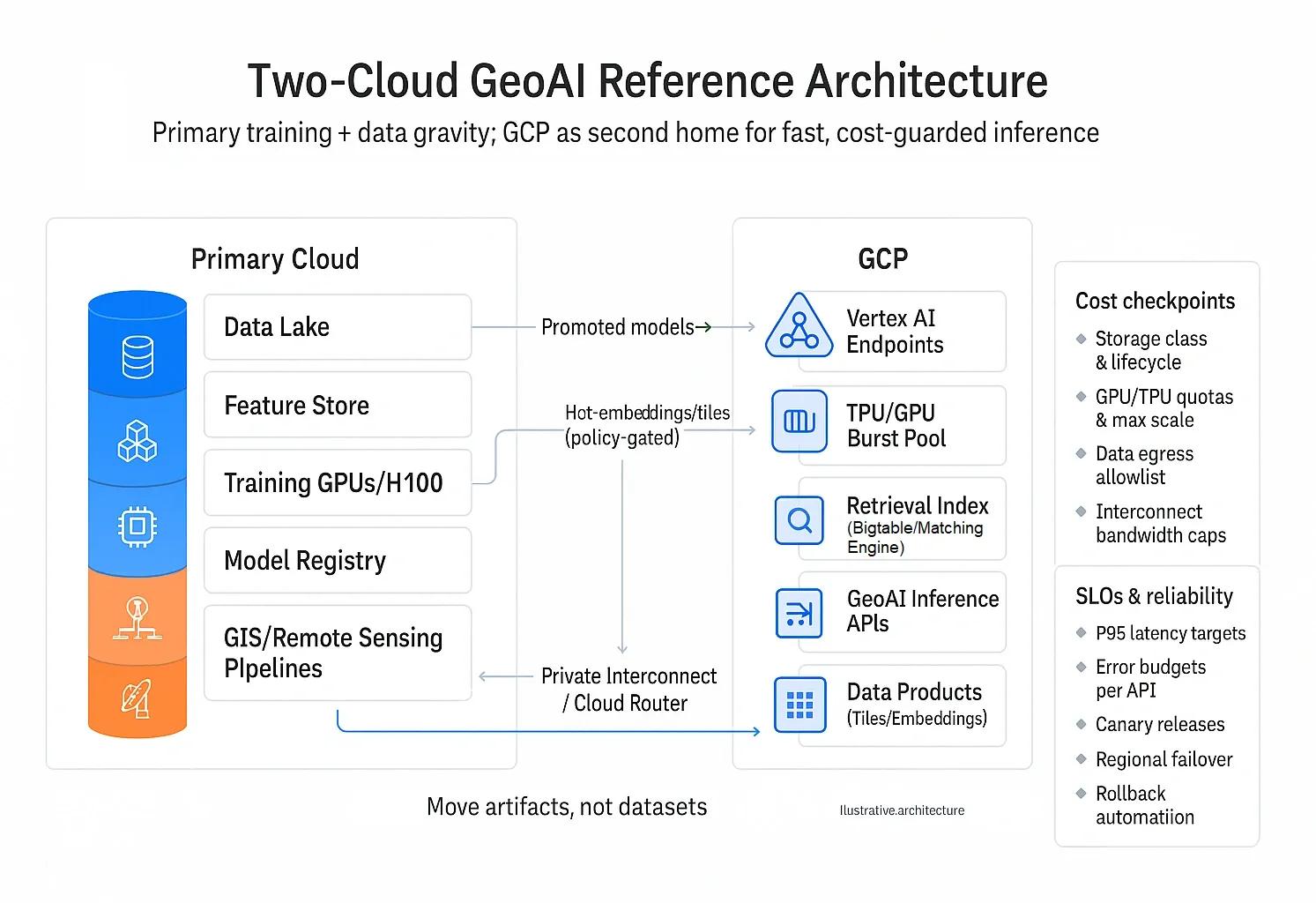
Design pattern: a “second home” for inference on GCP (keep training wherever it’s best)
Baseline
Primary cloud: authoritative data lake, feature store, model training, registry, and MLOps.
Second home (GCP): on-demand TPU/GPU pool, Vertex AI endpoints, retrieval index (e.g., Bigtable/Matching Engine), and real-time observability.
Data movement principles
Hot, minimal, controlled: move only compact artifacts (model bundles, embeddings, vector tiles, slimmed features).
Policy-gated egress: allowlists per dataset and region; cache near inference.
Private interconnect: to tame variability, keep traffic predictable.
Operational guardrails
Budget alerts per endpoint (per-QPS caps; disable autoscale beyond a threshold).
Latency SLOs with canarying and automatic rollback.
Drift telemetry feeds back to training in the primary cloud.
Architecture, step-by-step
Train where capacity is firm Keep your heavy training jobs on the cloud where you’ve secured GPU quotas (or on-prem clusters). Export models in portable formats and register them with metadata (schema, data lineage, license, cost tags).
Promote models to GCP for inference Ship just the artifacts you need: model binary, tokenizer, post-processing, and a small retrieval index (if RAG). Deploy on Vertex AI or GKE with HPA-based autoscaling. Version endpoints (e.g., v1, v2-canary).
Keep data gravity in mind
For imagery tiles/rasters , pre-tile and cache near users.
For vectors/embeddings , replicate only hot partitions.
For telemetry , stream summaries (not raw) back to primary for retraining.
Wire cost and reliability into the design
Cost checkpoints: storage class lifecycle rules; per-endpoint budget ceilings; interconnect bandwidth caps.
Reliability: regional failover; error budgets per API; runbooks for automated rollback and redeploy.
Standardize control planes Use common IaC and policy tooling across clouds (e.g., Terraform, Open Policy Agent) to reduce drift and keep security posture consistent.
Practical checklist for GeoAI teams
Minimize egress by design: colocate inference with user traffic; ship artifacts, not datasets. Regulatory and market changes help switching, but ongoing cross-cloud traffic still costs.
Reserve burst capacity: pre-negotiate quotas and regions; keep deployment manifests ready on GCP.
Instrument everything: per-endpoint P95/P99, cost per 1,000 calls, drift metrics, and autoscale limits.
Keep models portable: ONNX/TorchScript; avoid deep entanglement with proprietary SDKs unless there’s clear ROI.
Run game-days: simulate a primary-cloud shortfall and fail over inference to the second home.
Use case: State-scale land and utility analytics
A statewide GeoAI platform processes satellite/LiDAR for parcel updates, encroachment detection, and utility vegetation risk. Training stays on the primary cloud close to the historical data lake; inference for citizen and field apps bursts on GCP in regions nearest users. Hot tiles and embeddings replicate via policy; telemetry flows back to retraining. Result: lower latency for end users, resilient capacity during seasonal spikes, and predictable spend through cost checkpoints. (Google’s growing AI cloud footprint, and prior Llama availability, make it a viable second home.)
Benefits & ROI (at a glance)
Latency: 20–40% faster P95 for end-user APIs by placing inference closer to traffic (illustrative).
Capacity: shorter GPU queues and fewer missed SLAs during spikes.
Cost control: fewer surprise egress charges; budget ceilings at endpoints; predictable interconnect.
Resilience: failover paths across providers; faster recovery from regional incidents.
Optionality: negotiate better rates, adopt new accelerators sooner, and avoid lock-in.
Conclusion
Meta’s Google Cloud move makes the multi-cloud AI pattern explicit: build where you have data gravity and contracts but keep a second home ready for inference and burst training. For GeoAI, that’s a direct path to lower latency, shorter queues, and cleaner cost control, all without re-platforming your core. The best time to wire this in is before the next surge in demand, not after.
Sources
Meta’s six-year, ~$10B Google Cloud deal; scope includes datacenter infrastructure and services.
Prior Llama availability on Vertex AI; context on pragmatic model/platform mix.
GPU demand/shortage context; guidance to pace build-outs.
Enterprise preference for unified operations across clouds and edge; privacy priority.
Egress-fee dynamics and switching policies/regulatory pressure.