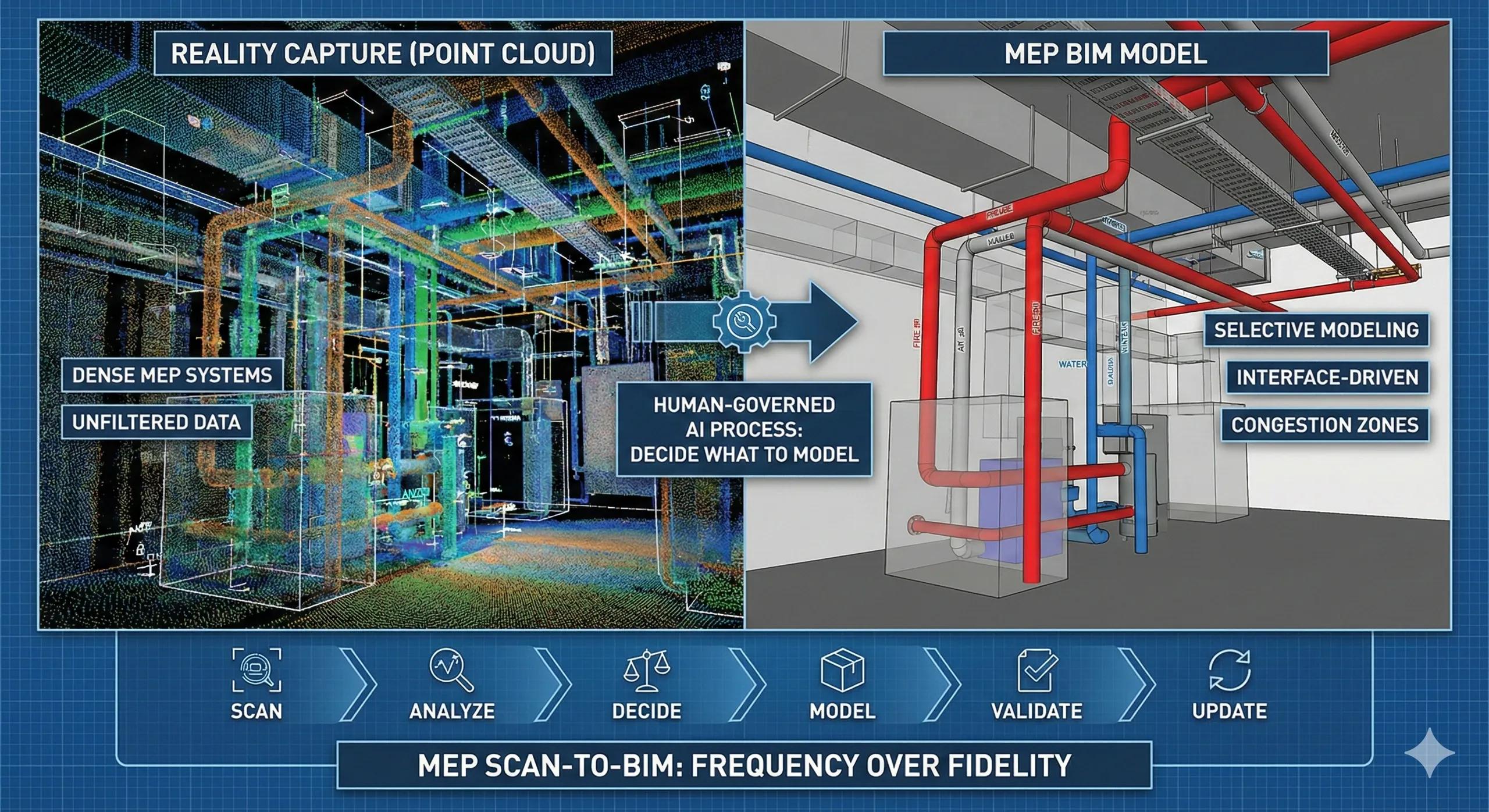
If structural Scan-to-BIM fails because of over-modeling, MEP Scan-to-BIM fails because of complexity .
MEP systems are dense, layered, multi-trade, and installed in sequences that rarely match design intent. Scans capture this reality perfectly, pipes crossing out of plane, ducts offset for site constraints, trays adjusted to avoid clashes. The challenge is not seeing this complexity. The challenge is deciding what to model, how much to model, and when modeling actually adds value .
This article breaks down why MEP modeling from scans is hard, and how to approach it without drowning in geometry.
1. Why MEP Is the Hardest Scan-to-BIM Domain
MEP systems differ fundamentally from structure:
Multiple trades in the same volume
Tight clearances and tolerance sensitivity
Late design changes and site adjustments
Temporary routing during installation
Frequent rework and re-sequencing
Scans capture everything . BIM needs selective abstraction . The gap between the two is widest in MEP.
2. The Biggest Mistake: Modeling Every Detected Pipe and Duct
AI and manual workflows can now detect most MEP elements from scans. The mistake is assuming detection equals value.
Modeling everything leads to:
Bloated federated models
Slow updates
Constant rework as routing changes
Confusion about what is “approved”
MEP Scan-to-BIM must start with scope boundaries , not geometry.
3. Decide First: What Decision Will This MEP Model Support?
Before modeling, ask:
Is this for clearance validation ?
Is it for clash resolution with downstream trades ?
Is it for handover and O&M ?
Is it for progress verification only ?
Each purpose implies a different modeling depth.
If the decision is visual awareness or progress tracking, the point cloud is often enough .
4. Why Tolerances Matter More in MEP Than Structure
MEP failures cascade.
A 20 mm offset in a column may be acceptable. A 20 mm offset in a duct can break:
Ceiling coordination
Fire clearance
Maintenance access
This is why:
MEP modeling must be interface-driven
Not all runs need the same precision
Critical zones deserve modeling priority
5. Congestion Zones vs Transit Zones
Not all MEP areas are equal.
Congestion Zones
Shafts
Plant rooms
Ceiling voids with multiple systems
These zones benefit from:
Accurate modeling
Clearance envelopes
Explicit routing geometry
Transit Zones
Long straight runs
Single-trade corridors
Here, scans or simplified centerlines are often sufficient.
Model where risk concentrates, not where geometry is easy.
6. Modeling Systems vs Modeling Geometry
Another common failure is focusing on shape instead of system logic.
A pipe model is useless if:
System type is wrong
Flow direction is unknown
Isolation boundaries are missing
For MEP, metadata often matters more than exact geometry , especially for handover.
7. AI Helps, But Only Partially
AI feature extraction works best for:
Identifying candidate elements
Pre-classifying pipes, ducts, trays
Speeding up repetitive modeling
AI struggles with:
System intent
Temporary vs permanent routing
Trade responsibility
Construction sequence logic
MEP Scan-to-BIM must remain human-governed .
8. Frequency Over Fidelity
In active installation phases:
Weekly alignment checks matter
Monthly “perfect” models arrive too late
Lean MEP models updated frequently outperform detailed models updated slowly.
9. When NOT to Model MEP from Scans
Avoid modeling when:
Routing is still changing
Systems are incomplete
Install is provisional
The model won’t drive a decision
Use:
Point clouds for awareness
Deviation reports for control
10. A Practical MEP Scan-to-BIM Rule
Model only what another trade, inspection, or downstream decision depends on.
Everything else stays in reality data.
Conclusion
MEP Scan-to-BIM is hard not because scans are inaccurate, but because MEP decisions are context-sensitive .
When done right:
Congestion risks reduce
Coordination improves
Rework drops
BIM earns trust
When done wrong:
Models bloat
Updates lag
Teams revert to screenshots
In BIM-to-field workflows, MEP modeling succeeds when restraint is treated as a skill, not a compromise .