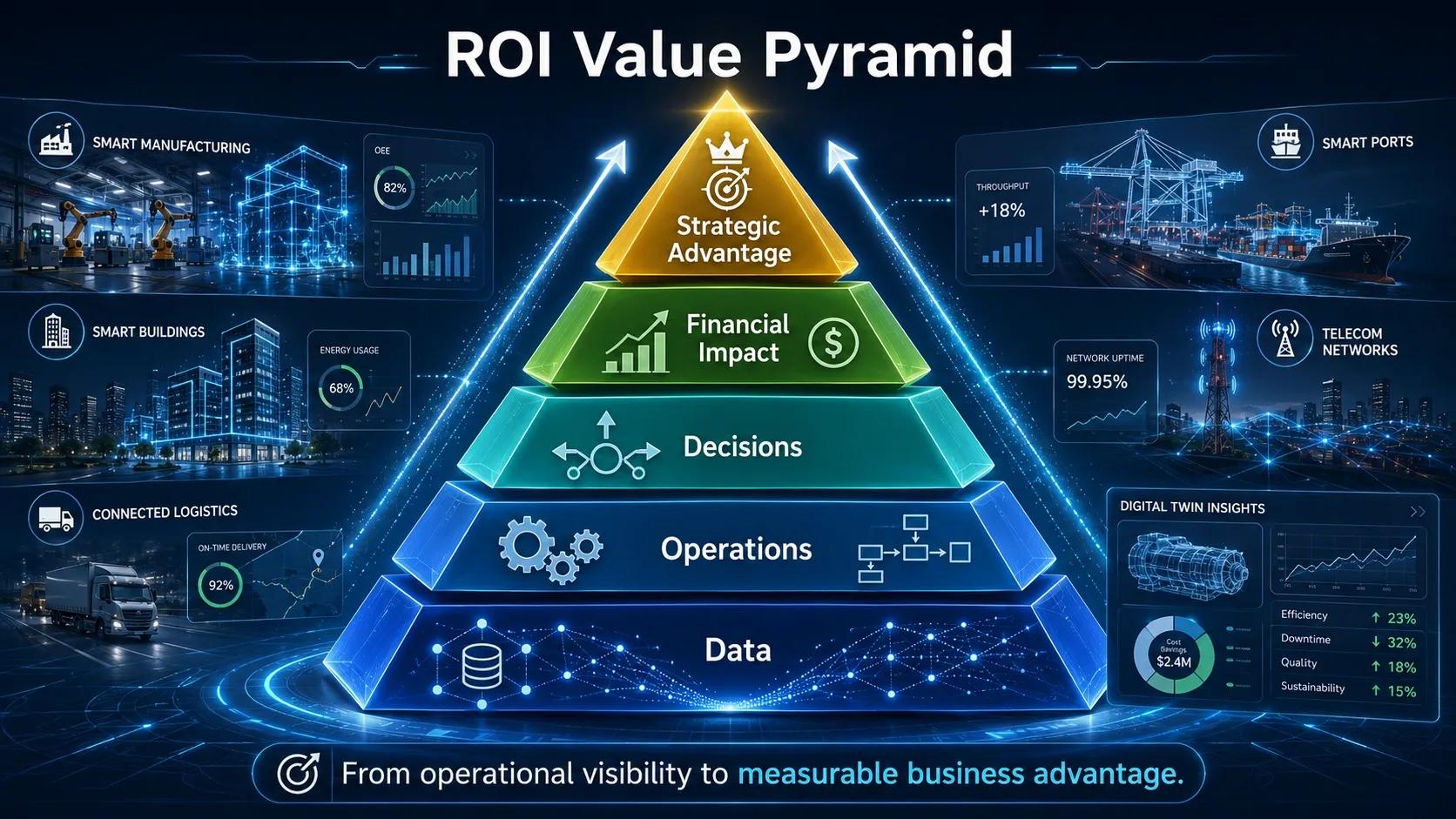
Most Digital Twin ROI calculations fail because they measure savings after deployment.
The real question is:
👉 what decisions improved because the system existed?
Introduction (Phase 4 Continuation)
In Day 41, we explored:
👉 how Digital Twin success should be measured through KPIs.
But KPIs alone are not enough.
Because eventually, every executive asks:
“What business value did this actually create?”
This is where many Digital Twin initiatives struggle.
Not because:
technology failed
But because:
👉 value was never clearly connected to operational outcomes that matters
Today’s challenge is bigger than technology adoption.
It is:
👉 proving measurable ROI.
The Core Problem: ROI Is Often Misunderstood
Most organizations calculate ROI using:
hardware costs
software licensing
implementation expense
operational savings
But Digital Twins create value in ways that are often indirect:
faster decisions
avoided downtime
improved coordination
reduced risk
predictive capability
These are harder to measure, but often more valuable.
The Biggest Mistake: Treating ROI as a Cost-Saving Exercise
Many Digital Twin projects are justified only through:
reduced manpower
maintenance savings
operational efficiency
But this is incomplete.
Because the biggest ROI often comes from:
👉 avoiding losses before they occur
Examples:
preventing outages
avoiding delays
reducing disaster impact
preventing production failures
Digital Twins are not only:
👉 efficiency systems
They are:
👉 risk reduction and decision acceleration systems
The Five Dimensions of Digital Twin ROI
1. Operational ROI
Measures:
👉 performance improvement
Examples:
downtime reduction
throughput increase
faster maintenance cycles
Example
A manufacturing Digital Twin:
reduces unplanned downtime by 20%
Result:
👉 increased production output
2. Financial ROI
Measures:
👉 direct business impact
Examples:
reduced maintenance cost
lower energy consumption
optimized inventory
Example
A smart building:
reduces energy usage by 18%
Result:
👉 measurable financial savings
3. Decision ROI
Measures:
👉 faster and better decisions
Examples:
reduced incident response time
faster scheduling
improved coordination
Critical Insight
This ROI is often invisible in spreadsheets, but highly visible operationally.
4. Risk Reduction ROI
Measures:
👉 losses avoided
Examples:
prevented equipment failure
avoided downtime
reduced disaster damage
Example
A flood Digital Twin:
enables early evacuation
Result:
👉 massive reduction in economic and human loss
5. Strategic ROI
Measures:
👉 long-term organizational capability
Examples:
resilience
scalability
operational agility
future readiness
Example
A telecom Digital Twin:
improves infrastructure planning
Result:
👉 faster future expansion
The Hidden ROI Most Organizations Ignore
The most undervalued ROI is:
Decision Velocity
Meaning:
👉 how quickly an organization can:
detect
understand
decide
execute
Because in modern systems:
Speed itself becomes competitive advantage.
ROI Is Different Across Industries
Manufacturing
ROI comes from:
uptime
throughput
predictive maintenance
Ports & Logistics
ROI comes from:
reduced delays
throughput optimization
coordination efficiency
Energy
ROI comes from:
forecasting
stability
reduced downtime
Healthcare
ROI comes from:
accessibility
optimized resource allocation
faster response
Disaster Management
ROI comes from:
avoided loss
preparedness
resilience
The ROI Timeline Problem
Another major challenge:
Digital Twin ROI is often:
👉 long-term
But organizations expect:
👉 immediate returns
This creates tension.
Because some benefits appear:
instantly, while others compound over years.
Short-Term ROI
operational visibility
workflow optimization
faster reporting
Mid-Term ROI
predictive maintenance
cost optimization
improved coordination
Long-Term ROI
resilience
planning intelligence
operational transformation
Where Most ROI Strategies Fail
1. No Baseline
Organizations never define:
👉 current performance levels
So improvements cannot be proven.
2. ROI Limited to Cost Savings
Ignoring:
risk reduction
decision acceleration
resilience
3. Measuring Technology Usage Instead of Outcomes
Tracking:
dashboards used
instead of:
operational improvement
4. No Continuous Optimization
ROI degrades when systems are not continuously tuned.
The Real ROI Formula
The future ROI equation is not:
Technology Cost vs Savings
It is:
Decision Quality × Decision Speed × Operational Scale
Because:
faster wrong decisions create chaos
slow correct decisions create delay
The advantage belongs to organizations that:
👉 decide accurately and quickly at scale.
Ask Yourself
Is your organization measuring:
👉 cost reduction
Or
👉 operational advantage?
Indian Context
Many Digital Twin initiatives in India are still evaluated as:
IT expenses
pilot projects
innovation initiatives
The next maturity shift will happen when organizations measure:
👉 operational resilience
👉 coordination efficiency
👉 decision velocity
👉 risk reduction
That’s when Digital Twins move:
👉 from experimentation
To
👉 strategic infrastructure.
Benefits of ROI-Driven Digital Twins
measurable business value
operational resilience
faster decisions
reduced risk
long-term scalability
Conclusion
Digital Twins do not create ROI because they exist.
They create ROI when:
👉 decisions improve
👉 risks reduce
👉 operations scale intelligently
The future winners will not be organizations with:
the most sensors
the most dashboards
But those with:
👉 the fastest, smartest operational decisions.