Many organizations are interested in Digital Twins today.
The idea is attractive: a live digital representation of physical assets, buildings, factories, campuses, utilities, roads, ports, or cities. A system that connects data, visualization, simulation, monitoring, and decision-making.
But before asking “Which Digital Twin platform should we choose?” , organizations need to ask a more important question:
Are we ready for a Digital Twin?
Because Digital Twin success does not begin with software.
It begins with clarity.
Clarity about the business problem.
Clarity about available data.
Clarity about operational workflows.
Clarity about ownership.
Clarity about expected ROI.
Without this readiness, even a technically strong Digital Twin may remain underused.
Digital Twin Readiness Is Not Only a Technology Question
Many organizations assume that Digital Twin readiness means having advanced tools, IoT sensors, BIM models, GIS data, cloud infrastructure, or AI capabilities.
These are important, but they are not enough.
An organization may have sensors but no structured asset register.
It may have BIM models but no updated operational data.
It may have GIS layers but no workflow integration.
It may have dashboards but no decision process.
It may have leadership interest but no defined business case.
Readiness is not just about whether the technology exists.
It is about whether the organization can use that technology to improve real decisions.
The First Question: What Decision Should the Digital Twin Improve?
A Digital Twin should not start with the statement:
“We want a Digital Twin.”
It should start with a sharper question:
Which decision are we trying to improve?
For a manufacturing plant, the decision may be related to production quality, energy consumption, equipment downtime, inventory movement, or safety monitoring.
For a building, it may be about asset maintenance, space utilization, energy optimization, or facility operations.
For a port, it may be about berth planning, equipment movement, cargo flow, asset condition, emissions, or operational risk.
For a city, it may be about flooding, traffic, utilities, land use, public safety, or infrastructure planning.
For a road network, it may be about pavement condition, maintenance prioritization, safety risks, or budget allocation.
If the decision is not clear, the Digital Twin becomes a visual system without operational direction.
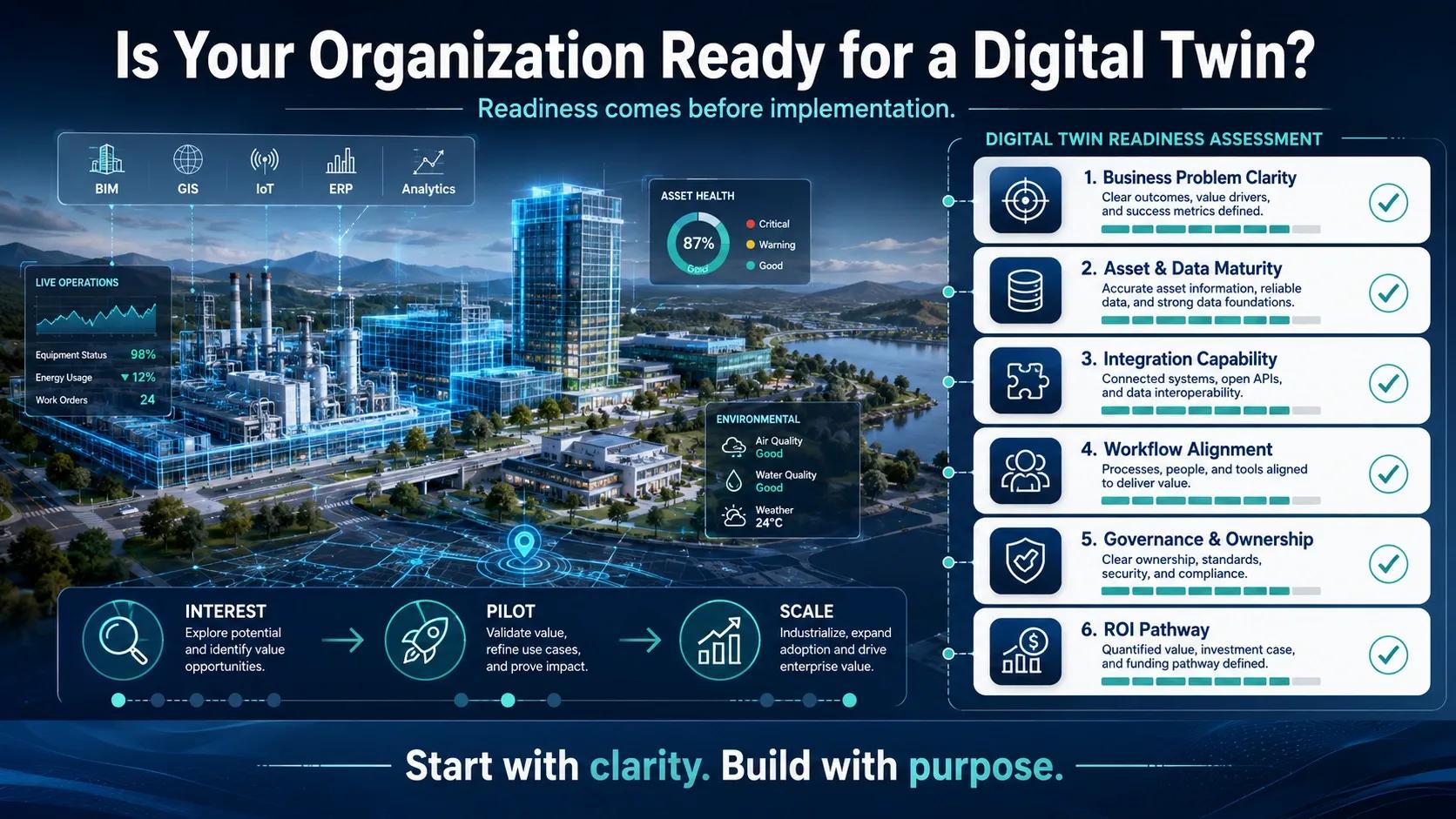
Readiness Area 1: Business Problem Clarity
The first sign of readiness is a clearly defined problem.
An organization is more ready for a Digital Twin when it can answer:
What operational pain point are we trying to solve?
How often does this problem occur?
Who is affected by it?
What is the current cost of this problem?
What happens if we do not solve it?
What improvement would be considered successful?
This is important because a Digital Twin must be connected to measurable value.
If the problem is vague, the solution will also become vague.
A strong Digital Twin use case usually has a clear link to cost, time, quality, safety, compliance, sustainability, or asset performance.
Readiness Area 2: Asset and Data Maturity
Digital Twins depend on data.
But in many organizations, data is scattered across multiple systems, departments, and formats.
Asset information may be stored in Excel sheets. Drawings may be outdated. BIM models may not reflect as-built reality. GIS data may not be connected to asset records. Sensor data may exist without context. Maintenance history may be available, but not structured for analysis.
Before starting a Digital Twin, organizations need to assess their data maturity.
Key questions include:
Do we have an updated asset register?
Do we know where our assets are located?
Are drawings, BIM models, GIS layers, and documents reliable?
Do our assets have unique IDs?
Is maintenance history available?
Are sensors already installed?
Is real-time data accessible?
Are data formats standardized?
Who owns and maintains the data?
A Digital Twin is only as reliable as the data behind it.
If the data foundation is weak, the Digital Twin may look impressive but produce limited operational value.
Readiness Area 3: Integration Capability
A real Digital Twin does not work in isolation.
It needs to connect multiple systems.
These may include BIM, GIS, IoT platforms, ERP, CMMS, SCADA, energy management systems, security systems, document management platforms, mobile applications, and analytics tools.
This is where many organizations face difficulty.
They may have the required systems, but they are not connected. Data moves manually. Teams depend on exports, spreadsheets, screenshots, and repeated follow-ups.
In such cases, the Digital Twin becomes another disconnected layer.
Readiness means understanding:
Which systems need to be integrated?
Are APIs available?
Can data be exchanged securely?
Are data standards defined?
Is there a common asset ID structure?
Can real-time and historical data be connected?
Can insights trigger workflows or actions?
Integration is the bridge between visualization and value.
Without integration, the Digital Twin may remain a dashboard. With integration, it can become an operational intelligence system.
Readiness Area 4: Workflow and User Alignment
A Digital Twin should fit into the way people work.
This is often overlooked.
Organizations may build a Digital Twin, but users may continue using old processes because the new system is not aligned with daily workflows.
Before implementation, it is important to identify:
Who will use the Digital Twin?
What decisions will they make using it?
How often will they use it?
What alerts or insights do they need?
What actions should follow?
Which reports should be automated?
Which manual tasks should be reduced?
How will teams be trained?
A Digital Twin should reduce friction, not add another screen to monitor.
If the users do not see practical value, adoption will remain low.
Readiness Area 5: Governance and Ownership
A Digital Twin is not a one-time project.
It is a living system.
That means it needs governance.
Someone must be responsible for updating asset data. Someone must validate sensor feeds. Someone must manage access control. Someone must maintain integrations. Someone must measure value. Someone must decide how the platform evolves.
Without ownership, the Digital Twin becomes outdated.
Governance questions include:
Who owns the Digital Twin?
Who owns the data?
Who validates updates?
Who manages security and access?
Who approves system changes?
Who measures ROI?
Who ensures that the Digital Twin remains aligned with business needs?
Governance may not sound exciting, but it is one of the strongest predictors of long-term success.
Readiness Area 6: ROI Pathway
A Digital Twin should have a value pathway from the beginning.
This does not mean every benefit must be fully proven on day one. But the organization should know where value is expected to come from.
Possible ROI areas include:
reduced downtime,
faster inspections,
lower maintenance cost,
reduced energy consumption,
improved asset utilization,
better safety response,
faster reporting,
reduced rework,
improved compliance,
better planning,
reduced site visits,
improved customer or citizen service.
The ROI pathway should be connected to the selected use case.
For example, if the use case is predictive maintenance, the ROI should be measured through downtime reduction, maintenance efficiency, equipment life extension, and avoided failures.
If the use case is energy optimization, ROI should be measured through energy savings, peak load reduction, sustainability reporting, and operational efficiency.
Digital Twin readiness improves when the organization knows what success looks like.
A Simple Digital Twin Readiness Checklist
Before starting, ask these ten questions:
Do we have a clearly defined operational problem?
Do we know which decision the Digital Twin should improve?
Do we have reliable asset data?
Do our assets have location and identification structure?
Do we have BIM, GIS, IoT, or system data available?
Can our existing systems be integrated?
Do we know who will use the Digital Twin?
Are workflows connected to the expected insights?
Is ownership and governance defined?
Do we have a measurable ROI pathway?
If most answers are unclear, the organization may not be ready for full-scale implementation.
But that does not mean it should wait.
It means the first step should be a readiness assessment, not platform deployment.
Start Small, But Start Correctly
The best starting point is usually not a large enterprise-wide Digital Twin.
It is a focused pilot.
Choose one asset class, one facility, one corridor, one operational process, or one high-value decision.
Start where the problem is clear, data is accessible, users are engaged, and ROI can be measured.
A small but well-designed pilot is better than a large but unclear implementation.
The purpose of the first pilot should be to prove value, build confidence, and create a repeatable model for scale.
Closing Thought
Digital Twin readiness is not about having everything perfect.
It is about knowing where you stand.
Some organizations may be ready for real-time operational intelligence. Some may first need data structuring. Some may need BIM-GIS integration. Some may need IoT deployment. Some may need workflow redesign. Some may simply need clarity on the right use case.
The key is to avoid starting blindly.
A Digital Twin should not be built because the technology looks impressive.
It should be built because the organization is ready to use it for better decisions, better operations, and measurable value.