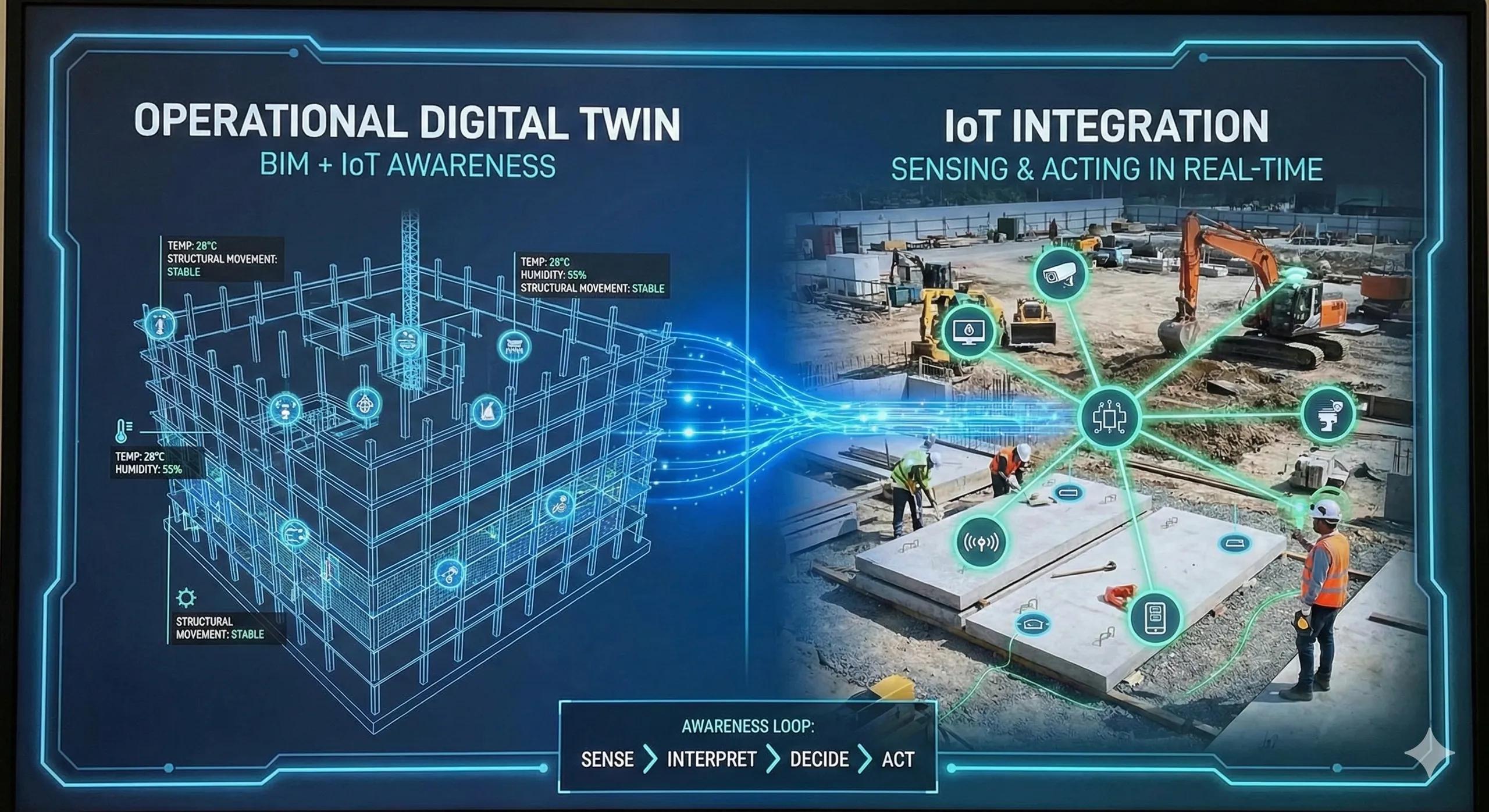
A BIM model without live data is a memory.
A BIM model with IoT is awareness .
Most BIM implementations stop at coordination, handover, or documentation. The moment construction begins, the model slowly drifts away from reality. IoT integration is what prevents that drift and what turns BIM into an operational digital twin .
1. The Difference Between a Model and a Twin
A model:
Describes what should exist
Updates periodically
Reflects intent
An operational twin:
Knows what is happening now
Detects change
Triggers response
IoT is the sensory layer that gives BIM perception.
2. What IoT Integration Actually Means
This is not about adding dashboards.
True IoT–BIM integration means:
Sensors are linked to specific BIM elements
Data streams are spatially and temporally contextualized
Thresholds are tied to actions
The model doesn’t just show data, it interprets state .
3. High-Impact Construction Use Cases
IoT-enabled BIM delivers immediate value in:
Concrete curing and strength gain
Structural movement and vibration monitoring
Environmental compliance (dust, noise, heat)
Equipment utilization and safety
Occupancy and access control
These are areas where timing matters more than reports.
4. Why Context Is More Important Than Volume
Raw sensor data is noisy.
What matters is:
Which element is affected
When the deviation occurred
Whether it violates design or safety limits
By anchoring IoT data to BIM geometry, teams move from signal overload to decision clarity .
5. From Alerts to Actions
Operational twins only work when:
Alerts are meaningful
Ownership is defined
Response pathways are clear
If data doesn’t change behavior, it adds cost, not value.
6. Governance Is the Hidden Layer
Successful IoT–BIM systems define:
Data ownership
Validation rules
Retention and auditability
Trust boundaries
Without governance, live data becomes questionable evidence.
7. India Context: Practical, Not Perfect
In Indian construction:
Connectivity is uneven
Cost sensitivity is high
Sites are highly dynamic
Successful deployments:
Start with a few critical sensors
Focus on high-risk activities
Scale after value is proven
Operational twins grow incrementally.
8. Why Many “Digital Twins” Stall
They stall because:
Data is collected but not contextualized
Models aren’t updated
Insights aren’t acted upon
Twins are treated as dashboards
A twin must participate in operations .
9. The Awareness Loop
An operational twin follows a simple loop:
Sense (IoT)
Interpret (BIM + rules)
Decide (thresholds, context)
Act (alerts, adjustments)
Break the loop and the twin becomes passive.
10. A Simple Operational Twin Rule
If the model cannot tell you what is changing right now, it is not operational.
Conclusion
IoT integration is not an add-on.
It is the moment BIM becomes alive.
When sensors feed the model:
Assumptions are replaced with evidence
Delays are detected earlier
Safety improves
Decisions become timely
BIM documents the plan.
IoT reveals reality.
Together, they create operational intelligence .