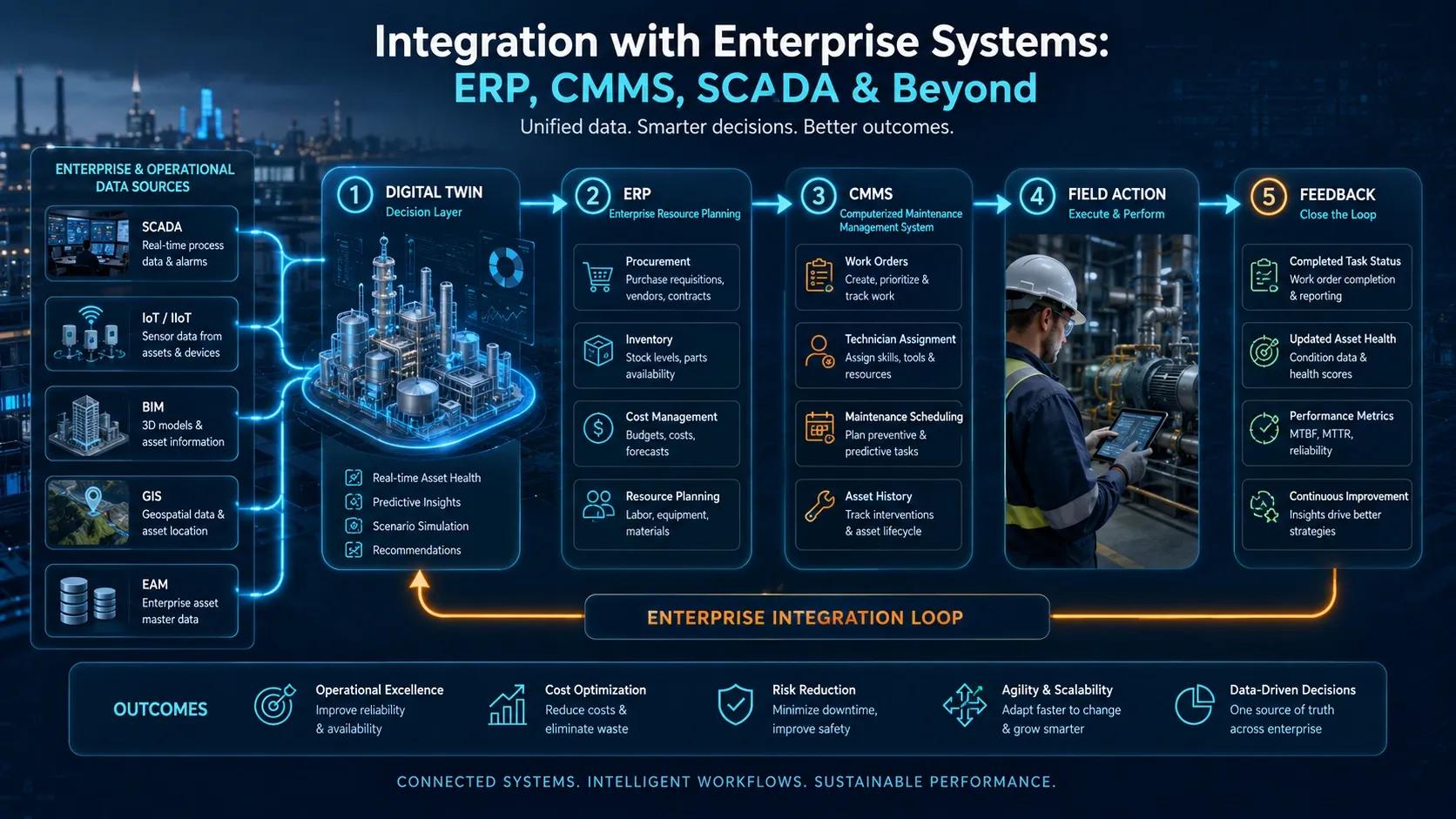
A Digital Twin that does not connect with enterprise systems remains a separate intelligence layer.
It may show the problem.
But it cannot help the organization act on it.
Introduction: Phase 4 Continuation
In Phase 4, we are focusing on:
👉 Operations, KPIs & ROI
So far, we discussed:
defining KPIs
measuring ROI
moving from pilot to scale
operationalizing workflows
predictive vs prescriptive decision-making
cost breakdown
change management
data ownership and governance
Now we move to another critical success factor:
Integration with Enterprise Systems
Because in most organizations, work does not happen inside the Digital Twin alone.
Work happens through:
ERP systems
CMMS platforms
SCADA systems
EAM platforms
procurement tools
project management systems
field service apps
So if the Digital Twin is not integrated with these systems:
👉 it becomes another dashboard.
The real value emerges when Digital Twin intelligence flows directly into enterprise workflows.
The Core Problem: Insight Without System Handoff
Many Digital Twins can detect:
asset anomalies
energy inefficiencies
maintenance risks
production bottlenecks
safety issues
compliance deviations
But then what?
If the insight does not create:
a work order
a procurement request
a maintenance schedule
an approval workflow
an operational alert
a field task
then the system stops at visibility.
That is where ROI gets lost.
Why Enterprise Integration Matters
Enterprise systems already control daily operations.
For example:
ERP manages finance, procurement, inventory, and resources
CMMS manages maintenance work orders
SCADA manages industrial control and monitoring
EAM manages asset lifecycle
GIS manages spatial context
BIM manages asset structure and design information
A Digital Twin becomes powerful only when it connects these systems into a usable operational loop.
The Digital Twin Integration Loop
A mature integration flow looks like this:
👉 Detect → Analyze → Decide → Execute → Record → Learn
Example:
sensor detects abnormal vibration
Digital Twin identifies asset risk
CMMS creates a maintenance work order
ERP checks spare part availability
field team completes the task
outcome feeds back into the Digital Twin
This is how the system becomes operational.
Key Enterprise Systems to Integrate
1. ERP: Enterprise Resource Planning
ERP systems manage:
finance
procurement
inventory
vendors
resource planning
Why integration matters
If the Digital Twin recommends maintenance but spare parts are not available, the recommendation is incomplete.
ERP integration helps answer:
are parts available?
what is the cost impact?
which vendor should be engaged?
what budget is affected?
2. CMMS: Computerized Maintenance Management System
CMMS platforms manage:
work orders
inspections
preventive maintenance
maintenance history
technician assignments
Why integration matters
A Digital Twin may detect equipment degradation.
But the CMMS turns that insight into:
👉 an assigned maintenance action.
Without CMMS integration:
👉 predictive maintenance remains only a prediction.
3. SCADA / OT Systems
SCADA and OT systems manage:
industrial equipment
real-time process data
control systems
alarms
operational states
Why integration matters
SCADA provides real-time operational signals.
Digital Twins add:
context
simulation
prediction
decision support
Together, they allow organizations to move from process monitoring to operational intelligence.
4. EAM: Enterprise Asset Management
EAM systems manage:
asset lifecycle
asset hierarchy
condition records
asset performance
replacement planning
Why integration matters
Digital Twins need accurate asset hierarchy and lifecycle data.
EAM integration helps maintain:
asset identity
condition history
lifecycle status
replacement planning
5. GIS and BIM Systems
GIS provides:
location
terrain
network context
environmental layers
BIM provides:
structure
geometry
asset attributes
design information
Why integration matters
Together, they provide the spatial and physical context needed for operational decisions.
Where Integration Usually Fails
1. APIs Exist, But Meaning Does Not Align
Systems may exchange data technically.
But if asset definitions differ:
👉 integration still fails.
Example:
ERP asset ID
BIM object ID
IoT sensor ID
CMMS equipment ID
may all refer to the same asset but remain disconnected.
2. Workflows Are Not Mapped
Integration is not only about data exchange.
It must answer:
👉 what happens after an event is detected?
Without workflow mapping:
alerts remain open
responsibility is unclear
action is delayed
3. One-Way Integration
Many systems push data into the Digital Twin.
But actions do not flow back into enterprise systems.
That creates an observation layer, not an operational loop.
4. Legacy Systems Limit Connectivity
Many organizations still use:
older ERP versions
custom maintenance tools
closed databases
manual reporting systems
This makes integration slower and more expensive.
5. Security and Access Issues
Enterprise integration requires:
authentication
role-based access
audit trails
data permission controls
Without this, integration creates risk.
The Critical Shift: From Integration to Orchestration
Integration connects systems.
Orchestration coordinates actions across them.
That is the difference.
A connected system can pass data.
An orchestrated system can:
detect a problem
check constraints
trigger approval
assign work
update records
measure outcome
That is where Digital Twin ROI becomes visible.
Practical Example: Power Plant Maintenance
A turbine shows early signs of performance degradation.
A weak Digital Twin setup:
shows alert on dashboard
waits for manual review
An integrated Digital Twin setup:
identifies degradation pattern
checks asset history in EAM
creates work order in CMMS
checks spare availability in ERP
alerts maintenance supervisor
tracks repair completion
updates asset health model
This is how prediction becomes operational action.
What Good Integration Looks Like
A mature integration approach includes:
1. Common Asset Registry
One trusted asset identity across:
ERP
CMMS
BIM
GIS
IoT
SCADA
2. API and Middleware Layer
A controlled layer for:
data exchange
transformation
validation
routing
monitoring
3. Workflow Mapping
Clear definition of:
triggers
approvals
owners
escalation paths
closure criteria
4. Data Governance
Rules for:
data quality
ownership
access
lifecycle updates
auditability
5. Feedback Loops
Every action should feed back into the Digital Twin.
That is how the system learns and improves.
Ask Yourself
Does your Digital Twin only show insights, or does it trigger action inside the systems your organization already uses?
Indian Context
In India, many organizations already use enterprise systems such as:
SAP
Oracle
Maximo
Microsoft Dynamics
custom ERP systems
SCADA and industrial platforms
But Digital Twin initiatives are often developed separately.
This creates a gap:
👉 intelligence is in one system
👉 execution is in another
The next maturity shift will be integration with existing enterprise workflows.
That is when Digital Twins move from pilot environments to operational systems.
Benefits of Enterprise Integration
faster decision execution
reduced manual coordination
better maintenance planning
improved asset lifecycle management
stronger accountability
measurable ROI
higher user adoption
Conclusion
A Digital Twin does not create full value by showing intelligence.
It creates value when that intelligence enters the enterprise operating system.
The real maturity shift is:
👉 from Digital Twin as a dashboard
To
👉 Digital Twin as an operational orchestration layer.
Because ROI appears when insights become actions.
And actions happen through the systems organizations already use every day.