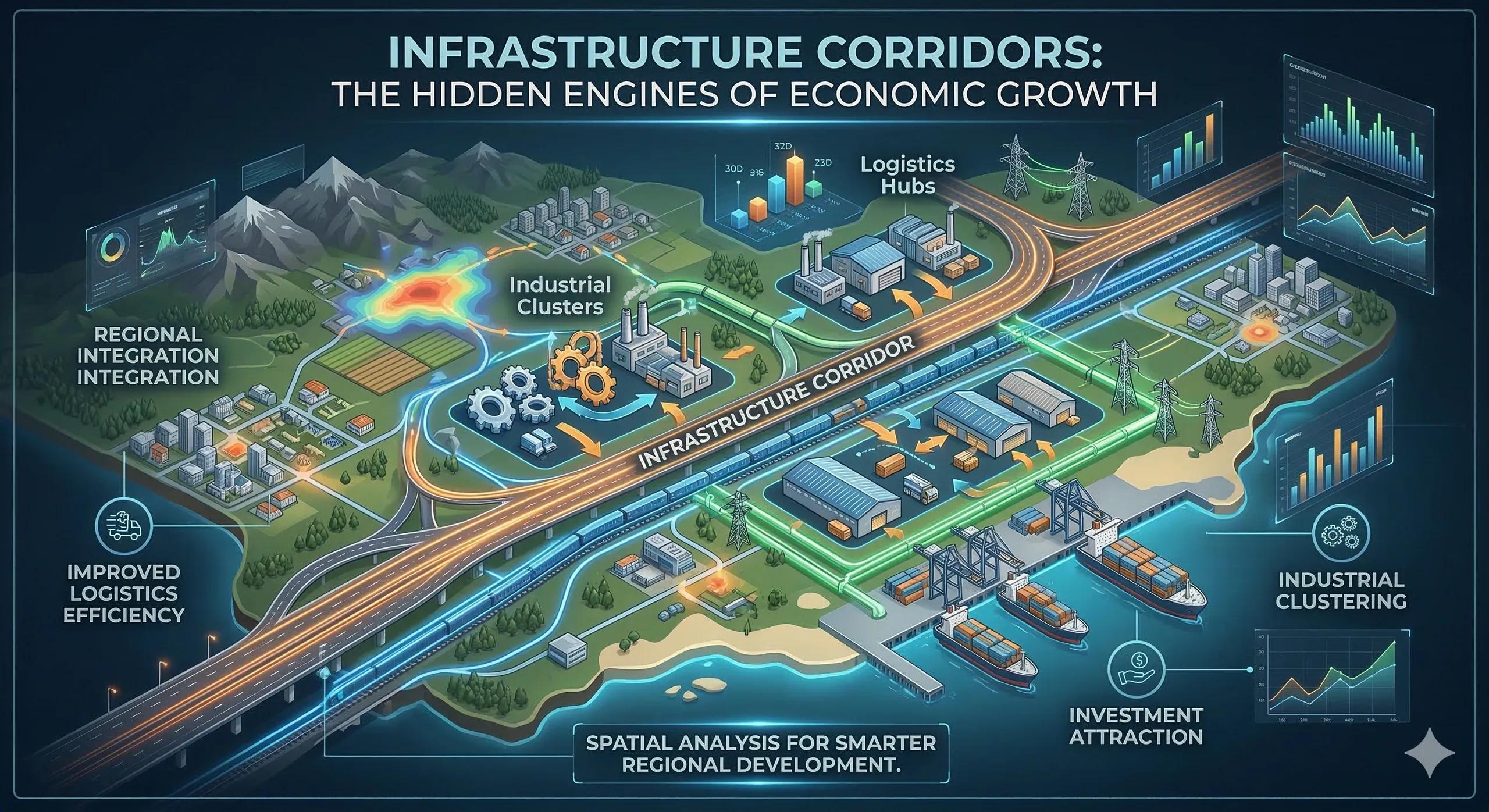
Growth Rarely Happens Randomly
Economic development often appears uneven across regions.
Some areas rapidly transform into industrial hubs.
Others evolve into logistics gateways.
Certain regions become thriving manufacturing clusters.
This growth is rarely accidental.
In many cases, it follows a pattern shaped by infrastructure corridors .
Highways, rail freight networks, ports, and energy pipelines form the physical pathways along which industries expand.
These corridors quietly become the engines of economic growth .
What Are Infrastructure Corridors?
An infrastructure corridor is a geographic zone where multiple transport and utility systems converge.
Typical elements include:
highways and expressways
freight rail networks
ports and inland logistics hubs
power transmission networks
industrial zones and logistics parks
These corridors reduce transportation costs, improve connectivity, and attract industrial activity.
Over time, they evolve into regional economic systems .
Why Corridors Drive Economic Development
Infrastructure corridors create economic advantages in several ways.
1️⃣ Improved Logistics Efficiency
Efficient transport corridors allow goods to move faster between production centers and markets.
This reduces:
logistics costs
delivery times
supply chain disruptions
Industries often locate near these corridors to optimize distribution.
2️⃣ Industrial Clustering
Manufacturing companies tend to cluster along corridors where logistics access is strong.
Over time, these clusters develop supplier networks, workforce specialization, and shared infrastructure.
This clustering effect increases productivity.
3️⃣ Regional Integration
Infrastructure corridors connect cities, industrial zones, and rural production areas.
This integration allows regions to function as coordinated economic systems rather than isolated markets .
4️⃣ Investment Attraction
Regions with strong corridor connectivity often attract:
manufacturing investment
logistics hubs
technology parks
warehousing clusters
Investors typically prefer locations where infrastructure reduces operational friction.
A Global Pattern
Many successful economic regions developed around infrastructure corridors.
Examples include:
port-led industrial zones
cross-border trade corridors
freight rail development zones
These corridors act as spines of economic activity , linking production centers with global markets.
Why Geospatial Intelligence Matters
Understanding corridor development requires spatial analysis.
Key insights include:
identifying emerging logistics hubs
analyzing transport network efficiency
mapping industrial cluster formation
assessing environmental and climate exposure
Geospatial intelligence helps planners evaluate where corridor investments will generate the highest economic impact.
Corridors and the Future of Regional Development
As economies expand, governments increasingly focus on corridor-based development strategies.
These strategies help:
reduce regional inequality
expand industrial capacity
improve supply chain resilience
support export-oriented growth
Infrastructure corridors also play a critical role in shaping future urban expansion patterns .
Cities located along major corridors often grow faster than those outside them.
The Monetization Bridge
Governments, infrastructure developers, and logistics operators are increasingly using geospatial analytics and digital twin environments to evaluate corridor performance, simulate freight flows, analyze land use dynamics, and identify locations where new infrastructure investments can accelerate economic development.
Looking Ahead
In the coming decades, infrastructure corridors will become even more important as:
global trade networks evolve
supply chains diversify
climate risks reshape logistics routes
regional manufacturing expands
Understanding how corridors influence spatial development will help policymakers and investors design more resilient economic systems.
Closing Insight
Economic growth does not simply emerge where policies encourage it.
It often follows the paths where infrastructure allows it to move .
Infrastructure corridors are not just transport systems.
They are the geographic frameworks upon which modern economies expand.