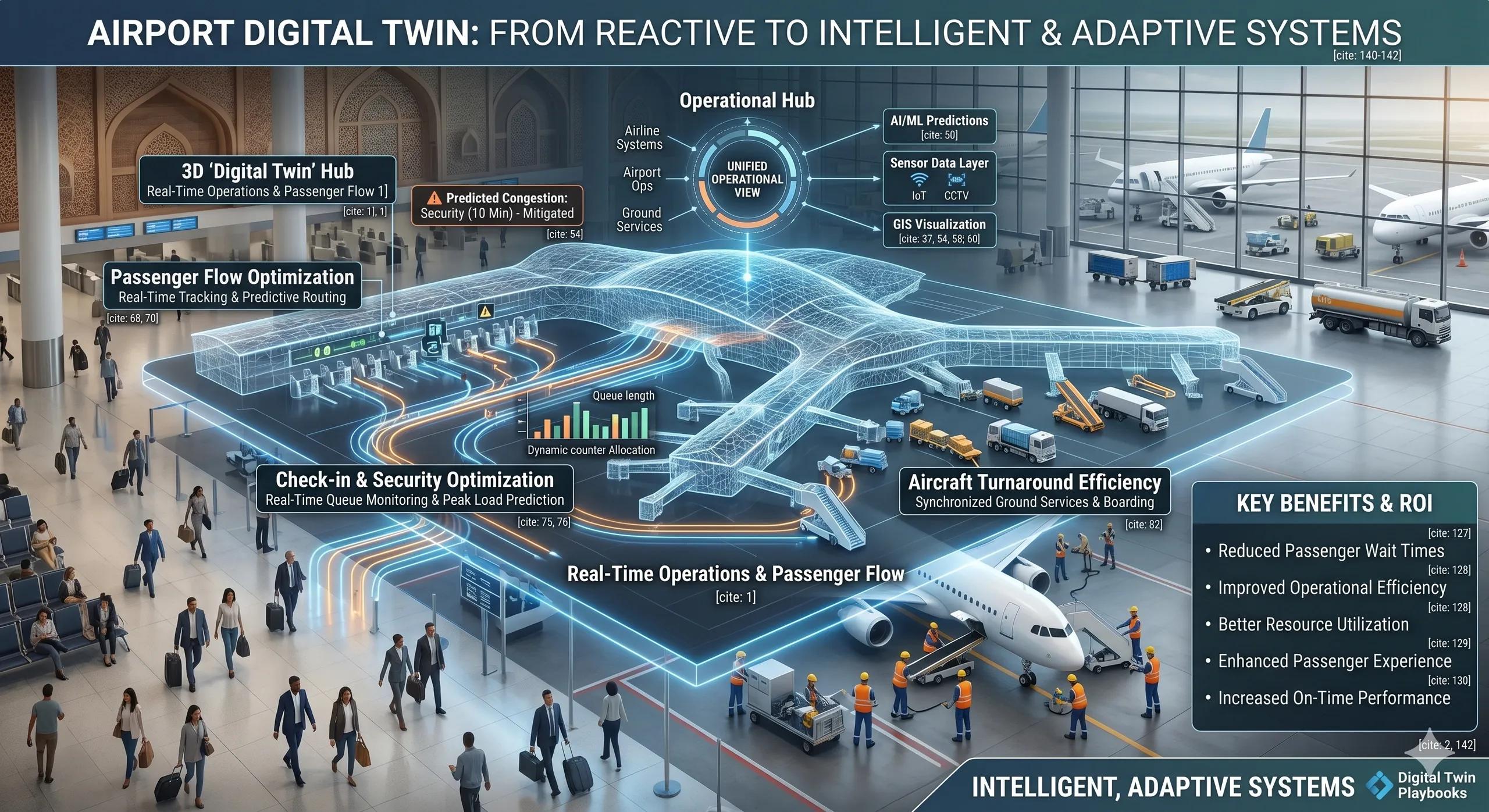
Airports don’t fail because of lack of infrastructure.
They fail when passenger flow and operations fall out of sync.
Introduction
In the previous articles, we explored how Digital Twins enable:
predictive maintenance in highways
integrated operations in smart cities
Now we move to one of the most complex, real-time environments:
👉 Airports
Airports combine:
infrastructure
logistics
passenger movement
security operations
All operating under tight time constraints.
In Phase 3, the focus is clear:
👉 how Digital Twins enable real-time decision-making and operational efficiency
The Core Problem: Fragmented Airport Operations
Airports typically operate through:
separate systems for check-in, security, boarding
independent airline and ground operations
limited real-time coordination
This leads to:
passenger congestion
delays in boarding and turnaround
inefficient resource allocation
👉 The system reacts instead of anticipating.
Where Digital Twins Change the Approach
A Digital Twin enables:
👉 real-time visibility and coordination across airport operations
Instead of:
isolated systems
It creates:
a synchronized operational environment
Key Components of an Airport Digital Twin
1. Sensor & Data Layer
IoT sensors: passenger movement queue lengths baggage handling
CCTV and computer vision: crowd density flow patterns
flight data: arrivals and departures delays
2. Integration Layer
connects: airline systems airport operations ground services
👉 creates a unified operational view
3. AI/ML Layer
predicts passenger flow
identifies congestion points
forecasts delays
4. Visualization Layer
real-time dashboards
GIS-based layouts
3D terminal models
Use Case 1: Passenger Flow Optimization
Traditional Approach
fixed layouts
manual monitoring
👉 reactive response to congestion
Digital Twin Approach
real-time tracking of passenger movement
predictive congestion alerts
dynamic routing within terminals
👉 Outcome:
reduced waiting time
smoother passenger experience
Use Case 2: Check-in & Security Optimization
monitor queue lengths in real time
predict peak loads
allocate counters dynamically
👉 Outcome:
reduced bottlenecks
improved throughput
Use Case 3: Aircraft Turnaround Efficiency
synchronize: baggage handling refueling boarding
predict delays and adjust schedules
👉 Outcome:
faster turnaround
improved on-time performance
Practical Example
Scenario: Peak Hour Congestion
sensors detect rising passenger density at security
AI predicts:
👉 congestion within the next 10 minutes
System triggers:
opening additional counters
redirecting passenger flow
notifying staff
👉 Outcome:
congestion avoided before it builds
Where Most Implementations Fail
1. Data Without Coordination
systems capture data
no unified operational response
2. Delayed Decision-Making
insights exist
actions are not triggered in time
3. Siloed Stakeholders
airlines, airport authorities, and services operate independently
4. No Predictive Layer
focus remains on monitoring
not on anticipation
Ask Yourself
Is your airport system:
👉 reacting to congestion
Or
👉 anticipating and preventing it?
Indian Context
India is witnessing rapid growth in air traffic and airport infrastructure.
Airports can benefit from Digital Twins by:
improving passenger experience
optimizing operations
reducing delays
increasing capacity utilization
👉 especially in high-density environments
Benefits & ROI
reduced passenger wait times
improved operational efficiency
better resource utilization
enhanced passenger experience
increased on-time performance
Conclusion
Airports are dynamic systems where:
👉 seconds matter
Digital Twins enable:
real-time visibility
predictive insights
coordinated action
This transforms airports from:
👉 reactive operations
To
👉 intelligent, adaptive systems