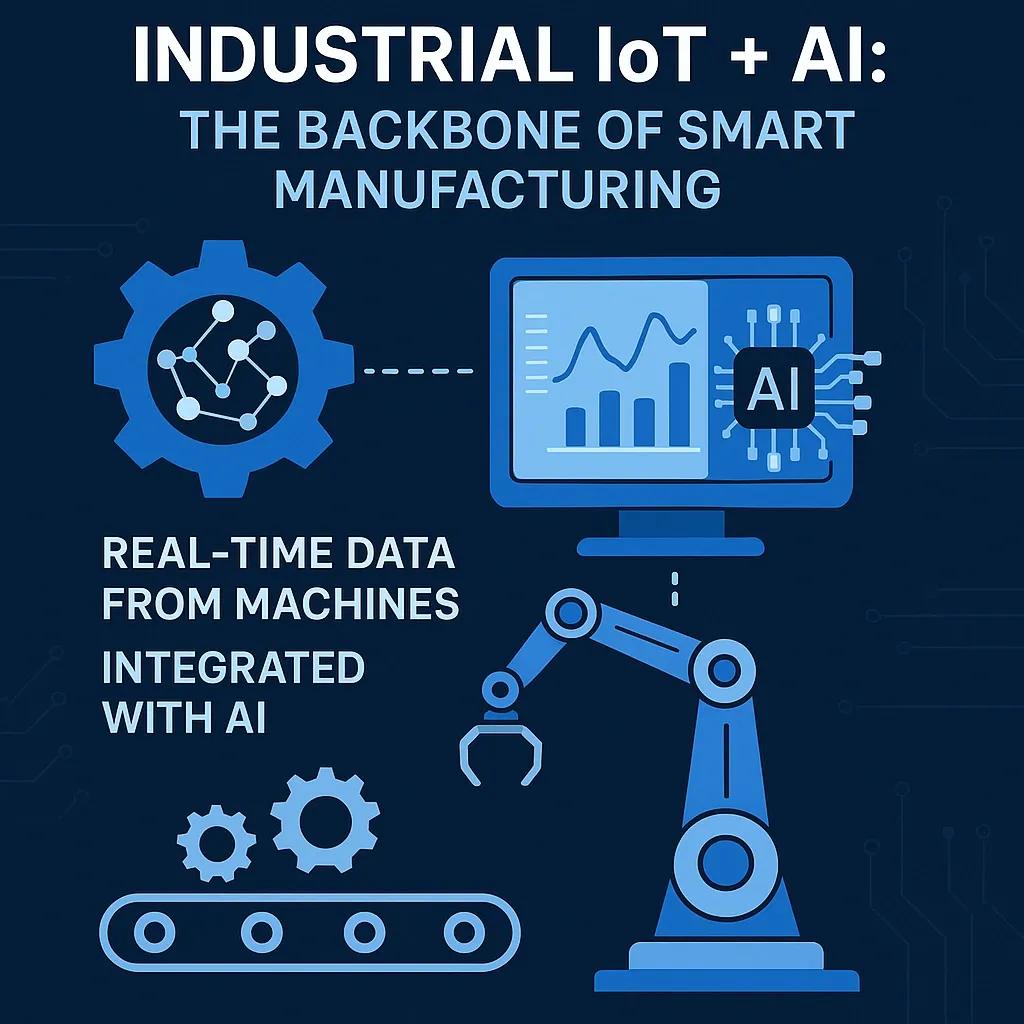
Smart manufacturing is reshaping how factories operate, emphasizing speed, precision, and flexibility. At the heart of this transformation lies the convergence of Industrial Internet of Things (IIoT) and Artificial Intelligence (AI). Together, these technologies enable factories to evolve from reactive environments into intelligent, self-optimizing systems. This article explores how IIoT and AI are transforming traditional manufacturing processes by enabling real-time insights, predictive capabilities, and autonomous decision-making, ultimately driving operational efficiency and competitiveness.
Understanding the Core Components
What is Industrial IoT?
Industrial IoT refers to the network of sensors, devices, machines, and systems connected through industrial communication protocols. These sensors gather operational data from manufacturing assets, such as temperature, vibration, cycle time, energy usage, and machine health metrics. Unlike consumer IoT, IIoT is tailored for industrial environments, prioritizing reliability, robustness, and scalability.
What Role Does AI Play?
AI, particularly in the form of machine learning (ML), computer vision, and deep learning, processes the massive volumes of data generated by IIoT systems. AI helps identify patterns, anomalies, and predictions that would be impossible for humans to detect in real-time. This allows for predictive maintenance, quality control, process optimization, and even autonomous decision-making.
Why Real-Time Data Matters in Manufacturing
In manufacturing, downtime, defects, and delays directly affect bottom-line performance. Traditionally, companies relied on periodic checks and manual reporting. This reactive approach often resulted in costly machine failures, inefficient energy use, and inconsistent quality.
IIoT enables continuous, real-time monitoring of every critical process. Sensors track operational parameters such as spindle speed, lubricant levels, or environmental conditions. This data is streamed to AI models trained to detect early signs of wear, misalignment, or process drift. The result: faster reaction times, fewer disruptions, and improved yield.
Key Use Cases of IIoT + AI in Smart Manufacturing
1. Predictive Maintenance
One of the most impactful use cases is predictive maintenance. Machines no longer need to be repaired after failure or on fixed schedules. Instead, AI models analyze vibration, temperature, and pressure data to predict failures before they occur. For example, Bosch uses ML to predict CNC machine spindle failures, allowing maintenance teams to intervene proactively. This approach extends machine life, reduces maintenance costs, and minimizes unplanned downtime.
2. Quality Control with AI Vision
Defects in manufactured goods can lead to recalls, customer dissatisfaction, and compliance penalties. Traditional quality checks are often manual and prone to error. AI-powered computer vision systems can now inspect products in real-time. Cameras mounted on production lines feed images to AI algorithms trained to detect deviations in shape, color, texture, or size. This ensures consistent quality while reducing human error and labor costs.
3. Production Process Optimization
IIoT sensors track variables such as material usage, line speed, environmental conditions, and energy consumption. AI analyzes this data to optimize operations, for example, adjusting the feed rate in response to material thickness or changing cooling patterns based on ambient temperature. Siemens uses AI-driven analytics in its Amberg factory to dynamically optimize process parameters, improving throughput and reducing energy use by up to 30%.
4. Supply Chain Synchronization
IIoT data doesn’t just stay within the factory, it connects upstream and downstream processes. AI-powered platforms analyze inventory levels, logistics data, and production schedules to synchronize the entire supply chain. This ensures raw materials arrive just in time and finished goods are delivered efficiently. Manufacturers like GE and Caterpillar are integrating AI-driven supply chain analytics to improve demand forecasting and supplier performance.
5. Energy Management
Factories are energy-intensive environments. Smart meters and IIoT-enabled devices provide granular energy consumption data across machines and zones. AI models analyze this to detect inefficiencies, suggest optimizations, or automatically shift non-critical operations to off-peak hours. Schneider Electric’s EcoStruxure platform is a strong example of how AI+IIoT is used to manage industrial energy footprints and reduce carbon emissions.
Benefits for Manufacturers
Increased Uptime - With predictive alerts, equipment can be serviced before it fails.
Higher Product Quality - AI-driven quality checks ensure defect-free production.
Lower Operational Costs - Reduced energy usage, fewer repairs, and minimal waste.
Data-Driven Decisions - Managers gain insights into every aspect of the production floor.
Faster Time to Market - Optimized workflows shorten production cycles.
Challenges in Adoption
Despite its promise, IIoT + AI integration in manufacturing isn’t without hurdles:
Data Silos : Legacy systems often don’t communicate, making it difficult to aggregate data.
Cybersecurity Risks : Connected systems increase the attack surface of industrial networks.
Skill Gaps : Operators and engineers need training to understand and manage AI-driven systems.
High Initial Investment : Sensors, edge computing devices, cloud infrastructure, and skilled personnel can demand significant upfront investment.
However, the long-term ROI from improved efficiency, lower maintenance costs, and better decision-making generally outweighs these challenges.
The Role of Edge AI and 5G
Edge computing and 5G are accelerating smart manufacturing adoption. Edge AI allows data processing to happen close to the machines, minimizing latency. This is critical for use cases like robotic control or real-time defect detection, where milliseconds matter.
Meanwhile, 5G ensures ultra-reliable, low-latency connectivity between devices and control systems. Combined, they enable hyper-responsive factories that can adapt on the fly without depending solely on cloud processing.
Future Outlook
By 2030, the smart manufacturing market is projected to exceed $15 trillion, largely driven by AI and IIoT technologies. As manufacturers face pressure to produce more sustainably and cost-effectively, digital transformation is no longer optional, it’s strategic.
Emerging technologies like Digital Twins, AR-assisted maintenance, and self-healing production lines will further enhance IIoT + AI systems. Smart factories will evolve into adaptive ecosystems that sense, learn, and act autonomously.
Conclusion
Industrial IoT and AI are not just tools, they are the foundation of smart manufacturing. Their integration allows real-time, intelligent operations that reduce costs, boost quality, and drive agility. Companies that embrace this convergence early will gain a significant competitive edge, while laggards risk obsolescence. The backbone of the next industrial revolution is digital, and it’s already taking shape on factory floors around the world.