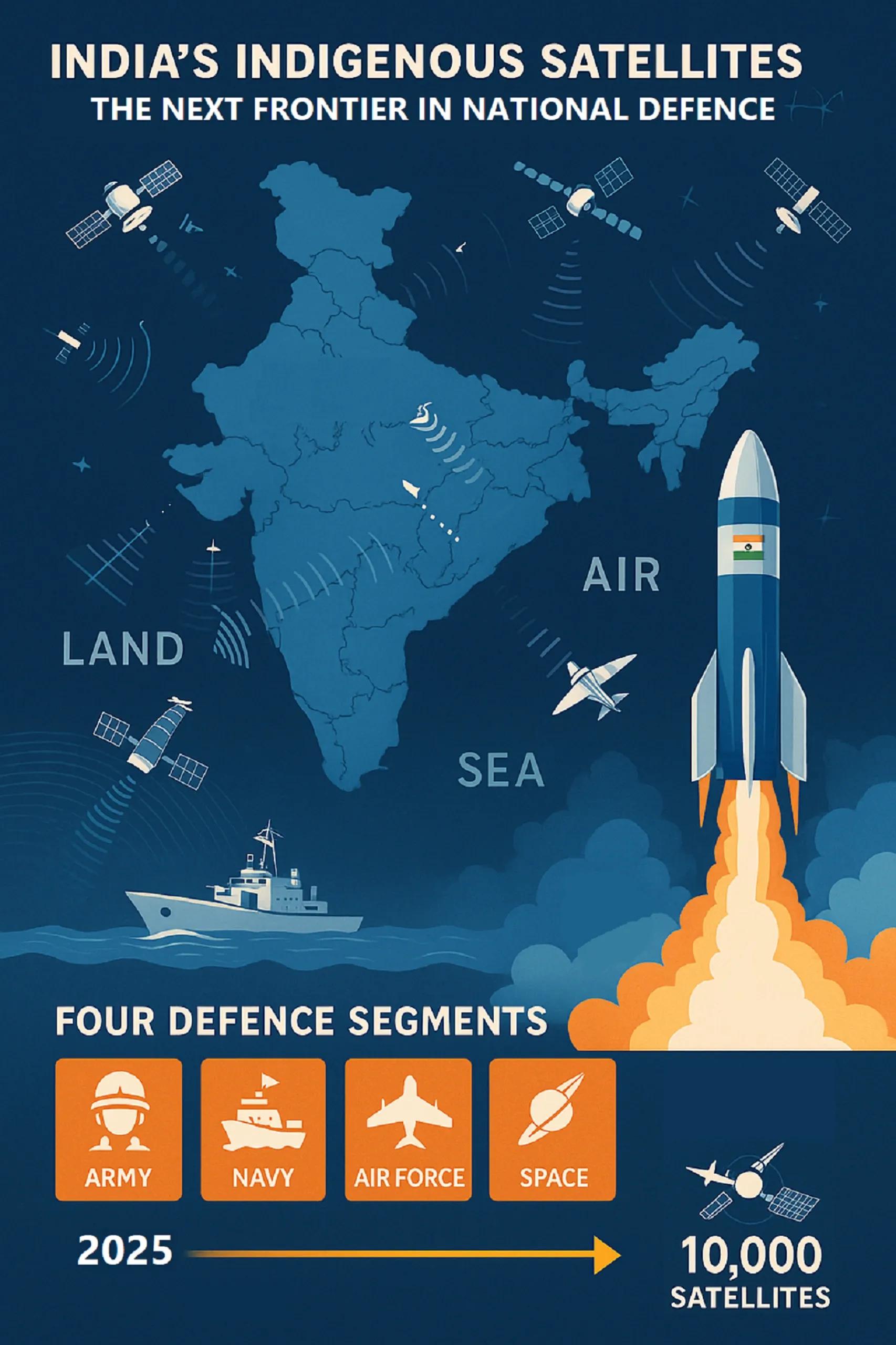
India's defence infrastructure is undergoing a strategic transformation, driven by the integration of homegrown satellite technology. The success of Operation Sindoor marked a pivotal moment, demonstrating how satellite-based intelligence can enhance national security. As global conflicts become increasingly technology-driven, the development and deployment of indigenous satellites are critical to enabling real-time intelligence, surveillance, and reconnaissance (ISR) across land, sea, and air domains.
This article explores the evolving role of India’s space-based assets in defence, the increasing involvement of private space players, and the technological roadmap required to create a secure, self-reliant, and future-ready defence ecosystem.
1. Operation Sindoor: A Proof of Capability
Operation Sindoor showcased the strategic utility of India’s satellite infrastructure in a live conflict scenario. During the operation, satellite constellations, particularly Cartosat (optical earth observation), Risat (radar imaging), and EOS (Earth observation satellites), provided critical intelligence to accurately locate and neutralize hostile assets, including radar installations and airbases deep inside enemy territory.
This mission demonstrated India’s growing capability in executing precision strikes based on satellite intelligence. These assets operated silently but effectively, offering persistent ISR over adversarial terrain without risking personnel on the ground. The operation also brought to light the urgent need for a denser, more resilient satellite network to reduce dependency on foreign data and maintain operational autonomy.
2. Current Satellite Infrastructure and Limitations
India currently operates around 55 defence and surveillance satellites, covering strategic locations and critical infrastructure. These include both geostationary (GEO) and low-Earth orbit (LEO) satellites, serving applications ranging from optical imaging and radar surveillance to communication and meteorology.
However, this number is insufficient given India’s diverse security landscape, which includes a 7,500 km coastline, complex border terrains, and increasing cyber-physical threats. Experts estimate that India requires an additional 100–150 satellites to ensure comprehensive, uninterrupted coverage across all operational theaters. This includes:
Persistent ISR over land and maritime boundaries
Real-time targeting support for long-range precision weapons
Monitoring of space-based threats and missile launches
Strategic early warning for natural disasters and enemy mobilization
3. The Role of Private Sector in Building Capacity
Recognizing the limitations of government-led satellite production and deployment, India has actively opened its space sector to private players. Startups such as Skyroot Aerospace , Dhruva Space are now developing indigenous solutions for small satellite manufacturing, launch vehicles, and downstream applications.
Skyroot Aerospace became the first Indian private company to launch a suborbital rocket, Vikram-S, in 2022. It plans to launch Vikram-1, a fully commercial orbital rocket, shortly. Meanwhile, Dhruva Space is preparing to launch its indigenously developed P-30 satellite platform, targeted for small-satellite missions.
These developments represent a shift toward building a robust private space ecosystem that can deliver:
Agile and cost-effective satellite platforms
Rapid launch cadence and flexibility
Dual-use technologies for both defence and commercial use
This approach aligns with the Indian government’s broader push under the IN-SPACe initiative to increase private participation in space-based infrastructure and reduce the burden on ISRO - Indian Space Research Organization .
4. Technological Enhancements in Satellite Surveillance
a. C-band Synthetic Aperture Radar (SAR)
One of the key technologies enhancing India’s defence satellite capability is C-band SAR. Unlike optical sensors, SAR can penetrate clouds, smoke, and even certain types of foliage, making it effective in all-weather, day-night conditions. SAR satellites such as Risat-1B provide:
Coherent change detection (CCD)
High-resolution terrain mapping
Subsurface object identification (e.g., camouflaged structures)
This capability is essential for border security, counter-terrorism, and maritime domain awareness.
b. Earth Observation Satellites (EOS)
EOS platforms offer multispectral and hyperspectral data for environmental monitoring, land use change detection, and urban development. In defence applications, this data enables:
Detection of troop movements and infrastructure buildup
Coastal surveillance and illegal encroachment detection
Strategic mapping of sensitive terrains
c. Data Fusion and AI Integration
The real advantage lies in the fusion of SAR, optical, and infrared imagery, combined with AI-based analytics to extract actionable intelligence. Integrating these data streams into defence command systems supports faster decision-making and predictive threat modeling.
5. Strategic Value: The Fourth Segment of Defence
Traditionally, the armed forces have been segmented into the Army, Navy, and Air Force. Today, space-based defence capabilities are being positioned as the fourth critical segment, alongside cybersecurity. Former DRDO, Ministry of Defence, Govt. of India chief Avinash Chander emphasized that satellite intelligence is now more crucial than ever in pre-empting threats, maintaining deterrence, and ensuring national sovereignty.
For instance, satellites can provide:
Early warning for missile launches
Tracking of hypersonic glide vehicles
Secure encrypted communications for deployed troops
Navigation support in GPS-denied environments
India’s strategic roadmap must therefore prioritize dual-use satellite constellations that serve both military and civilian purposes, ensuring maximum return on investment.
6. Scaling Ambition: 10,000 Satellites in the Next Decade
India has set an ambitious target of launching over 10,000 satellites over the next 10 years, spanning defence, communication, scientific research, and commercial applications. This aligns with global trends where countries such as the United States, China, and Russia are investing heavily in mega-constellations to gain strategic superiority.
To meet this target, India must:
Expand small satellite manufacturing capabilities
Develop low-cost launch systems
Ensure spectrum availability and orbital slot management
Integrate a national command and control infrastructure for defence satellites
7. Inter-agency Collaboration and Data Security
Building a satellite-driven defence ecosystem requires collaboration between multiple agencies, ISRO, DRDO, IN-SPACe, and private players. This inter-agency synergy must focus on:
Standardization of satellite bus designs
Secure ground station networks
Quantum encryption for satellite communication
Cyber-resilient architecture for C4ISR (Command, Control, Communications, Computers, Intelligence, Surveillance, and Reconnaissance)
Furthermore, given the increasing vulnerability of space assets to jamming, spoofing, and anti-satellite weapons, India must also invest in space situational awareness (SSA) and satellite hardening techniques.
Conclusion
The success of Operation Sindoor has catalyzed a renewed emphasis on homegrown satellite capabilities in India’s defence planning. As geopolitical threats become more complex and multi-domain, space-based intelligence will be indispensable for maintaining strategic deterrence and operational superiority.
India’s path forward lies in a hybrid space model, leveraging government infrastructure and private innovation, to deploy a resilient, multi-layered satellite network. By integrating advanced remote sensing, AI analytics, and secure communications, India can transform its defence posture and emerge as a leading space-faring nation.
As the fourth pillar of national defence, space is no longer optional, it is essential.
Source: The Times of India newspaper article published on May 26, 2025