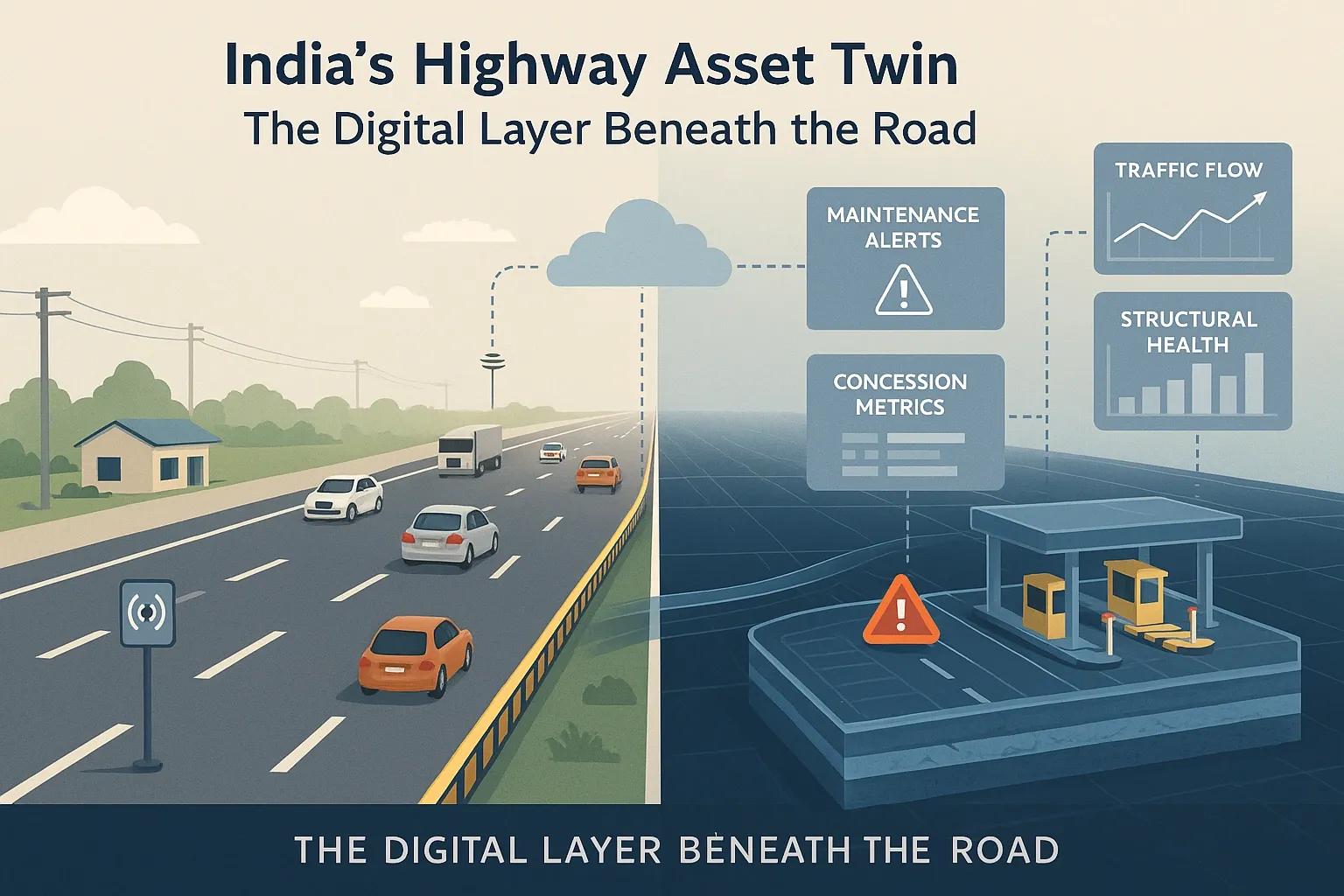
India has one of the largest road networks in the world, with over 6.3 million kilometers of roads, of which national highways account for a mere 2% but carry nearly 40% of road traffic. As public-private partnerships (PPPs) increasingly drive highway development, ensuring efficient concession monitoring, lifecycle management, and accountability becomes critical. In this context, Highway Asset Twins, a digital replica of physical road infrastructure, can play a transformative role.
A Highway Asset Twin offers a virtual representation of highway assets, integrating real-time data, analytics, and predictive insights to support decision-making across the asset lifecycle. As India scales up highway construction and modernization through the Bharatmala and Gati Shakti programs, adopting this digital innovation is no longer optional, it is essential for operational transparency, efficiency, and risk mitigation in PPP frameworks.
What is a Highway Asset Twin?
A Highway Asset Twin is a digital model that mirrors the physical condition, performance, and operations of highway infrastructure. It is developed using inputs from:
3D LiDAR scans, drone photogrammetry, and satellite imagery
Geospatial data layers and BIM models
IoT-enabled sensors for traffic, weather, structural health, and pavement conditions
Asset registries and maintenance logs
Historical and real-time data on vehicular movement, toll collection, and service levels
The digital twin is dynamically updated as the physical asset evolves, offering stakeholders a comprehensive and accurate view of the asset status.
Why India Needs a Highway Asset Twin
1. Efficient Concession Monitoring in PPP Projects
India’s highway sector has extensively used PPP models such as BOT (Build-Operate-Transfer), HAM (Hybrid Annuity Model), and TOT (Toll-Operate-Transfer). However, challenges persist:
Disputes over performance-linked payments and penalties
Ambiguity in compliance with concession terms
Limited visibility into actual asset condition over time
A Highway Asset Twin provides a neutral, transparent platform that both public authorities (like NHAI and MoRTH) and private concessionaires can use to validate operations, verify claims, and monitor KPIs. For instance, asset condition monitoring can be automated using AI-based crack detection or rutting analysis, thereby reducing dependence on manual inspections.
2. Lifecycle Asset Management
Current practices are heavily skewed toward construction and initial operations. Long-term performance monitoring, preventive maintenance, and asset renewal decisions are often reactive and subjective.
Digital twins enable:
Predictive maintenance using real-time degradation models
Dynamic risk assessment of bridges, culverts, and pavements
Integrated scheduling of repair and rehabilitation activities
This helps extend asset life and reduce maintenance costs.
3. Improved Planning and Project Execution
Highway projects in India often face delays due to poor coordination between stakeholders and lack of situational awareness on-ground.
Highway Asset Twins enable:
Clash detection and construction simulation using BIM-GIS integration
Progress tracking with drones and mobile mapping
Real-time coordination between EPC contractors, consultants, and government agencies
The twin acts as a digital control tower, minimizing overruns and enhancing delivery efficiency.
4. Enhanced Safety and Emergency Response
With India accounting for over 150,000 road accident deaths annually, real-time monitoring of safety infrastructure is vital.
Asset twins can:
Monitor guardrails, signage, lane markings, and lighting
Integrate with incident detection systems and emergency response protocols
Feed real-time alerts to traffic command centers
For example, if a median barrier is damaged or absent in a high-risk zone, the digital twin can flag this for immediate rectification.
5. Data-Driven Toll and Revenue Management
Highway revenues are often tied to traffic projections, toll rates, and performance metrics. Asset twins integrate traffic sensor data, automatic vehicle classification (AVC), and toll plaza telemetry to:
Validate revenue models against actual performance
Detect anomalies in toll collection (e.g., underreporting, evasion)
Forecast future traffic trends using historical and seasonal patterns
This transparency supports better financial closure for PPPs and informed decision-making on annuity payouts.
Technology Stack for India’s Highway Asset Twin
A scalable implementation will require a layered technology stack:
Layer - Components
Data Acquisition - UAVs, Mobile LiDAR, IoT sensors, HD cameras, legacy datasets
Integration Platform - GIS-BIM engine, SCADA interfaces, APIs to NHAI databases
Analytics Layer - AI/ML for defect detection, deterioration modeling, traffic forecasting
Visualization - 3D dashboards, interactive maps, mobile apps for field teams
Security & Governance - Role-based access, data provenance, compliance with Digital Personal Data Protection Bill, 2023
Cloud-native infrastructure will enable scalable deployment across India’s 800+ toll plazas and over 40,000 km of national highways.
Implementation Strategy
Phase 1: Pilot on High-Value Corridors
Select corridors under TOT or BOT with high traffic density
Deploy LiDAR, drone surveys, and IoT instrumentation
Build initial 3D twin with BIM and GIS integration
Phase 2: Integration with NHAI’s FASTag, Data Lake, and INAM Pro+
Sync toll data, construction materials, and compliance workflows
Enable real-time dashboards for NHAI monitoring units
Phase 3: National Rollout via Gati Shakti Platform
Integrate highway asset twins with Gati Shakti’s multimodal logistics layers
Expand to state highways and strategic roads (e.g., border roads, green highways)
Challenges to Anticipate
Challenge - Mitigation
High data volume and heterogeneity - Use data lakes and standard schemas (OGC, IFC, CityGML)
Inter-agency coordination - Set up a Highway Digital Twin Task Force under MoRTH
Initial CAPEX for twin creation - Tie-up with private players via digital service concessions
Data privacy and cybersecurity - Adhere to Indian cybersecurity norms and DPDP Bill provisions
Global Examples to Learn From
UK’s National Digital Twin (NDTp) emphasizes an open framework for infrastructure twins across sectors.
Singapore’s Intelligent Transport Systems (ITS) use digital twins to manage expressways and tunnels.
UAE’s Road and Transport Authority (RTA) has implemented BIM-GIS integration for 3D road asset management in Dubai.
India can adapt and scale such models, customizing for PPP-heavy corridors and local terrain complexity.
Conclusion
India’s future highways will not just be roads, they will be digitally instrumented, context-aware assets that demand precise monitoring and data-driven management. A Highway Asset Twin is the backbone of this transformation. It promises better concession enforcement, reduced disputes, proactive maintenance, and seamless integration into India’s logistics and mobility vision.
As India targets heavy infrastructure investments under the National Infrastructure Pipeline (NIP), digital twins must be viewed as not just a technology but a governance enabler, bridging physical asset management and digital accountability. The road ahead is digital, and the Highway Asset Twin is the engine driving it.