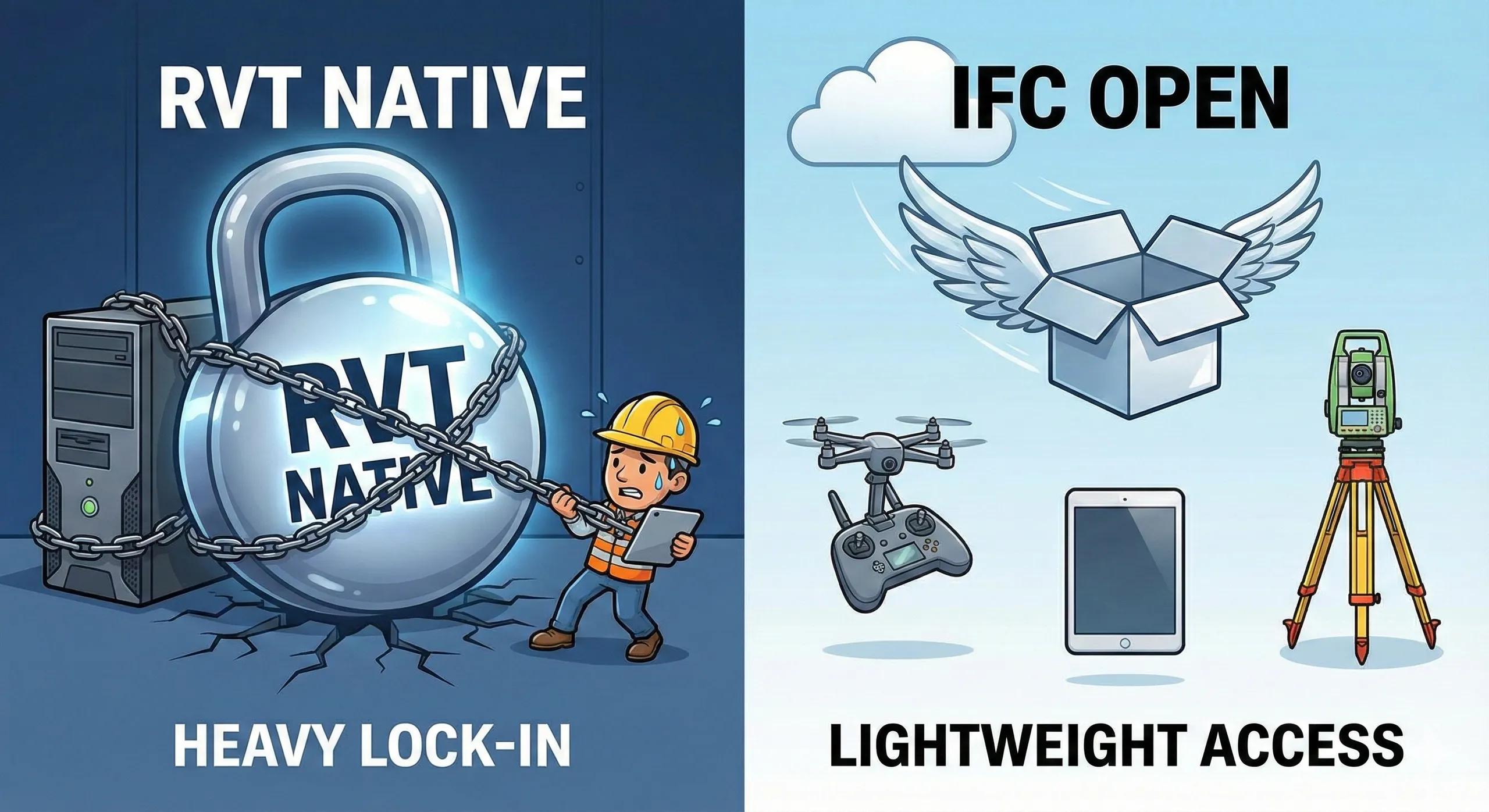
One of the most common, and costly, decisions in BIM-to-field workflows is which model format reaches the site .
On many projects, this choice is made casually: “Just publish whatever model we have.” In reality, the decision between native BIM models (like RVT) and open formats (like IFC) directly affects field usability, coordination accuracy, mobile performance, and long-term interoperability.
Field teams don’t care about authoring convenience. They care about clarity, reliability, speed, and trust . Choosing the wrong format introduces friction at the exact point where execution needs certainty.
This article explains the practical differences between IFC and native RVT models, how each behaves in field workflows, and how to choose the right format depending on project stage and use case.
1. Why Model Format Matters on Site
Field operations impose constraints that design offices rarely experience:
Limited bandwidth
Mobile devices with restricted processing power
Time pressure
Zero tolerance for ambiguity
A model that works perfectly on a workstation may become unusable on a tablet.
The question is not “Which format is better?”
The question is “Which format is fit for purpose on site?”
2. Understanding Native BIM Models (RVT, DGN, etc.)
Native models are created and maintained inside authoring tools.
Strengths
Full parametric intelligence
Complete element relationships
Rich metadata
Ideal for editing, coordination, and design changes
Limitations for the Field
Large file sizes
Heavy computational load
Software dependency
Risk of accidental edits
Difficult version control on site
Publishing native models directly to the field often results in:
Slow loading times
Partial visibility of elements
Field teams reverting to PDFs
Increased support overhead
Native models are authoring assets , not execution assets.
3. Understanding IFC Models
IFC (Industry Foundation Classes) is an open, vendor-neutral exchange format.
Strengths
Lightweight compared to native models
Read-only by nature
Platform-independent
Stable geometry
Better suited for mobile viewing
Ideal for long-term archiving and handover
Limitations
Loss of some parametric intelligence
Requires disciplined export settings
Quality depends heavily on authoring standards
IFC models represent frozen intent , which is exactly what the field often needs.
4. The Real Difference: Control vs Stability
The core distinction between RVT and IFC is not technical, it is operational.
Aspect - Native RVT - IFC
Editability - High - None
Field Safety - Risky - Safe
Mobile Performance - Weak - Strong
Interoperability - Limited - High
Long-term Use - Poor - Strong
Version Stability - Fragile - Robust
Field teams should not edit models.
They should trust them .
IFC enforces trust by design.
5. When Native Models Make Sense on Site
There are scenarios where native models are appropriate:
BIM coordinators on site
Temporary access for issue resolution
Controlled coordination sessions
Design-build environments with tight integration
Even in these cases:
Access should be restricted
Edit permissions tightly controlled
Usage limited to specific roles
Native models should never be the default field deliverable.
6. When IFC Is the Better Choice
IFC excels in:
Daily field reference
Construction sequencing reviews
Installation checks
Clash verification
As-built comparison
AR-based overlays
Digital handover
For most supervisors, engineers, and inspectors: IFC is faster, safer, and clearer.
7. IFC for BIM-to-Field and Digital Twins
IFC plays a critical role in digital twin readiness:
Stable geometry
Persistent object IDs
Open integration pathways
Longevity beyond software lifecycles
When IFC is combined with:
Reality capture
GIS context
Sensor data
…it becomes a spatially grounded, software-agnostic twin foundation .
8. The Hidden Risk: Poor IFC Exports
Many teams dismiss IFC because of bad experiences, usually caused by:
Inconsistent classifications
Missing property sets
Poor LOD discipline
Incorrect export settings
These are process failures , not format failures.
A good BEP + clean authoring standards = high-quality IFC.
9. Recommended Field Model Strategy
A mature BIM-to-field strategy uses both formats , intentionally.
Authoring Environment
Native RVT for design and coordination
Field Environment
IFC models for reference and execution
Lightweight viewers
Strict version control
Handover & Operations
IFC as the baseline asset model
This separation protects the project from confusion and error.
10. The Field Test
Ask this before publishing any model to site:
Can this model be opened, understood, and trusted by a site engineer in under 30 seconds?
If the answer is no, it does not belong on site.
Conclusion
Choosing between IFC and native RVT is not a software preference, it is a workflow decision .
Native models empower designers.
IFC models empower the field.
Successful BIM-to-field workflows respect this distinction and publish models that:
Are stable
Are readable
Are device-friendly
Are safe from accidental modification
When the right format reaches the right user, BIM stops being a coordination burden and starts becoming execution intelligence .