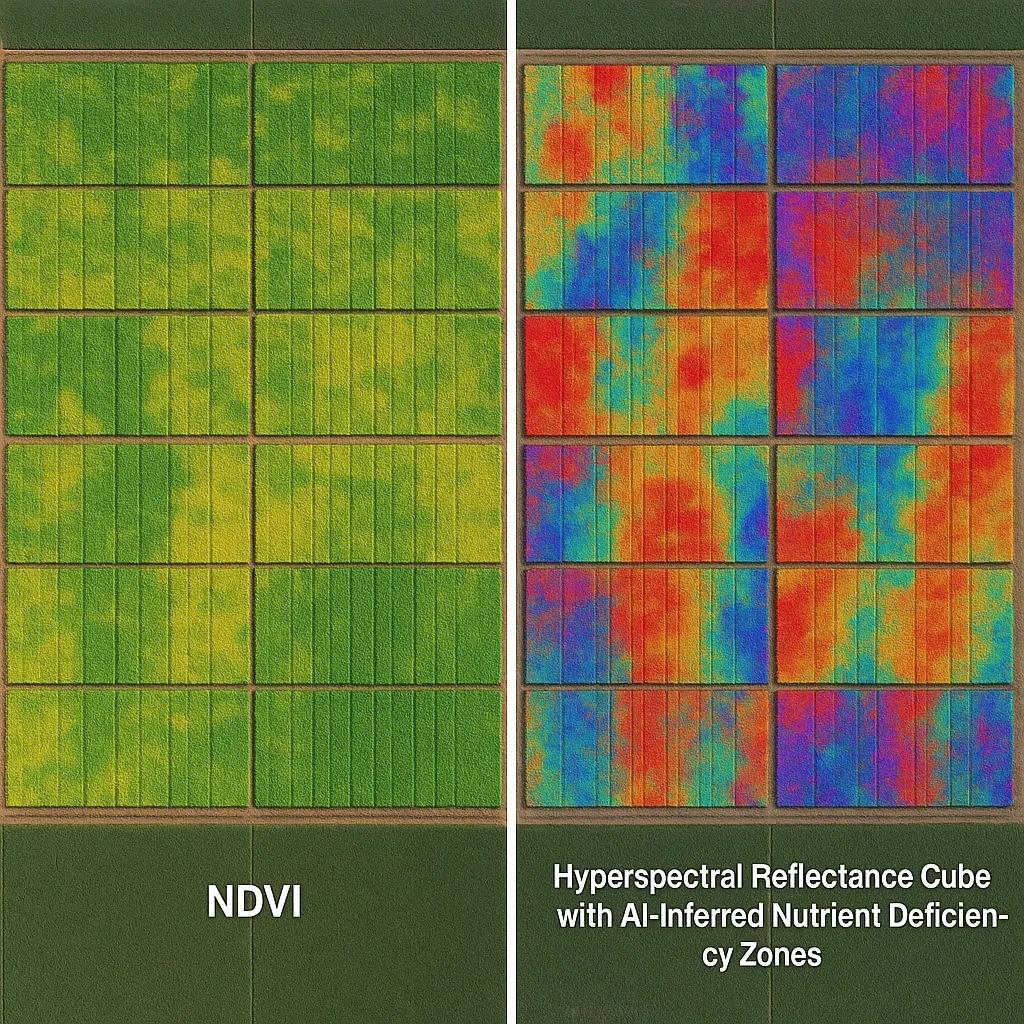
Agriculture monitoring has significantly advanced with remote sensing technologies, particularly through the use of multispectral imagery. Multispectral data, collected through satellites and drones, has enabled crop health monitoring, yield estimation, and stress detection using a few broad spectral bands. However, as climate variability, input optimization, and food security challenges grow, conventional multispectral solutions are reaching their limitations.
Enter hyperspectral imaging (HSI), a technology that captures hundreds of contiguous spectral bands, offering fine-grained insights into crop biochemistry and physiology. When paired with artificial intelligence (AI), hyperspectral imaging transforms from data-heavy outputs into actionable intelligence, opening a new era for precision agriculture.
1. From Multispectral to Hyperspectral: What’s the Difference?
Multispectral sensors capture data in a limited number of wide bands (typically 3 to 12), such as red, green, blue (RGB), near-infrared (NIR), and shortwave infrared (SWIR). These bands help generate vegetation indices like NDVI (Normalized Difference Vegetation Index), which correlate broadly with chlorophyll content and crop health.
Hyperspectral sensors, in contrast, collect reflectance data in hundreds of narrow (often <10 nm) and contiguous spectral bands across the visible, NIR, and SWIR spectrum. This detailed spectral resolution enables detection of subtle biochemical differences such as:
Leaf nitrogen, phosphorus, and potassium (NPK) levels
Water stress before visual symptoms appear
Plant diseases and pest infestation signatures
Soil organic carbon and salinity differentiation
Crop varietal identification and phenotyping
Thus, hyperspectral imaging provides a richer, more nuanced dataset that goes beyond greenness to decode the “chemical fingerprint” of vegetation.
2. The Role of AI in Hyperspectral Agriculture
Hyperspectral data is high dimensional, a single image can have hundreds of layers per pixel. Analyzing such data manually or with traditional image processing is impractical. This is where AI, particularly machine learning (ML) and deep learning (DL), becomes essential.
AI plays four critical roles in hyperspectral agriculture:
a) Dimensionality Reduction Techniques like PCA (Principal Component Analysis), t-SNE, or autoencoders help reduce data volume while preserving essential information, making analysis tractable.
b) Feature Extraction AI models can learn relationships between specific spectral signatures and agronomic parameters, e.g., linking specific bands to crop moisture levels or early-stage blight infection.
c) Classification and Regression Supervised ML models (e.g., SVM, Random Forest, CNNs) can be trained to classify plant species, predict yield, or estimate nutrient deficiencies with high accuracy.
d) Anomaly Detection Unsupervised AI can flag areas of crop stress, disease outbreaks, or irrigation issues even in the absence of labeled training data.
3. Key Applications in Agricultural Monitoring
a) Early Disease and Pest Detection Hyperspectral signatures reveal physiological stress before visual signs emerge. AI models trained on known disease patterns can alert farmers to potential threats days or weeks in advance, enabling timely intervention.
b) Nutrient Deficiency Mapping AI can analyze subtle spectral differences tied to nutrient uptake and create spatial maps of nitrogen, phosphorus, and potassium availability, guiding variable-rate fertilizer application.
c) Crop Classification and Variety Identification Each crop variety has a unique spectral profile. AI algorithms can distinguish between cultivars even when planted in the same field, which aids breeding programs and traceability initiatives.
d) Water Stress and Irrigation Management Hyperspectral data captures changes in water absorption bands. AI models can predict evapotranspiration rates and detect localized water stress, optimizing irrigation.
e) Precision Weed and Invasive Species Detection AI can identify spectral anomalies that represent non-crop vegetation, enabling targeted herbicide application or manual removal of invasive plants.
4. Indian and Global Use Cases
India: Hyperspectral Satellite “HySIS” and Agri Monitoring ISRO’s HySIS (Hyperspectral Imaging Satellite), launched in 2018, provides 55 spectral bands from 400–950 nm. Coupled with drone and UAV-based HSI, Indian agritech startups are experimenting with AI models for paddy, wheat, and cotton monitoring, particularly in Punjab, Telangana, and Maharashtra.
Global: AVIRIS-NG and NASA CHIME Mission NASA’s AVIRIS-NG sensor has been used in California for vineyard disease monitoring and biomass estimation. The upcoming CHIME hyperspectral mission by ESA also promises agricultural applications across Europe and Africa.
Private Sector: Agri-Tech Startups Companies like Gamaya (Switzerland), Headwall Photonics (USA), and SatSure (India) are pioneering hyperspectral + AI workflows for insurance claims, input advisory, and crop damage detection.
5. Challenges and Limitations
Despite its promise, hyperspectral technology in agriculture faces several challenges:
Data Volume and Processing Cost : Hyperspectral data is large and requires significant cloud or edge processing capabilities.
Sensor Cost and Accessibility : UAV-based hyperspectral cameras are expensive (~$50,000+), limiting use to large farms or research institutions.
Need for Ground Truthing : AI models require labeled datasets from field samples to train effectively, which involves time and cost.
Weather and Lighting Sensitivity : Hyperspectral reflectance can vary due to cloud cover or sun angle, requiring calibration and correction.
6. The Road Ahead: Democratizing Hyperspectral AI
To scale adoption, several innovations are underway:
Miniaturized Hyperspectral Sensors : Emerging startups are creating low-cost, lightweight sensors for drones and tractors.
Cloud-based AI Platforms : Platforms like Google Earth Engine and Amazon SageMaker are being used to train and deploy models without on-premise hardware.
Federated Learning : Collaborative AI training using data from multiple regions without centralizing it, preserving privacy while improving model generalization.
Government Support : Programs like Digital Agriculture Missions in India are expected to support pilot projects involving AI + hyperspectral integration.
Conclusion
Hyperspectral imaging, when combined with AI, is set to be a game changer in agricultural monitoring. It moves precision farming from macro-scale indicators like NDVI to micro-scale biochemical analysis. While still in the early stages of commercial adoption, falling hardware costs, improved AI algorithms, and growing climate risk will accelerate its relevance.
The future of agriculture lies in understanding not just what is visible, but what is hidden, in wavelengths the eye can’t see but AI can decode.