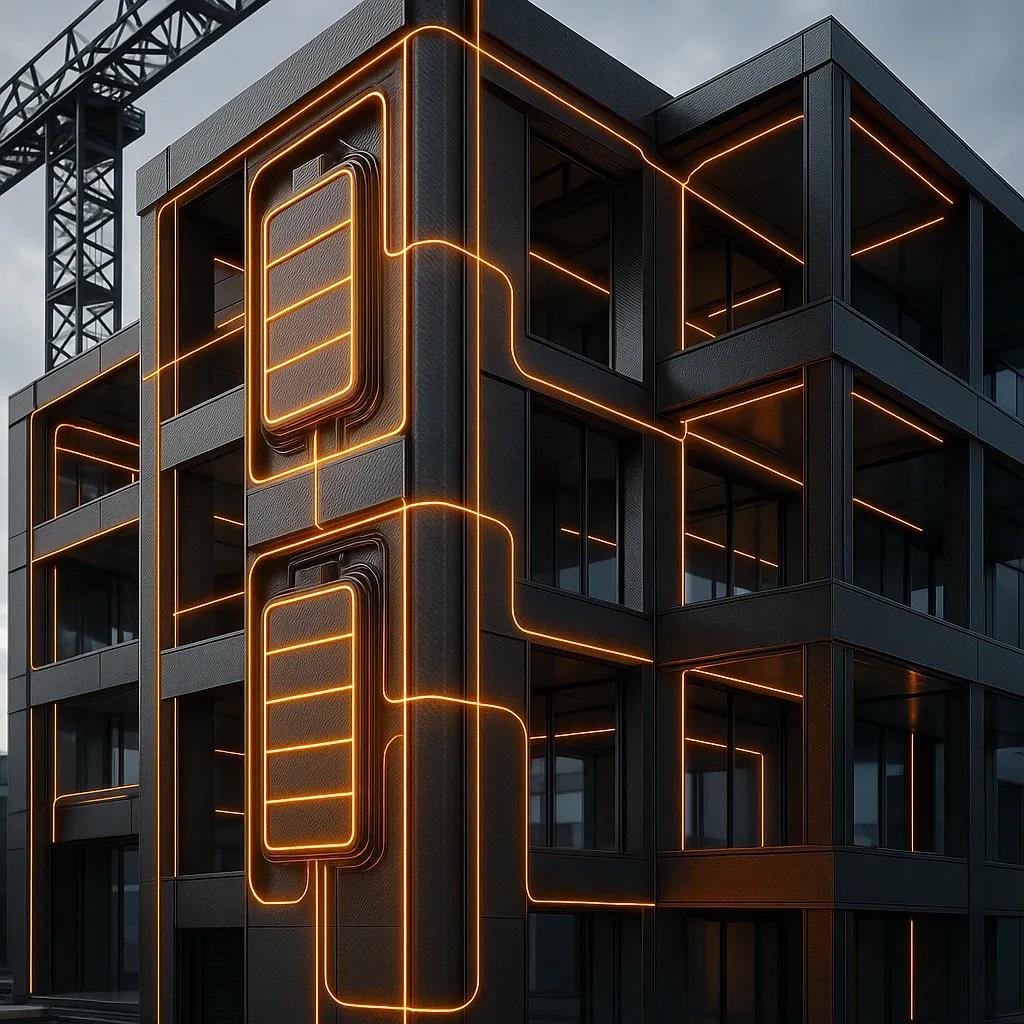
The construction industry stands on the precipice of a transformative revolution. According to the World Economic Forum's 2025 Emerging Technologies report, structural battery composites (SBCs) have emerged as the top breakthrough technology poised to reshape how we design, build, and power the structures of tomorrow. This innovation represents far more than an incremental improvement, it signals the end of "dead weight" in construction, where every component serves a single purpose, and heralds an era of multifunctional building materials that simultaneously provide structural integrity and energy storage.
Understanding Structural Battery Composites: A Paradigm Shift
Traditional construction separates structural elements from energy systems, creating redundancy and inefficiency. Buildings rely on steel, concrete, and timber for structural support while depending entirely on external power sources and separate energy storage systems. Structural battery composites fundamentally challenge this approach by integrating load-bearing mechanical components with rechargeable energy storage capabilities within the same material.
SBCs typically utilize carbon fiber, a material five times stronger than steel and twice as stiff while remaining significantly lighter, as both the structural reinforcement and the electrode for energy storage. The carbon fibers are embedded within a solid polymer electrolyte matrix that serves dual functions: providing ionic conductivity for battery operation and acting as the structural binder. This revolutionary design enables building components to store energy while maintaining the mechanical properties required for structural applications.
The Technical Foundation: From Laboratory to Construction Site
Research institutions, particularly Chalmers University of Technology in Sweden, have made remarkable strides in developing commercially viable SBCs. Recent breakthroughs demonstrate structural battery composites with energy densities exceeding 60 Wh/kg and elastic modulus values over 100 GPa, approximately half the energy capacity of conventional lithium-ion batteries while maintaining half the stiffness of steel. Critically, these materials retain both functions simultaneously, representing a true multifunctional achievement.
The manufacturing process involves integrating carbon fiber reinforcement with specialized electrolytes that cure alongside traditional composite resins. This approach allows for standard composite manufacturing techniques while incorporating energy storage functionality. Advanced fabrication methods, including 3D printing optimization, enable customization for specific structural requirements and energy storage capacities.
Revolutionary Applications in Construction
The implications for construction are profound and far-reaching. Building-integrated photovoltaics (BIPV) currently demonstrate how structures can generate energy, but SBCs take this concept further by enabling buildings to store energy within their very framework. Imagine facade panels that capture and store renewable energy during peak generation hours, releasing it when needed.
Carbon fiber reinforced polymer (CFRP) composites already show promise in construction applications, offering superior strength-to-weight ratios and corrosion resistance compared to traditional materials. Germany's Carbonhaus, the world's first concrete building reinforced with carbon fiber, demonstrates the viability of these advanced materials in real-world applications. The integration of energy storage capabilities into such systems represents the next evolutionary step.
Structural battery composites could transform various building elements: load-bearing walls that store energy from integrated solar panels, structural beams that serve as building-wide energy distribution systems, and facade elements that provide both weather protection and energy storage. This integration eliminates the need for separate battery installations, reducing construction costs and complexity while maximizing usable space.
Environmental and Economic Implications
The environmental benefits of SBCs extend beyond their energy storage capabilities. Traditional construction generates approximately 37% of global CO2 emissions, with buildings consuming 34% of total energy demand. By enabling structures to become energy-positive through integrated storage and renewable generation, SBCs offer a pathway toward carbon-neutral construction.
Weight reduction represents another crucial environmental benefit. A 10% reduction in building weight can improve overall energy efficiency by 6-8%, while the elimination of separate battery systems reduces material requirements and associated manufacturing emissions. The World Economic Forum analysis suggests that SBCs could contribute to 70% reductions in greenhouse gas emissions for certain applications.
Economically, SBCs address multiple cost centers simultaneously. While carbon fiber materials currently cost approximately $13-15 per kilogram, comparable to steel reinforcements, they eliminate the need for separate energy storage systems, electrical infrastructure, and associated installation costs. The modular nature of SBC components also enables faster construction timelines and reduced labor requirements.
Challenges and Implementation Pathways
Despite their promise, structural battery composites face significant implementation challenges. Current energy density limitations mean SBCs provide roughly half the energy storage capacity of conventional batteries while offering half the stiffness of steel. While these trade-offs may be acceptable for certain applications, they require careful optimization for each use case.
Safety regulations present another critical hurdle. Existing building codes do not account for dual-function materials that simultaneously provide structural support and energy storage. Comprehensive regulatory frameworks must be developed to ensure safety standards for materials that could potentially fail in both structural and electrical domains.
Manufacturing scalability represents a practical challenge. While laboratory demonstrations show promise, scaling SBC production to construction industry volumes requires significant investment in specialized manufacturing equipment and workforce training. The construction industry's traditionally conservative approach to new materials may slow adoption despite clear technical advantages.
The Future Construction Ecosystem
The integration of structural battery composites aligns with broader trends toward smart buildings and energy-autonomous structures. Advanced building management systems can optimize energy flow between SBC elements, renewable generation sources, and occupancy demands. This creates buildings that not only minimize energy consumption but actively contribute to grid stability through distributed energy storage.
The convergence of SBCs with other emerging technologies, including building-integrated photovoltaics, smart sensors, and advanced control systems, promises to create truly intelligent structures. These buildings will adapt energy consumption and production in real-time, participate in demand response programs, and provide grid services while maintaining optimal occupant comfort.
Conclusion: Beyond Dead Weight
Structural battery composites represent more than a technological innovation, they embody a fundamental shift toward resource efficiency and functional integration in construction. By eliminating the distinction between structural and energy systems, SBCs enable architects and engineers to design buildings that are simultaneously lighter, stronger, and more energy-efficient than anything previously possible.
The path forward requires coordinated effort across industries, regulatory bodies, and research institutions. While challenges remain in scaling production, ensuring safety, and updating building codes, the potential benefits, reduced construction costs, enhanced building performance, and significant environmental improvements, justify the investment required for widespread adoption.
As the construction industry grapples with climate change, urbanization pressures, and resource constraints, structural battery composites offer a compelling solution. They herald the death of dead weight in construction, replacing passive structural elements with active, energy-storing components that serve multiple functions. This revolution will not happen overnight, but the foundation is already being laid in research laboratories and demonstration projects worldwide. The buildings of tomorrow will not merely shelter their occupants, they will power them, store energy for them, and actively contribute to a more sustainable future.