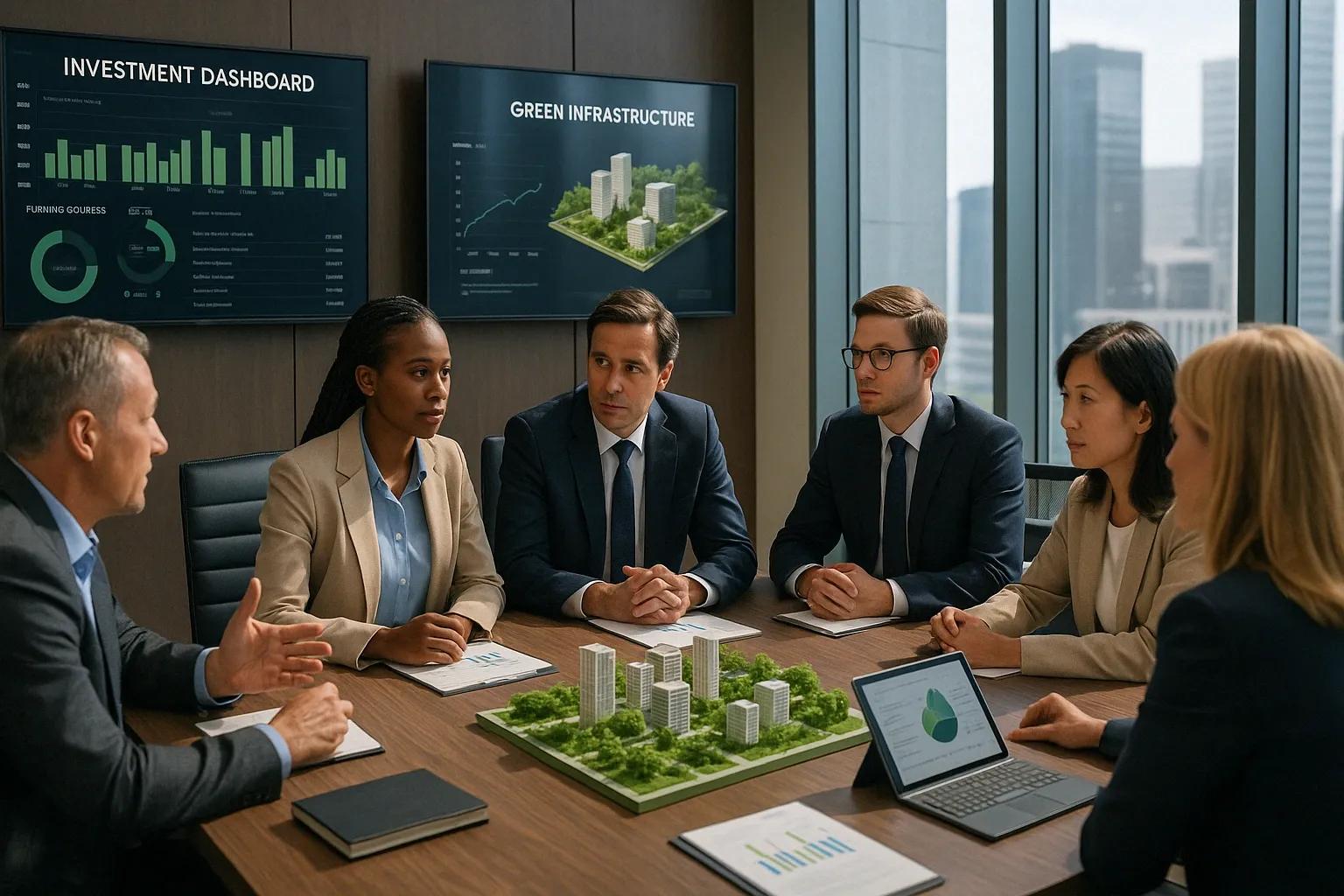
Nature-based urban infrastructure is often seen as a public good, essential, but hard to fund at scale through public budgets alone.
At the same time, private investors hesitate due to perceived risks, unclear returns, and lack of performance data.
Blended finance bridges that gap. It strategically combines public or concessional capital with private sector investment to unlock funding for projects that deliver environmental, social, and financial value.
As cities push toward nature-positive transitions, public-private partnerships (PPPs) and blended finance models are becoming key tools to get projects off the ground.
Why It Matters
Without blended finance:
Cities rely solely on limited public funding.
Large-scale nature-positive infrastructure remains underdeveloped.
Private capital continues to favor grey over green infrastructure.
Blended finance not only expands capital availability but also:
Shares project risk across stakeholders.
Builds investor trust through public commitment.
Encourages co-design between public planners and private developers.
How It Can Be Structured
1. Use Public Capital to De-risk Private Investment
Governments can:
Provide first-loss guarantees or viability gap funding
Underwrite environmental performance risks
Support land access and permitting
Technology enabler: Digital Twins and UAV imagery can model and validate ecosystem benefits, reducing perceived uncertainty.
2. Establish Performance-Based Contracts
Tie investor returns to measurable outcomes such as:
Urban cooling
Air quality improvement
Stormwater retention
Technology enabler: IoT sensors and AI dashboards provide real-time data to track nature-positive KPIs for payments.
3. Create Project Aggregators
Bundle small-scale green infrastructure projects into one investment portfolio across a region or city.
Technology enabler: Geospatial mapping platforms can identify, cluster, and analyze suitable sites at scale.
4. Attract Institutional Investors
Cities can co-develop nature investment funds with banks or development finance institutions (DFIs).
Technology enabler: BIM + environmental valuation models improve design transparency and cost forecasting.
Role of Digital Technologies
For blended finance to work, cities must be able to:
Measure impact
Reduce uncertainty
Communicate results transparently
Your technology stack enables this:
Need: Enabling Tech
Site & impact mapping: Geospatial platforms, UAVs
Cost & benefit modeling: BIM, Digital Twins
Real-time tracking: IoT, AI dashboards
Investor reporting: Digital simulations, environmental data layers
These tools give both public and private actors the visibility they need to collaborate effectively.
Conclusion
Public-private partnerships backed by smart digital infrastructure can dramatically scale urban nature investment.
Blended finance doesn’t just raise money, it builds alignment, trust, and long-term shared value.
The future of urban resilience lies in co-creation between public leadership and private innovation, and technology is the connector.