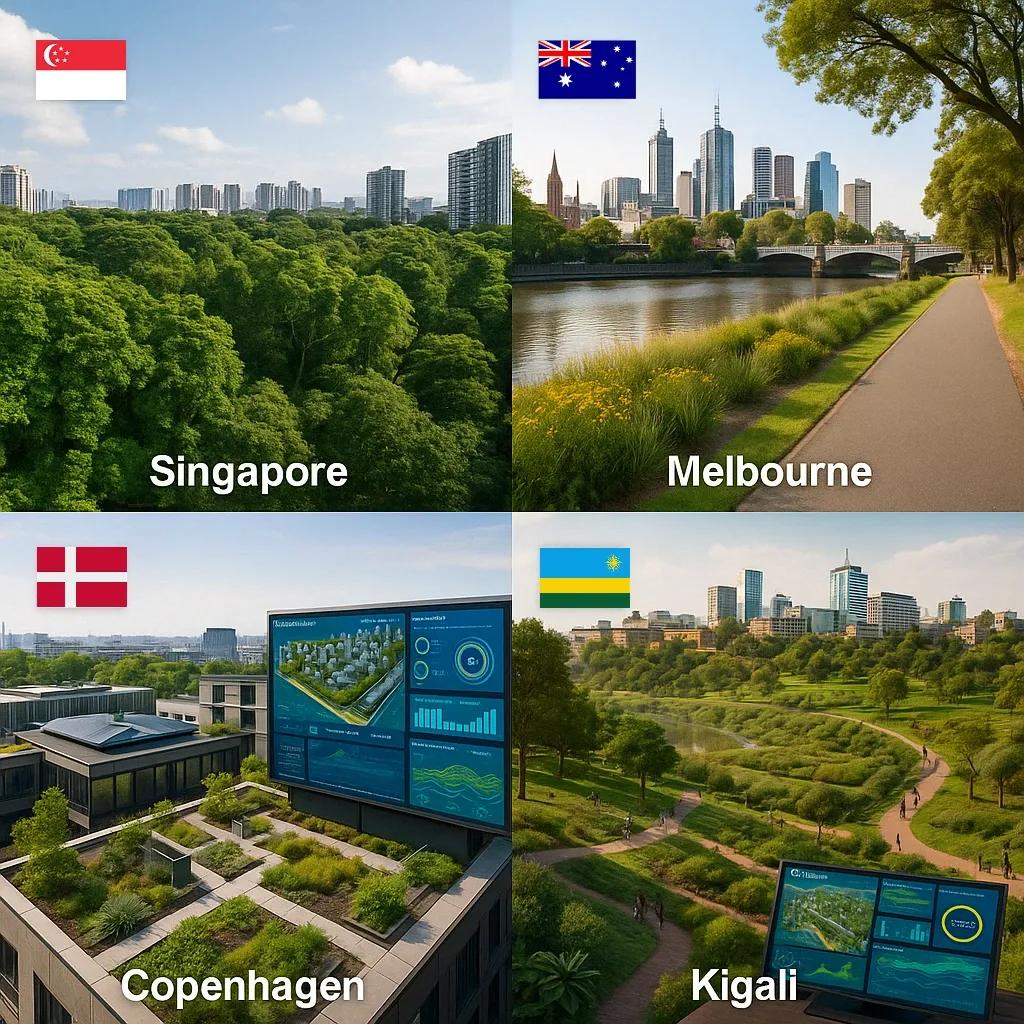
From planning and policy to investment and implementation, some cities are already proving that nature-positive development is not just possible, it’s profitable and replicable.
These pioneers are showing how local governments, backed by digital innovation and strategic finance, can reshape urban landscapes around resilience, biodiversity, and long-term economic value.
Let’s look at a few standout examples leading this transition.
1. Singapore: Nature as Strategic Infrastructure
Singapore’s City in Nature vision embeds biodiversity across planning, water management, housing, and mobility systems.
What makes it work:
Integrated geospatial biodiversity baselines
Digital Twins simulate urban ecosystem performance
100% of public housing includes nature-based elements
Finance strategy: Public infrastructure budgets linked to climate adaptation KPIs, green bond frameworks, and land value capture.
2. Melbourne, Australia: Urban Forest and Cooling Targets
Melbourne set a goal to double tree canopy by 2040 to reduce heat stress and improve air quality.
Tech enabler:
IoT sensor networks monitor urban heat island effects
UAV imagery verifies vegetation coverage and growth rates
Finance model: Municipal green bonds and public-private partnerships fund ongoing tree planting, maintenance, and monitoring.
3. Copenhagen, Denmark: Cloudburst Resilience through Nature
After major flooding in 2011, Copenhagen invested in green infrastructure like retention parks, blue-green boulevards, and sponge city elements.
Digital backbone:
BIM-integrated drainage systems
Real-time water flow simulations via Digital Twins
Finance structure: Insurance-backed municipal financing tied to climate resilience performance.
4. Kigali, Rwanda: Green Growth in Emerging Economies
Kigali’s urban expansion is tied to green corridors, wetland restoration, and low-impact transport zones.
What stands out:
GIS-supported land use planning ensures biodiversity buffers
Local universities and NGOs use UAVs for community-based mapping
Funding: Support from the Green Climate Fund, World Bank, and blended development finance platforms.
Why These Cities Succeed
Across different regions and income levels, the common enablers are:
Enabler: How it Helps
Geospatial Data: Identifies opportunities and tracks results
Digital Twins & BIM: Plan infrastructure around natural systems
UAVs & IoT: Real-time environmental validation
Public-Private Finance: Shares risk, scales investment
Transparent Reporting: Builds trust and long-term investor confidence
Lessons for Other Cities
Success is less about size or budget and more about:
Willingness to rethink planning frameworks
Embedding measurable nature goals into city strategies
Investing in digital tools that make outcomes verifiable
Partnering across sectors to fund and maintain green infrastructure
These cities have shown that nature can be treated as an asset, not a cost, and that climate resilience can be built into the balance sheet.
Conclusion
Nature-positive transformation is already underway.
From Singapore to Kigali, cities are proving that the integration of nature, finance, and technology can shape a better urban future.
The next step? Scale these models, share data, and make digital infrastructure a foundation for every city’s green transition.