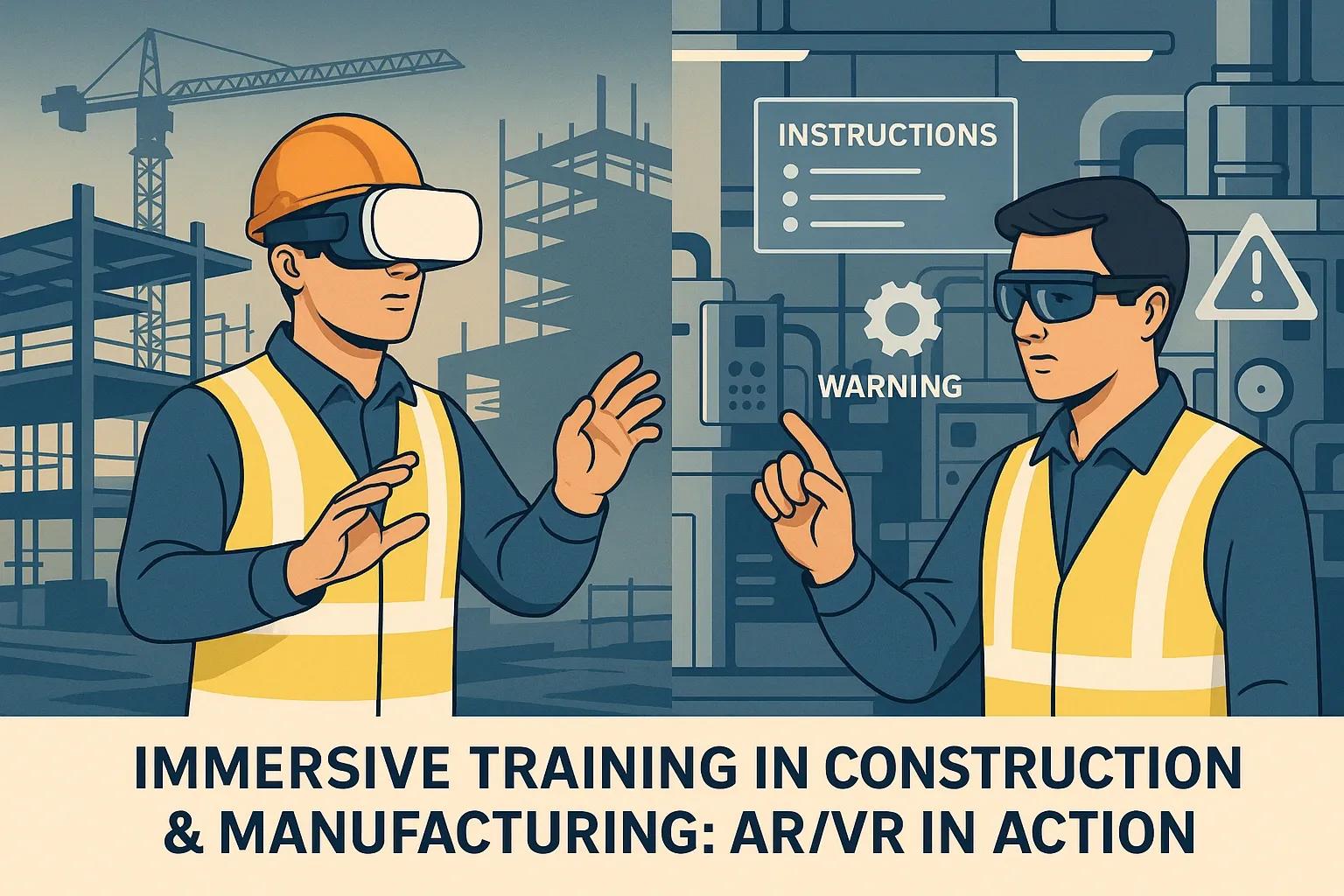
In an industry defined by precision, safety, and productivity, traditional training methods often fall short in preparing workers for high-risk, dynamic environments like construction sites and manufacturing plants. Augmented Reality (AR) and Virtual Reality (VR) technologies are reshaping this narrative. By placing workers into realistic simulations of real-world tasks and environments, AR/VR-based training platforms are rapidly becoming a cornerstone of modern workforce development in the construction and manufacturing sectors.
This article explores how immersive learning is revolutionizing skills training, what technologies are driving this shift, and the implications for operational efficiency and safety.
Why Traditional Training Falls Short
Conventional training in construction and manufacturing often relies on classroom lectures, printed manuals, or observational learning on active job sites. These approaches are limited in scope:
Passive Learning : Retention rates are low due to lack of interactivity.
High-Risk Exposure : Learning on active sites increases the risk of accidents.
Standardization Challenges : Training quality varies across locations and instructors.
Skill Gaps : Workers may not encounter edge-case or emergency scenarios during training.
This gap has prompted a need for scalable, consistent, and safe training systems, precisely where AR/VR excels.
AR/VR: A New Paradigm in Workforce Training
AR and VR offer immersive environments where workers can:
Engage with realistic equipment, machinery, or site layouts.
Practice standard operating procedures and safety protocols.
Experience rare, dangerous, or complex situations without actual risk.
The core difference:
Virtual Reality (VR) creates a fully simulated environment. Trainees wear headsets to enter digital replicas of construction sites, factories, or control rooms.
Augmented Reality (AR) overlays digital content onto the real world, using smart glasses or mobile devices to guide users during live tasks.
Together, they enable “learn by doing”, increasing engagement, reducing errors, and improving retention.
Key Use Cases Across Construction and Manufacturing
1. Safety Training and Hazard Awareness
In both industries, safety is paramount. VR scenarios simulate fall hazards, electrical risks, chemical exposure, and equipment failures, teaching workers how to respond appropriately before facing these dangers in the field.
Example: A virtual walkthrough of a high-rise building under construction lets workers practice evacuation procedures, recognize hazard signs, or operate fire extinguishers in a safe, repeatable environment.
2. Machinery Operation and Maintenance
AR/VR simulates machine controls, part replacements, and routine checks. Workers interact with digital twins of CNC machines, HVAC systems, or cranes, understanding sequences and best practices before handling real equipment.
Example: An AR overlay on an assembly line helps new technicians learn part assembly, torque specifications, or sequence flows by projecting instructions directly on the workspace.
3. Design and BIM Coordination
VR is increasingly integrated into Building Information Modeling (BIM) workflows. Project teams and workers can step into 3D models, identify clashes, and gain spatial awareness of site layouts.
Example: Before pouring concrete, site supervisors can explore the VR model of a building’s foundation and utilities, identifying conflicts or verifying readiness.
4. Soft Skills and Crisis Simulation
VR allows training beyond technical skills, covering conflict resolution, team coordination, and emergency decision-making.
Example: A plant manager may go through a simulated breakdown scenario requiring calm communication with maintenance, shift managers, and safety officers.
Benefits of Immersive Training
✅ Faster Skill Acquisition
Workers learn complex tasks faster when they interact with simulations instead of reading manuals or watching videos. Studies show VR-based training improves learning retention by 75–90% compared to traditional methods.
✅ Risk-Free Learning Environment
Trainees can make mistakes without consequence, encouraging experimentation and active learning.
✅ Standardized Training at Scale
Multinational firms can roll out the same immersive training modules globally, ensuring consistency in onboarding and compliance.
✅ Performance Tracking
AR/VR systems capture detailed analytics like reaction times, decision paths, and error rates. This helps personalize training, identify gaps, and certify readiness.
✅ Reduced Downtime
Workers trained on digital replicas can hit the ground running, minimizing the need for live supervision or on-the-job learning time.
Technologies Enabling Immersive Learning
Several enabling technologies are driving this transformation:
Game Engines like Unity and Unreal Engine power realistic 3D simulations.
Digital Twins connect VR environments to real-time data from physical assets.
Haptics and Wearables introduce touch-based feedback and physical movement tracking.
Cloud-Based Training Platforms make content accessible across devices and geographies.
AI Integration customizes the training journey based on performance and preferences.
Leading companies like Siemens, Caterpillar, and Larsen & Toubro are already investing in AR/VR-based training to improve productivity and safety.
Challenges in Adoption
Despite its advantages, immersive training has some barriers:
High Initial Investment : Custom content development and hardware setup can be costly.
Change Management : Older workers may resist new methods of training.
Content Relevance : Simulations must match site-specific or machine-specific scenarios.
Bandwidth and Hardware Limitations : High-quality VR requires strong network and device specs.
To overcome these, businesses are adopting a phased strategy, starting with pilot projects and scaling based on feedback and ROI.
Future Directions
Integration with LMS and HR Platforms : Immersive modules will merge into Learning Management Systems, aligning with certification and career development goals.
Edge-Based AR Devices : Lightweight, wearable AR devices powered by 5G will provide real-time training on live job sites.
AI-Coached Scenarios : Adaptive VR coaches powered by AI will personalize experiences and provide real-time feedback.
Cross-Industry Modules : Reusable content libraries will emerge, especially for common tasks like safety drills, equipment handling, or site walkthroughs.
Conclusion
As the construction and manufacturing industries transition into Industry 4.0, the workforce must evolve with it. AR/VR-based training offers a transformative path, bridging the gap between theoretical knowledge and practical execution. By simulating real-world conditions in a safe, immersive environment, these technologies prepare workers not just to operate, but to excel.
Companies that invest early in immersive learning will gain a workforce that is safer, faster, and future ready.