Healthcare systems don’t fail only inside hospitals.
They fail when access, location, and demand are misaligned.
Introduction
In the previous articles, we explored how Digital Twins enable:
infrastructure monitoring
operational optimization across sectors
environmental intelligence and risk management
Now we move to a domain where:
👉 decisions directly impact human lives
👉 Healthcare Infrastructure Planning
This is not just about hospitals.
It involves:
where facilities are located
how resources are distributed
how demand is anticipated
In Phase 3, the focus remains:
👉 how Digital Twins enable data-driven planning and system-level optimization
The Core Problem: Misaligned Infrastructure
Most healthcare planning today:
relies on historical data
follows administrative boundaries
responds to demand after it increases
This leads to:
underserved regions
overcrowded hospitals
inefficient resource allocation
👉 The system reacts instead of planning ahead.
Where Digital Twins Change the Approach
A Healthcare Digital Twin enables:
👉 spatial and demand-driven infrastructure planning
Instead of:
static planning
It creates:
a dynamic model of population, demand, and access
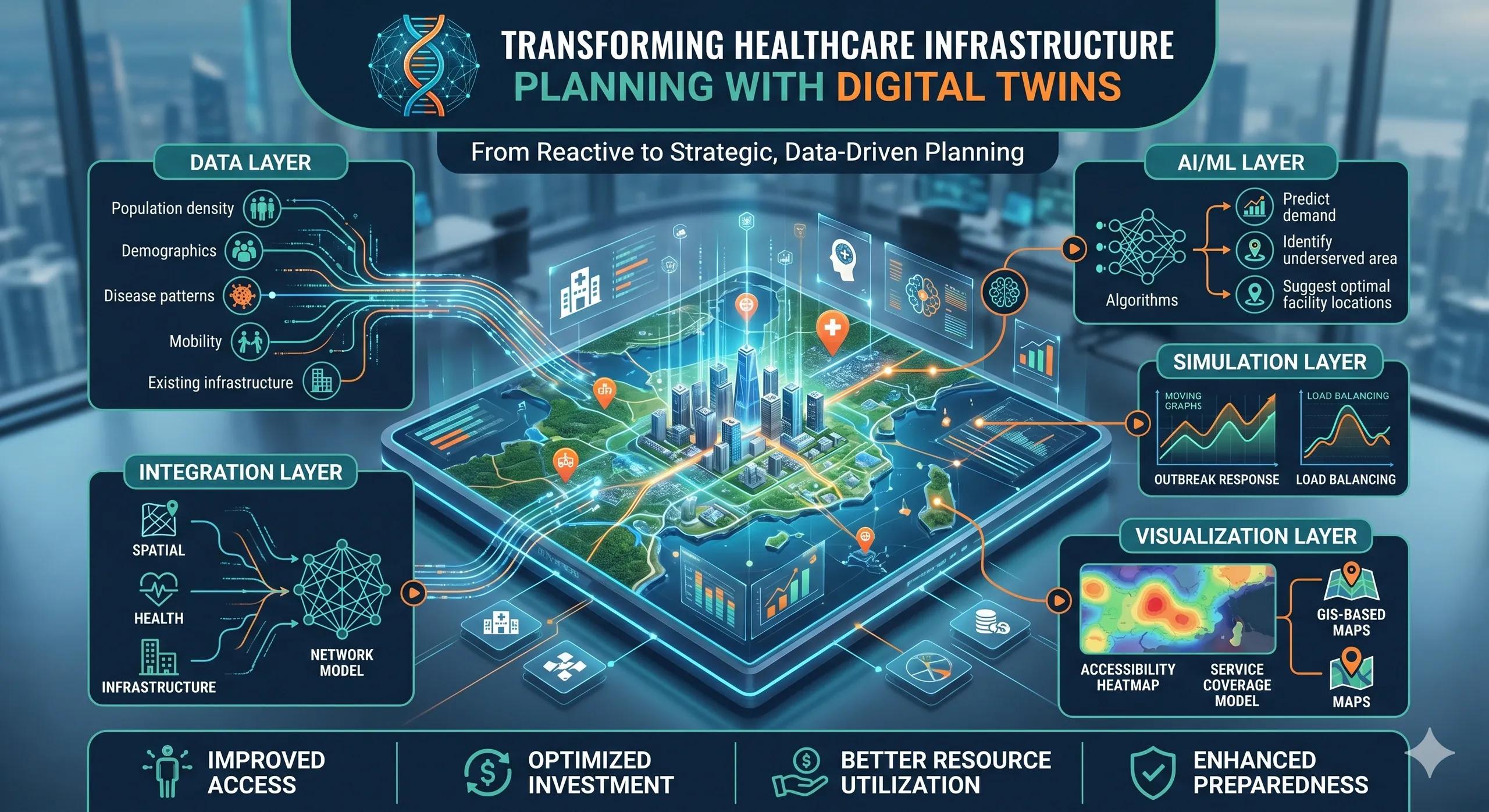
Key Components of a Healthcare Digital Twin
1. Data Layer
demographic data
disease patterns
population density
mobility and accessibility data
existing healthcare infrastructure
2. Integration Layer
combines: spatial data health data infrastructure data
👉 creates a unified planning view
3. AI/ML Layer
predicts healthcare demand
identifies underserved regions
optimizes facility placement
4. Simulation Layer
models infrastructure scenarios
evaluates accessibility and load
5. Visualization Layer
GIS-based maps
accessibility heatmaps
service coverage models
Use Case 1: Site Selection for New Facilities
Traditional Approach
based on administrative planning
limited spatial analysis
Digital Twin Approach
analyze: population distribution travel time demand patterns
👉 Outcome:
optimal facility placement
Use Case 2: Resource Allocation
allocate: beds equipment staff
based on predicted demand
👉 Outcome:
improved service delivery
Use Case 3: Emergency Preparedness
simulate outbreak scenarios
assess system capacity
👉 Outcome:
better preparedness
Practical Example
Scenario: Urban Healthcare Gap
analysis shows high population density with limited hospital access
Digital Twin identifies:
👉 underserved zone
System recommends:
new facility location
redistribution of resources
👉 Outcome:
improved accessibility
Where Most Implementations Fail
1. Planning Without Spatial Context
decisions made without location intelligence
2. Static Data Usage
reliance on outdated datasets
3. Lack of Integration
health data not connected with infrastructure data
4. Delayed Decision-Making
planning reacts to demand
Ask Yourself
Is your healthcare system:
👉 reacting to demand
Or
👉 planning for it?
Indian Context
India faces:
uneven healthcare distribution
urban-rural gaps
growing population demand
Digital Twins can help:
👉 optimize healthcare infrastructure
👉 improve accessibility
👉 support better planning decisions
Benefits & ROI
improved healthcare access
optimized infrastructure investment
better resource utilization
enhanced preparedness
data-driven planning
Conclusion
Healthcare infrastructure is not just about capacity.
It is about:
👉 location
👉 accessibility
👉 timing
Digital Twins enable:
understanding demand
predicting needs
planning proactively
This transforms healthcare from:
👉 reactive expansion
To
👉 strategic, data-driven planning