Geospatial technology has transcended its niche status to become an integral part of various economic sectors worldwide. Faced with accelerating global challenges such as climate change, natural disasters, inflation, resource depletion, and water scarcity, this technology acts as the circulatory system that keeps the world economy robust and resilient.
Harnessing the Power of Digital Transformation in Geospatial Industry
The geospatial industry is undergoing a profound shift driven by digital transformation, marked by a surge in data generation, changing business models, technological innovation, and an influx of funding and investment. These dynamics intertwine to redefine the landscape and potential of the geospatial sector.
Central to this transformation is the profusion of data. The proliferation of sensors and IoT devices, along with advancements in remote sensing technology, has exponentially increased the generation and availability of geospatial data. This data influx provides unprecedented insights into various aspects of the Earth, fostering the creation of innovative solutions for our planet's most pressing issues.
Business models in the geospatial industry are also evolving in response to digital transformation. The traditional transaction-based model is gradually being replaced by service-based and solution-based models. These new business models, focused on delivering comprehensive solutions, are capable of extracting greater value from geospatial data, leading to more substantial impacts and returns.
Simultaneously, the industry is experiencing a surge in technological innovation. Developments in digital twins and the metaverse are enabling a more immersive and interactive exploration of geospatial data, while advancements in prescriptive analytics allow for more accurate and actionable insights. Collaboration tools are also emerging, facilitating the sharing of knowledge and data within and between organizations and effectively catalyzing problem-solving and innovation.
Capitalizing on Investment Opportunities in the Geospatial Sector
The dynamism of the geospatial industry has not gone unnoticed by investors and funding agencies worldwide. A substantial percentage of funding has been directed toward this sector. To illustrate, more than 50% of total funding between 2019 and 2022 was attracted by Earth Observation companies, followed closely by GNSS and Positioning Technology Providers.
This investor interest underlines the concrete potential of the geospatial industry for significant returns and societal impact. In addition to providing solutions for global challenges, the geospatial sector also presents vast opportunities for economic growth and wealth creation.
The Future of the Geospatial Industry: A Wealth of Opportunities
The geospatial industry is currently undergoing a transformative transition that is unprecedented in its history. The sector now has a market size of USD 512.5 billion and a market cap of USD 1.7 trillion, figures that clearly underscore its rapidly increasing value.
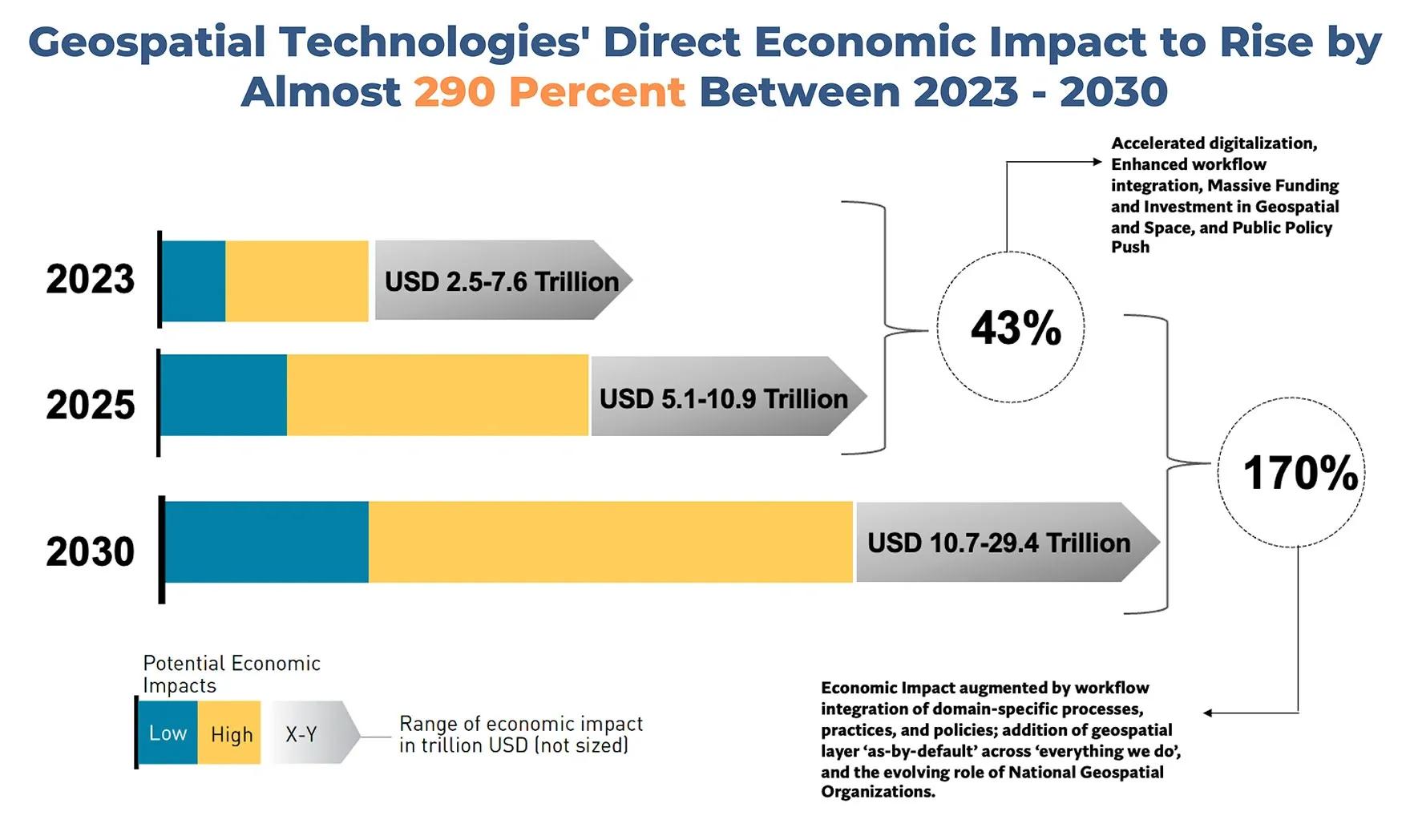
These trends point towards a promising future for the geospatial industry. Projections estimate that the market size will reach an impressive USD 1.37 trillion by 2030, generating a direct economic impact of approximately USD 30 trillion.
The geospatial industry's ongoing transformation and ascendency reveal its critical role in addressing global challenges and driving economic growth. As technology continues to evolve, the industry is poised to unlock even more value and opportunities, solidifying its position as a key player in the global economy. Thus, the geospatial revolution is not just reshaping the industry—it is reshaping our world.
Reference:
https://geospatialworld.net/consulting/reports/geobuiz/2023/index.html