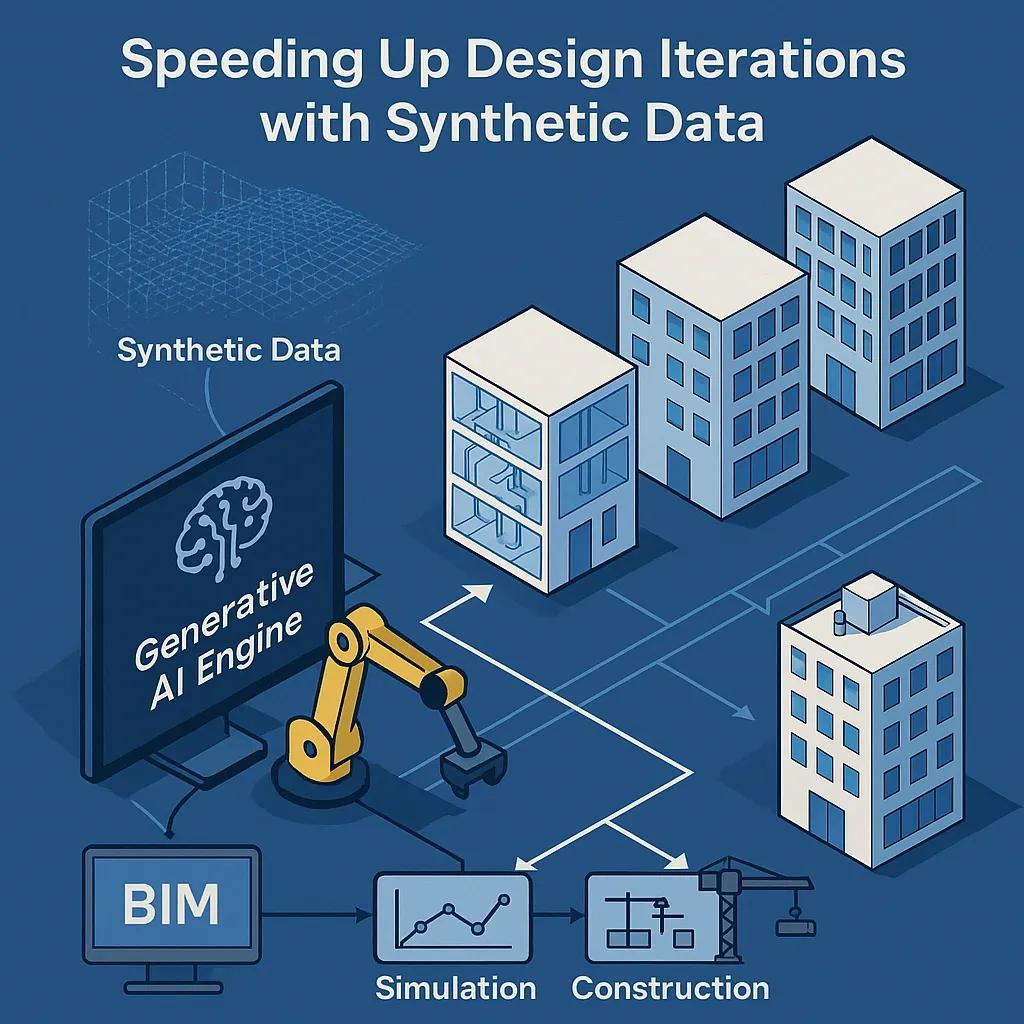
The Architecture, Engineering, and Construction (AEC) industry is undergoing a significant transformation with the adoption of digital technologies, and generative AI is emerging as a powerful enabler. One of its most promising applications is in 3D modeling, where it helps create detailed, accurate, and variant-rich models quickly. More importantly, it allows professionals to iterate faster by leveraging synthetic datasets, artificially generated but realistic data used to train or validate AI models.
This article explains how generative AI works in the context of 3D modeling, its use of synthetic data, and how it enables faster, more accurate design cycles in AEC projects.
1. What is Generative AI in AEC?
Generative AI refers to algorithms, typically deep learning models, that can autonomously create new content such as images, text, music, or 3D models. In AEC, this means generating architectural layouts, MEP configurations, structural models, and even urban plans.
The generative models most relevant to 3D modeling include:
Generative Adversarial Networks (GANs) : Used to synthesize new 3D structures by learning from existing design libraries.
Variational Autoencoders (VAEs) : Good at generating smooth, continuous variations of geometry.
Diffusion Models : Recently gaining traction for their ability to generate detailed and diverse data distributions, including point clouds and meshes.
Transformer-based Models : Adapted for 3D applications by processing spatial sequences and hierarchical design data.
These models learn from large datasets, real or synthetic, and can generate 3D representations from scratch or enhance existing models with more detail, annotations, or corrections.
2. The Role of 3D Modeling in AEC
3D modeling is central to modern AEC workflows. It supports:
Design visualization and stakeholder approvals
BIM integration for clash detection and asset tracking
Construction planning and site coordination
Facility management post-handover
Traditional 3D modeling, however, is time-consuming and labor-intensive. It involves manual drafting, interpretation of 2D data, and constant revisions, especially in large or iterative projects. This is where generative AI becomes a game-changer.
3. Synthetic Datasets: A Catalyst for AI Training
One of the key bottlenecks in training AI models for AEC applications is the limited availability of high-quality annotated 3D data. Projects are proprietary, geometries are complex, and data labeling is expensive. Synthetic datasets address this challenge.
What are synthetic datasets?
Synthetic datasets are computer-generated samples that simulate real-world environments. In 3D modeling, they can include:
Parametric buildings with labeled structural elements
Synthetic point clouds or LiDAR scans of urban environments
Simulated construction site scenarios
Fabricated MEP routing variations under different constraints
These datasets are used to:
Train AI models for segmentation, classification, and generation
Validate model performance across design variants
Simulate rare or edge-case scenarios not present in real-world datasets
For example, if a generative AI model needs to learn how HVAC ducts navigate through ceiling spaces, thousands of synthetic 3D models with labeled ducts under varied constraints can provide rich training data.
4. Key Applications of Generative AI for 3D Modeling
a) Automatic Floor Plan Generation
Generative AI can rapidly convert sketches, prompts, or zoning inputs into full 3D layouts. Startups and research labs have demonstrated tools that can generate multi-storey building layouts from basic user inputs. This accelerates early-stage design, site feasibility assessments, and stakeholder proposals.
b) MEP Routing Optimization
Generative models can simulate multiple MEP (Mechanical, Electrical, Plumbing) layouts that comply with building codes and avoid structural collisions. With reinforcement learning or GAN-based approaches, these models can generate solutions that optimize material use and spatial efficiency.
c) Façade and Massing Variants
For high-rise or urban projects, AI models can generate façade styles or massing options that conform to sun path, wind direction, and zoning regulations. This enables architects to explore a broad design space without manual modeling.
d) As-Built Modeling from Scan Data
Combining generative AI with reality capture techniques (e.g., laser scanning, photogrammetry) allows faster conversion of point clouds into structured 3D models. The AI learns to infer walls, floors, and fixtures from unstructured data, speeding up renovation or retrofit projects.
5. How It Speeds Up Design Iterations
The traditional design workflow often involves multiple back-and-forth loops between architects, engineers, and contractors. Every change in layout or systems design could take hours or days to reflect in the 3D model.
Generative AI significantly shortens this cycle:
Traditional Workflow - With Generative AI
Manual 3D model updates - AI updates model automatically
Single design variant - Dozens of variants in seconds
Limited reuse of data - Learns patterns from past models
Human error-prone - AI enforces constraints accurately
Dependent on CAD skills - Prompts or sketches sufficient
With AI-driven modeling tools, teams can generate alternatives, simulate outcomes, and decide on optimal configurations, within the same day.
6. Integration with BIM and Simulation Tools
Generative 3D models can be exported directly into BIM platforms (like Revit, ArchiCAD, or OpenBIM tools), where further detailing, quantity takeoff, and coordination takes place.
AI-generated models also integrate well with simulation tools, allowing rapid analysis of:
Energy performance
Structural loads
Pedestrian or vehicular circulation
Environmental impacts
This further improves decision-making early in the design stage, where the cost of change is minimal.
7. Challenges and Considerations
Despite its potential, generative AI in 3D modeling faces several hurdles:
Data Quality : Poorly annotated or biased training data can result in flawed outputs.
Design Intent : AI needs to interpret abstract concepts like aesthetics, cultural context, or client preferences, still a work in progress.
Regulatory Compliance : AI models must align with regional codes and standards, which vary widely.
Interoperability : Exporting AI models to standard AEC tools (IFC, RVT, etc.) without data loss remains a challenge.
Ethical concerns also arise around authorship and accountability in AI-generated designs.
8. The Future Outlook
Generative AI is set to become a co-pilot in the design process, not a replacement for human creativity. As synthetic dataset generation becomes more accessible through tools like Unity, Blender, and NVIDIA Omniverse, we’ll see faster training cycles and more capable models.
Emerging trends include:
Text-to-3D modeling for concept exploration
Multi-modal AI that combines voice, sketch, and semantic input
Physics-aware generation , enabling AI to consider material constraints, wind loads, or seismic forces during design
Feedback loops between design intent, generative output, and simulation validation
Conclusion
Generative AI, powered by synthetic datasets, is redefining how 3D models are created and iterated in the AEC industry. It enables faster, more informed design decisions, supports automation across disciplines, and lays the groundwork for a future where AI-driven tools are deeply integrated into the digital building lifecycle. While challenges remain, the direction is clear: smarter, faster, and more scalable modeling workflows that benefit every stakeholder in the built environment.