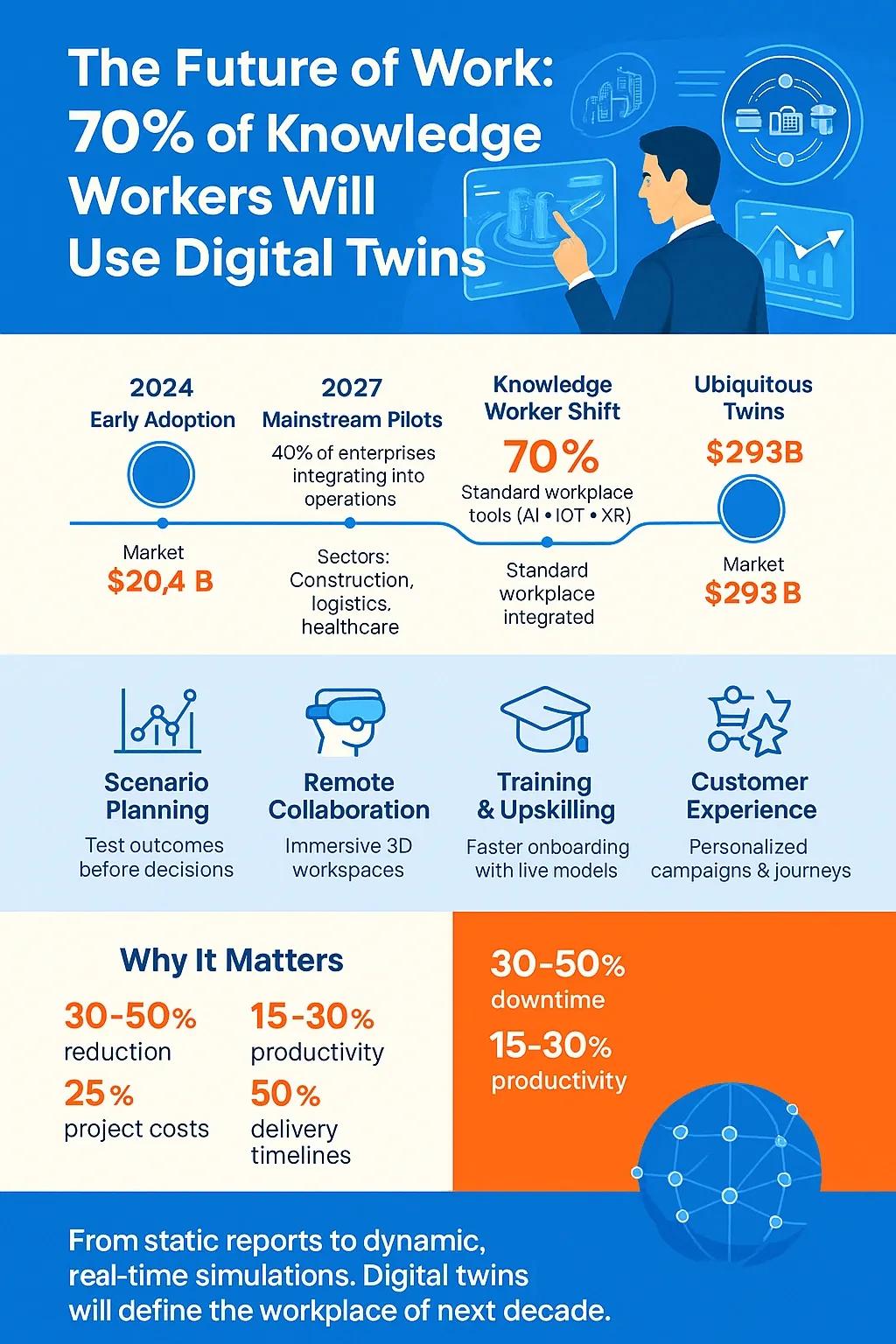
Digital twins are rapidly moving from specialized engineering tools to mainstream workplace enablers, reshaping how knowledge workers collaborate, innovate, and deliver value. By 2030, industry analysts project that 70% of knowledge workers worldwide will engage with digital twin technologies as part of their daily tasks. This trend reflects a fundamental shift in how data, simulation, and real-time feedback loops are embedded into business operations.
From Static Systems → Dynamic Workflows
Traditionally, knowledge work has relied on static reports, dashboards, and periodic updates. That model is giving way to digital twins, virtual representations of processes, assets, and systems that continuously update through IoT, AI, and analytics. This transformation enables workers to move from reactive decision-making to predictive and prescriptive workflows .
For example, instead of waiting for quarterly supply chain reports, a logistics analyst can interact with a digital twin of global freight operations in real time, testing alternative routing scenarios before disruptions occur. The shift is clear: from “what happened” → to “what happens next.”
1. The Expanding Role of Digital Twins in Knowledge Work
Market Growth : The global digital twin market is projected to grow from $20.4 billion in 2024 to $293 billion by 2035 at a 27.4% CAGR. Much of this adoption will extend beyond engineering into corporate operations, healthcare, finance, and public services.
Workforce Reach : Gartner estimates that 70% of knowledge workers will actively use digital twins by 2030 , driven by AI integration and remote collaboration demands.
Productivity Impact : Companies using digital twins report 30–50% reductions in machine downtime and 15–30% improvements in workforce productivity , proving tangible business value.
Real-world adoption is already visible:
Siemens uses digital twins in manufacturing lines, not only to optimize machinery but also to train operators in virtual environments.
Unilever applies digital twins in supply chain operations, simulating demand and logistics scenarios to avoid stockouts.
In Singapore’s Smart Nation initiative , digital twins of urban districts provide real-time insights for planners, energy managers, and policymakers.
These examples illustrate that digital twins are no longer the domain of engineers alone, they are embedding themselves into everyday decision-making.
2. New Competencies and Use Cases for Knowledge Workers
The future of knowledge work will be characterized by hybrid roles that combine domain expertise with digital twin literacy. Key use cases include:
Scenario Planning & Simulation : Business analysts will model “what-if” outcomes in real time, such as testing new pricing strategies or supply routes, before implementing them in the real world.
Remote Collaboration : Digital twins provide immersive 3D or XR workspaces where teams can interact with live data, reducing dependency on static video calls and slide decks.
Training & Upskilling : Instead of manuals, employees will learn by engaging with digital twins of assets, customer journeys, or workflows, leading to faster onboarding and reduced errors.
Customer Experience : Retailers like Nike are experimenting with digital twins of consumer behavior, helping marketers design personalized campaigns with higher ROI.
This transition will require knowledge workers to adapt from document-centric work → to model-centric work , where understanding dynamic systems becomes as critical as preparing presentations.
3. Organizational Shifts and Integration Challenges
Adopting digital twins at scale is not only a technical decision but also a cultural and organizational shift.
Integration with Legacy Systems : Many enterprises still rely on ERP and static BI tools. Digital twins require real-time data pipelines, making integration essential.
Data Governance : As twins pull information from IoT, AI, and external sources, ensuring compliance with privacy regulations (such as India’s Digital Personal Data Protection Bill, 2023 ) becomes critical.
Workforce Transition : Moving from PowerPoint reports to simulation-driven decision-making requires training, cultural adaptation, and new performance metrics.
Investment Justification : Executives need clear ROI, studies show digital twin adoption can reduce project costs by up to 25% and cut delivery timelines by 50% , but upfront investment remains a barrier.
Regions are responding differently. Europe is advancing through Digital Twin Victoria (Australia’s program is similar), the EU’s Destination Earth , while India is piloting state-level digital twins in smart cities and infrastructure projects. Each effort points to a convergence between digital transformation strategies and workforce adoption.
Outlook: The Next Phase of Knowledge Work
As digital twins evolve from pilot projects into enterprise platforms, several implications emerge:
AI-Infused Twins : The combination of generative AI and digital twins will allow workers to converse with simulations in natural language, lowering adoption barriers.
Cross-Industry Convergence : Sectors such as construction, finance, and healthcare will adopt common twin architectures, standardizing workflows across industries.
Democratization of Tools : Low-code/no-code interfaces will enable non-technical professionals to build and interact with digital twins, expanding the user base far beyond IT departments.
By 2030, knowledge work will no longer be defined only by information management but by simulation-based decision-making .
Conclusion
The integration of digital twins into everyday work represents a profound shift in the nature of knowledge work. From manufacturing plants to marketing departments, from city planning offices to boardrooms, the ability to interact with dynamic, real-time simulations will redefine productivity, collaboration, and strategy.
The future of work will not wait. Companies that embrace digital twin-driven workflows will move from reactive operations to proactive, predictive, and value-driven outcomes. For knowledge workers, this is not just a tool upgrade, it is a career-defining skillset . Those who adapt early will shape the next generation of digital-first organizations.