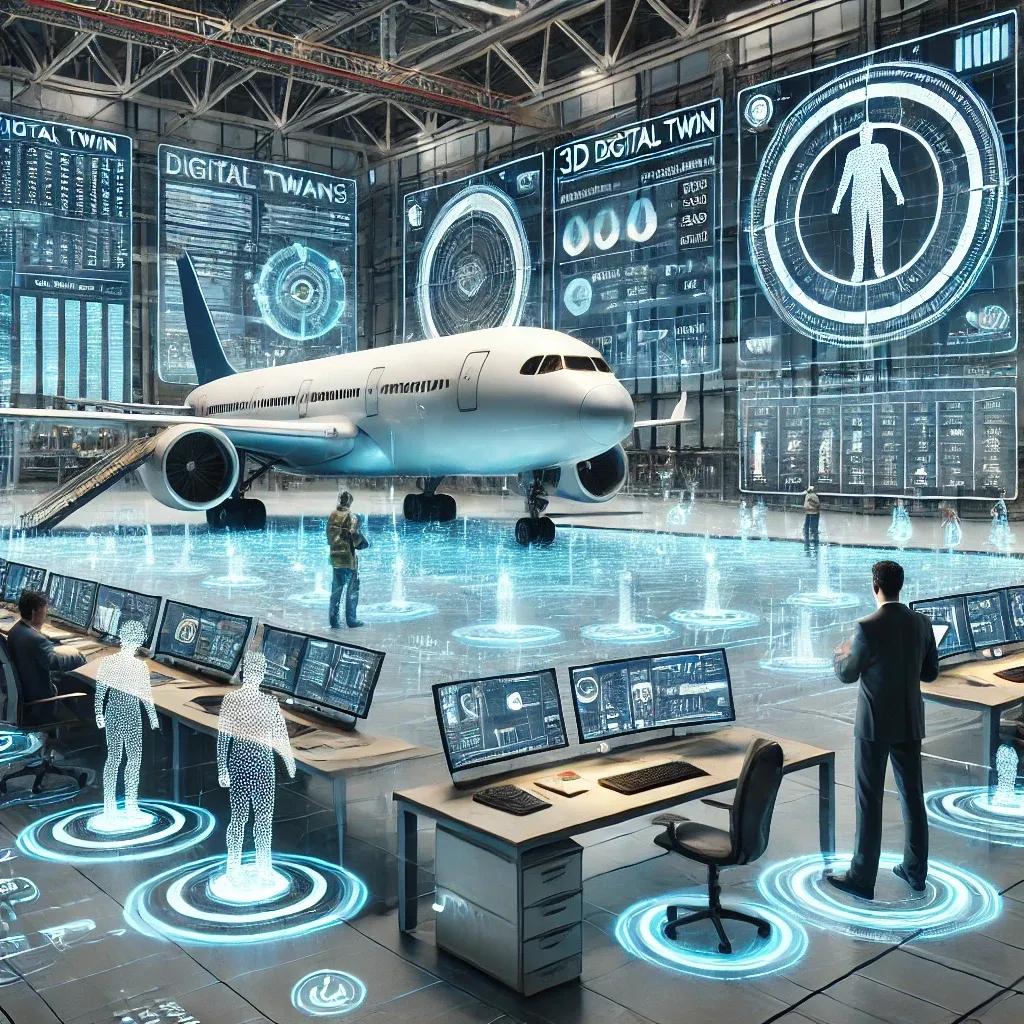
The aerospace industry stands on the cusp of a technological revolution, driven by the adoption of 3D digital twins. This technology is redefining how aerospace operations are conducted, from maintenance and training to design and simulation. However, the path to widespread adoption is not without challenges. Our innovative platform is at the forefront of overcoming these obstacles, offering tailored solutions that bring the full potential of 3D digital twins to the aerospace sector.
Understanding 3D Digital Twins in Aerospace
3D digital twins are highly detailed, real-time virtual representations of physical aerospace assets, such as aircraft, spacecraft, and their components. These digital replicas are continuously updated with data from sensors and other sources, allowing for precise monitoring, analysis, and management throughout the asset's lifecycle.
In aerospace, digital twins can simulate the behavior of an aircraft under various conditions, predict potential issues, and optimize operations without the need for costly and time-consuming physical tests. This capability is essential for an industry where safety, efficiency, and innovation are paramount.
Our Solutions for Aerospace: Visual Work Instructions
One of the most impactful applications of digital twins in aerospace is in the creation and deployment of Visual Work Instructions (VWIs) . These are interactive, step-by-step guides that leverage 3D models to train technicians, guide assembly processes, and ensure that maintenance tasks are performed correctly. Our platform excels in this area by offering a no-code environment where aerospace companies can rapidly develop and deploy VWIs tailored to their specific needs.
For example, our solutions have been used to boost assembly line output for the LCA Tejas and LCH Dhruv programs in India. By integrating VWIs into the assembly process, productivity increased by 12% to 20%, with a significant reduction in errors and wastage. These instructions are accessible on various devices, making them versatile and easy to implement across different work environments.
Overcoming Challenges in Adopting 3D Digital Twins
Despite the clear advantages, the adoption of 3D digital twins in aerospace is not without its challenges. These include:
High Initial Investment : Implementing digital twins requires significant upfront costs in terms of technology and infrastructure. Aerospace companies need to invest in sensors, data integration systems, and training for their workforce.
Data Security : The aerospace industry handles sensitive data, making cybersecurity a critical concern. Ensuring the integrity and security of the data used by digital twins is essential to prevent breaches that could compromise safety and operations.
Integration Complexity : Integrating digital twins with existing systems can be complex, especially in an industry with legacy infrastructure. Aerospace companies need solutions that can seamlessly connect with their current technologies.
Resistance to Change : As with any new technology, there is often resistance from stakeholders who are accustomed to traditional methods. Overcoming this requires demonstrating the clear benefits and reliability of digital twins.
Our platform addresses these challenges head-on.
Cost-Effective Solutions : Our no-code platform reduces the cost and time required to develop and deploy digital twins. By enabling rapid prototyping and deployment, our platform helps aerospace companies minimize the initial investment and see a faster return on their technology spend.
Robust Security Features : We offer solutions that can be deployed on private clouds, ensuring that sensitive data remains secure. The platform is built with data security in mind, offering features that protect against unauthorized access and data breaches.
Seamless Integration : Our platform is designed to integrate with various data sources, including CAD files, sensor data, and maintenance records. This ensures that digital twins can be seamlessly connected with existing systems, allowing for a smooth transition and maximizing the benefits of digital twin technology.
Ease of Use and Scalability : The platform’s no-code environment and intuitive interface make it easy for aerospace companies to adopt and scale digital twin technology across their operations. Whether it’s for training, maintenance, or design, our solutions can be easily customized and expanded as needs evolve.
Enhancing Maintenance and Training with VWIs
In addition to overcoming adoption challenges, our VWIs significantly enhance maintenance and training processes in aerospace. By providing technicians with detailed 3D instructions, we ensure that maintenance tasks are performed accurately and efficiently. This reduces the likelihood of errors, decreases downtime, and extends the lifespan of aerospace assets.
For training, our VWIs and VR simulations offer a realistic, immersive environment where aerospace personnel can learn and practice their skills. This is particularly valuable in high-stakes scenarios, such as emergency response or complex assembly tasks, where traditional training methods may fall short. Our work with Airbus, where black box data was integrated into VR simulations for pilot training, is a prime example of how these tools can improve safety and decision-making in critical situations.
The Future of Aerospace with our Digital Twin Platform
As the aerospace industry continues to evolve, the role of 3D digital twins will only grow more significant. We are leading the charge by providing a platform that not only addresses the current challenges but also paves the way for future innovations. With its robust, secure, and scalable solutions, we are empowering aerospace companies to fully realize the benefits of digital twins, from enhanced maintenance and training to improved design and operational efficiency.
In conclusion, the future of aerospace lies in the successful integration of 3D digital twins across all aspects of operations. Our platform is uniquely positioned to facilitate this transition, offering solutions that are both cutting-edge and practical. By overcoming the challenges associated with digital twin adoption, we are helping to usher in a new era of innovation, safety, and efficiency in the aerospace industry.