Most Digital Twin projects do not fail technically.
They fail in the transition from:
👉 demonstration
To
👉 operational adoption.
Introduction (Phase 4 Continuation)
In the previous articles, we explored:
KPI definition
ROI measurement
operational value creation
And one reality became increasingly clear:
👉 many Digital Twin projects succeed as pilots, but never scale across the organization.
This is one of the biggest challenges in the industry today.
Organizations launch:
innovation initiatives
proof-of-concepts
smart pilot programs
The demo works.
The dashboards impress.
The AI predictions look promising.
But after that:
👉 momentum slows
👉 adoption weakens
👉 scaling never happens
The question is:
Why?
The Core Problem: Pilots Are Built for Demonstration, Not Operations
Most pilots are designed to prove:
technology feasibility
visualization capability
AI functionality
But operational systems require:
governance
ownership
integration
workflow alignment
long-term maintenance
This creates a dangerous gap.
A pilot can succeed technically,
while still failing operationally.
The Real Difference Between a Pilot and a Scaled System
A pilot asks:
👉 “Can this technology work?”
A scaled system asks:
👉 “Can this become part of daily operations?”
That shift changes everything.
The Five Reasons Most Digital Twin Projects Stall
1. No Operational Ownership
This is the biggest reason.
The pilot is often owned by:
innovation teams
consultants
IT departments
But scaling requires:
👉 operational ownership.
If operations teams do not own the system:
adoption weakens
optimization stops
workflows revert back
Critical Insight
A Digital Twin becomes valuable only when:
👉 operators trust it enough to use it daily.
2. No KPI Alignment
Many pilots demonstrate:
visualization
analytics
AI models
But they are never connected to:
👉 measurable operational outcomes.
Without:
downtime reduction
throughput improvement
decision acceleration
executives struggle to justify scaling.
3. Integration Complexity
Pilots are usually:
isolated
controlled
simplified
Real environments are not.
Scaling requires integration with:
ERP systems
IoT infrastructure
GIS platforms
operational workflows
legacy systems
This complexity often slows deployment dramatically.
4. No Change Management
This is heavily underestimated.
Digital Twins do not only change technology.
They change:
👉 how people make decisions.
That creates resistance:
teams distrust automation
operators prefer old workflows
departments protect silos
Without change management:
👉 adoption collapses.
5. ROI Expectations Become Unrealistic
Organizations often expect:
👉 immediate enterprise-scale ROI
But scaled operational systems require:
tuning
iteration
process adaptation
Value compounds over time.
The expectation mismatch kills many initiatives early.
The Hidden Problem: Pilot Environments Are Too Perfect
Most pilots operate in:
clean datasets
controlled workflows
highly managed environments
But real operations involve:
incomplete data
organizational friction
unpredictable behavior
Scaling exposes reality.
And that is where many systems struggle.
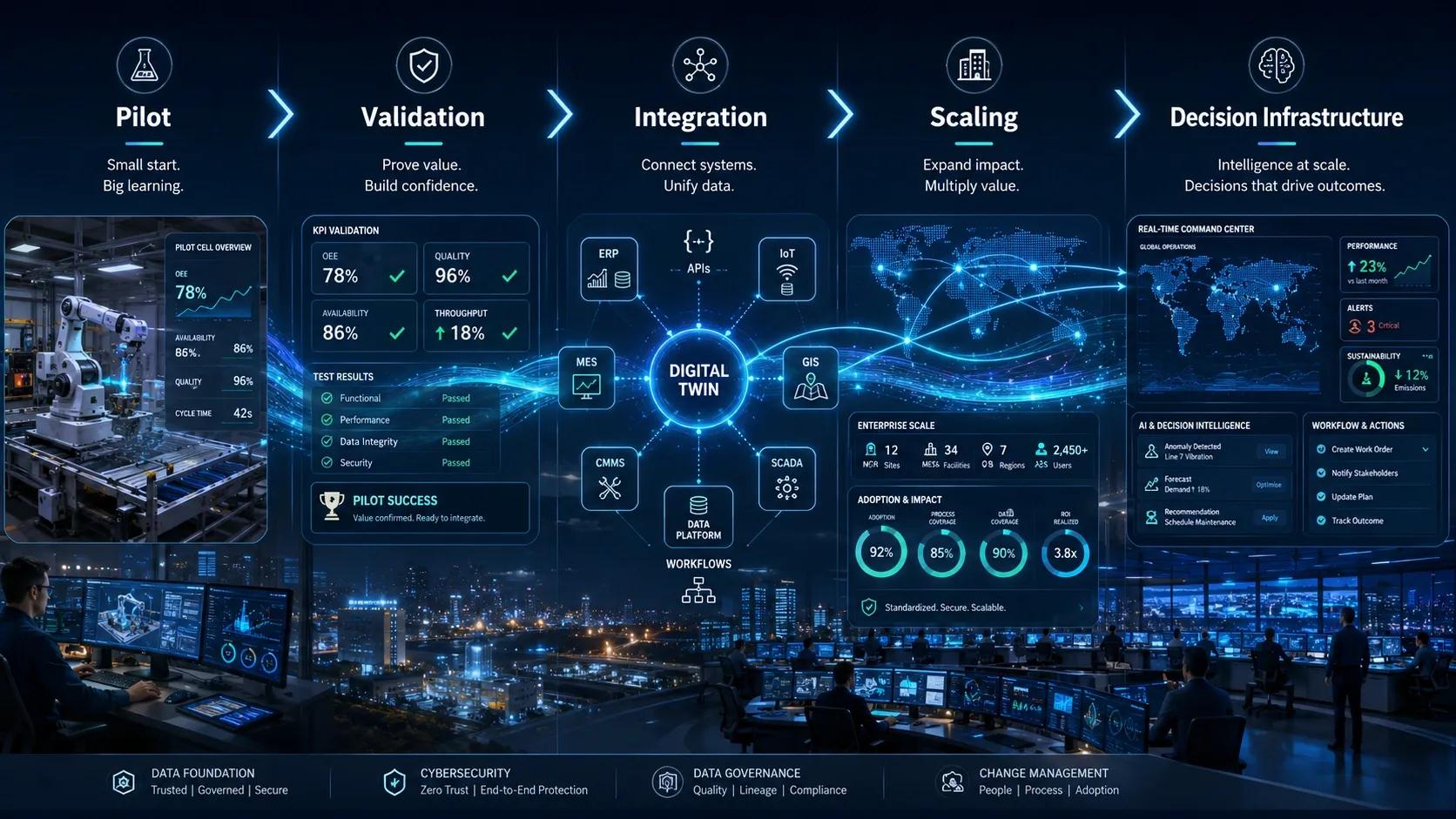
The Maturity Curve of Digital Twin Adoption
Stage 1: Innovation Pilot
Goal:
👉 prove the concept
Stage 2: Operational Validation
Goal:
👉 validate measurable outcomes
Stage 3: Workflow Integration
Goal:
👉 embed into operations
Stage 4: Enterprise Scaling
Goal:
👉 expand across systems and departments
Stage 5: Decision Infrastructure
Goal:
👉 become part of organizational intelligence
Most Projects Stall Between Stage 2 and Stage 3
Because this is where:
organizational resistance
operational complexity
governance gaps
become visible.
What Successful Scaling Actually Requires
1. Clear Operational KPIs
Not:
dashboard metrics
But:
measurable business outcomes
2. Executive Sponsorship
Scaling requires:
👉 strategic commitment
Not just innovation enthusiasm.
3. Continuous Optimization Teams
Scaled systems need:
ongoing tuning
KPI monitoring
operational adaptation
Optimization cannot remain project-based.
4. Cross-Department Integration
Digital Twins only scale when:
👉 silos are reduced.
5. Decision Integration
The system must influence:
👉 actual operational decisions.
Otherwise:
adoption remains superficial.
Ask Yourself
Is your Digital Twin:
👉 a demonstration system
Or
👉 an operational system?
Indian Context
Many Digital Twin initiatives in India remain:
pilot-driven
showcase-oriented
innovation-focused
The next wave of maturity will come when organizations focus on:
👉 operational embedding,
not just technology deployment.
That means:
KPIs
ownership
integration
governance
adoption
must become part of the strategy from Day 1.
Benefits of Scaling Successfully
operational consistency
enterprise-wide visibility
decision acceleration
measurable ROI
long-term resilience
Conclusion
Technology scaling is not the hardest part.
Operational adoption is.
The future winners will not be the organizations with:
the most pilots
the most dashboards
the most AI demos
But those that successfully transform:
👉 pilots into operational intelligence systems.