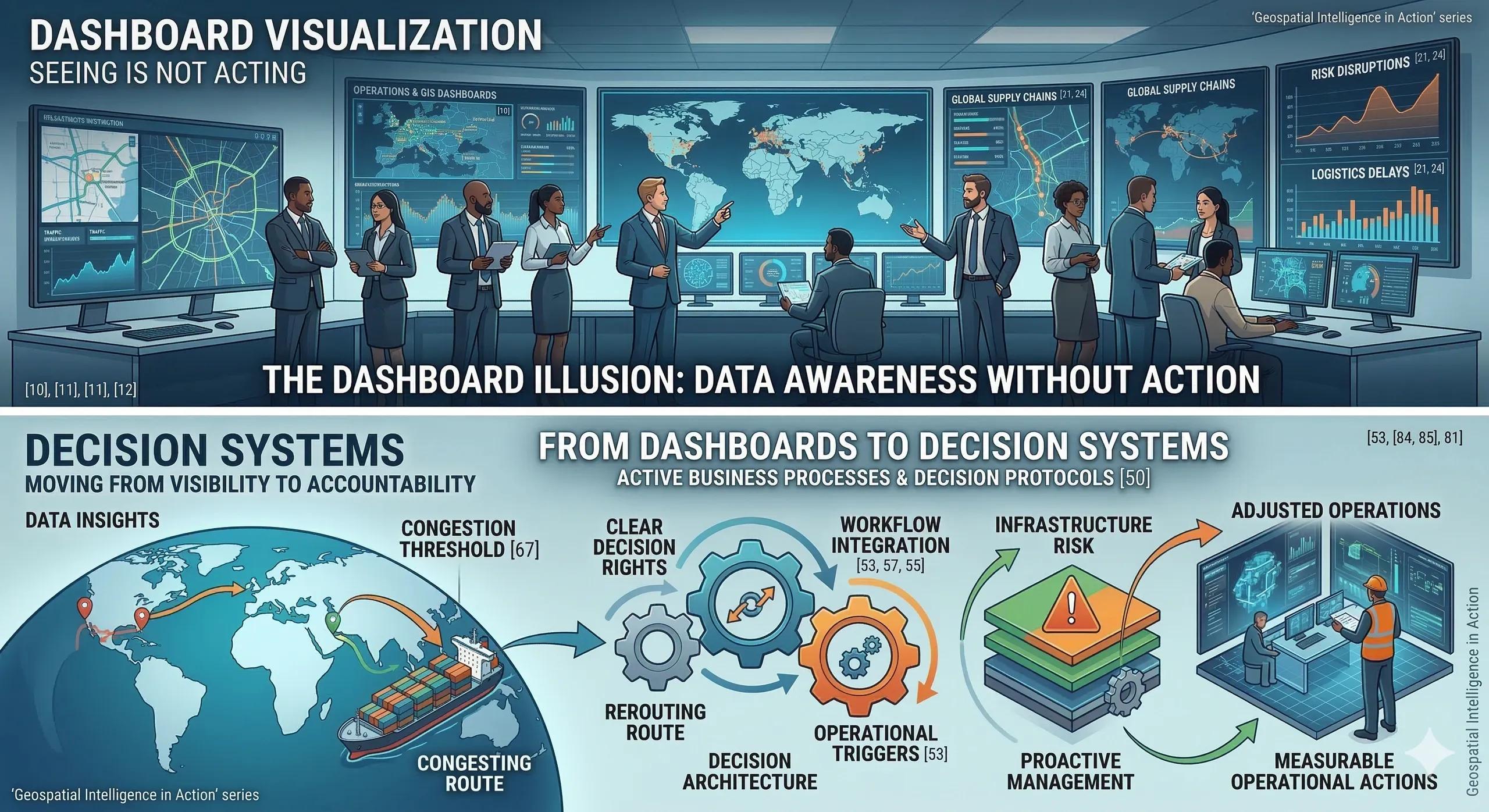
Seeing Is Not the Same as Acting
Over the past decade, organizations have invested heavily in dashboards.
Operations dashboards.
Risk dashboards.
Supply chain dashboards.
GIS dashboards.
Maps now display real-time infrastructure data.
Cities visualize traffic patterns.
Companies monitor global supply chains.
Yet a common pattern appears across many organizations.
The dashboard is viewed.
The decision is still made elsewhere.
Visibility improves, but the decision process often remains unchanged.
The Dashboard Illusion
Dashboards create the impression that an organization is “data-driven.”
But visualization alone does not guarantee better decisions.
A dashboard may show:
supply chain disruptions
infrastructure performance
climate exposure
logistics delays
However, if the organization lacks clear decision pathways, that information may remain observational rather than operational .
The result is data awareness without action .
Why Spatial Intelligence Often Stops at Visualization
Several organizational factors explain why spatial insights rarely translate into decisions.
1️⃣ Undefined Decision Ownership
If no one is accountable for acting on spatial insights, the information remains advisory.
Teams review the data but hesitate to take action.
2️⃣ Disconnected Decision Workflows
Many organizations operate through separate functional silos.
Operations teams analyze one set of metrics.
Finance evaluates another.
Risk teams monitor separate indicators.
Spatial insights often sit outside these workflows.
3️⃣ Lack of Trigger Thresholds
Even when dashboards highlight emerging risks, organizations often lack predefined thresholds that trigger action.
For example:
When should logistics routes be rerouted?
At what flood risk level should infrastructure operations change?
When should supply chains shift suppliers?
Without defined triggers, dashboards remain informational tools.
4️⃣ Legacy Decision Culture
In many organizations, leadership decisions still rely heavily on experience and intuition.
Data is consulted, but it rarely becomes the primary driver.
This cultural factor limits the operational influence of spatial intelligence.
Moving from Visualization to Decision Systems
For spatial intelligence to influence outcomes, organizations must build decision systems .
These systems define how insights translate into action.
Key components include:
Clear decision rights
Who is responsible for acting on spatial insights?
Operational triggers
Which thresholds require immediate response?
Workflow integration
Where do spatial insights enter operational and strategic decisions?
Escalation pathways
When should spatial risks reach executive leadership?
When these structures exist, spatial intelligence becomes part of the operating model , not just the analytics layer.
A Practical Example
Consider a logistics company monitoring global shipping routes.
A dashboard may show increasing congestion at a major port.
If the organization lacks decision protocols, teams may simply observe the congestion.
A decision-driven system would define:
a congestion threshold that triggers rerouting
alternative logistics corridors
operational authority for adjusting transport plans
In this case, spatial intelligence becomes actionable infrastructure .
Why Decision Systems Matter
Organizations that integrate spatial intelligence into decision workflows gain several advantages.
They can:
respond faster to disruptions
anticipate infrastructure vulnerabilities
optimize logistics routes
reduce operational uncertainty
The difference lies not in the data itself, but in how the organization acts on it .
The Monetization Bridge
As organizations recognize the limitations of dashboard-only analytics, many are adopting geospatial platforms and digital twin environments that integrate real-time spatial data with operational workflows. These systems connect analytics with decision protocols, enabling organizations to translate geographic insight into measurable operational actions.
Looking Ahead
In the next phase of digital transformation, the goal will not simply be better visualization.
The goal will be decision architecture .
Organizations that build decision systems around spatial intelligence will move from passive monitoring to proactive management.
Closing Insight
Dashboards help organizations see the world.
Decision systems help them act within it.
Spatial intelligence becomes powerful only when it moves from visibility to accountability .