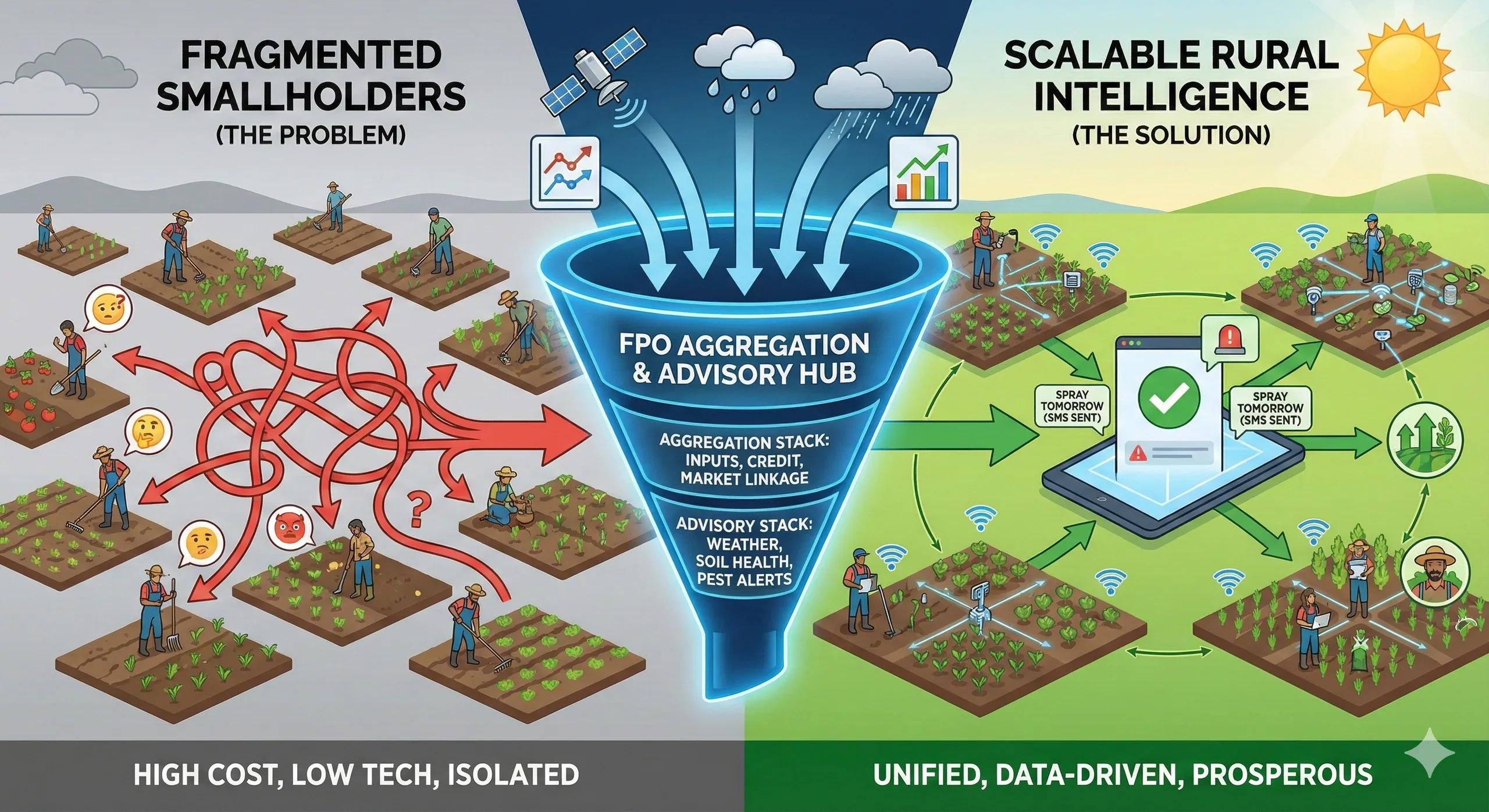
What if 1,000 farmers could access the same intelligence, bargaining power, and advisory precision as a single large enterprise farm?
Farmer Producer Organizations (FPOs) are India’s most strategic institutional layer for transforming smallholder agriculture.
They aggregate not just produce , but data, decisions, and digital services .
Yet most FPOs still operate with limited information, fragmented supply chains, and reactive advisories.
A geospatial-first FPO Playbook solves this by integrating land intelligence, crop analytics, market signals, and advisory workflows into a unified, farmer-facing operational system.
This article outlines the core operational stack that makes FPOs smarter, scalable, and sustainable.
1️⃣ FPOs as Data Aggregators, Not Just Market Aggregators
An FPO is a natural hub for collecting and organizing spatial information:
farm boundaries
crop patterns
sowing windows
irrigation sources
soil types
risk exposure (weather, pest, water)
demographic & socioeconomic layers
With geospatial mapping, an FPO knows: who grows what, where, when, and with what risk .
This becomes the foundation for advisory, input planning, and procurement strategies.
2️⃣ Cluster Intelligence, The Power of Spatial Aggregation
A single farm’s variability makes advisories noisy.
But aggregated across dozens or hundreds of farms, spatial intelligence becomes extremely powerful.
FPO cluster layers include:
dominant crop signatures
moisture & stress maps
high-risk zones (erosion, drought, flood)
productivity clusters
soil carbon profiles
pest hotspots (NDVI deviations)
Cluster-level intelligence helps FPOs move from: generic advisories → location-specific, time-specific recommendations.
3️⃣ Advisory Stack, A Multi-Layer Engine
The FPO advisory stack integrates five key layers:
A. Weather + Risk Layer
IMD alerts
rainfall forecasts
heat/cold extreme windows
wind, humidity, VPD
Used for: spray advisories, irrigation timing, harvest planning.
B. Crop Intelligence Layer
NDVI time-series
SAR moisture signatures
phenology stage detection
sowing/harvest detection
crop stage-based advisories
Supports: nutrient scheduling, stress alerts, pest scouting.
C. Soil Intelligence Layer
soil type
pH, EC, SOC, micronutrients
erodibility
moisture holding capacity
Used for: variable-rate recommendations and long-term soil management.
D. Input Optimization Layer
seed advisories
fertilizer blends
irrigation hours
chemical recommendations
cost-benefit modeling
This is the core of profitability enhancement for member farmers.
E. Market Intelligence Layer
mandi trends
arrival-volume patterns
MSP signals
procurement potential
storage/aggregation strategies
FPOs can negotiate better terms when they know projected yield + market timing.
4️⃣ Digital Advisory Pipelines (Push + Pull)
A modern FPO uses automated pipelines:
Push Alerts
“Irrigate in next 48 hours.”
“Window for spraying is safe till 4 PM tomorrow.”
“Moisture deficit rising in Zone 3 plots.”
“Harvest advisory: humidity drop expected.”
Pull Queries
Farmers request:
soil reports
crop stage predictions
rainfall outlook
pest risk scores
input recommendations
Advisory becomes two-way and data-driven .
5️⃣ Aggregation Playbook, From Field to Market
FPOs operate as supply-chain nodes.
A geospatial-first model strengthens every step.
A. Production Forecasting
Yield models (RS + IoT + weather) predict:
total expected output
variety-specific volumes
harvest windows
This improves buyer negotiations and logistics planning.
B. Input Planning
Cluster zoning enables:
bulk seed procurement
fertilizer optimization
shared machinery allocation
irrigation schedules
Cost reductions of 10–30% are common.
C. Quality Assurance
With spatially tagged plots:
traceability
pesticide compliance
GAP adherence
premium market readiness
FPOs become reliable suppliers for processors and exporters.
D. Carbon & Sustainability Programs
FPOs are ideal for:
carbon farming MRV
regenerative practice adoption
agroforestry pilots
SOC improvement programs
Aggregation allows credit distribution based on field-level performance.
6️⃣ GeoAI for FPOs, The Multiplier
AI unlocks value across the advisory stack:
A. Crop-Stage Models
Daily crop stage detection for each parcel.
B. Stress Anomaly Detection
When NDVI drops unexpectedly → alert.
C. Pest/Disease Risk Estimation
Based on weather + canopy signatures.
D. Yield Forecasting
Fusion-based pipelines (Day 54).
E. Cluster Health Scores
Combine soil, moisture, crop, and weather layers into a single score.
F. Procurement Optimization
Predict which villages will harvest earlier and plan logistics.
AI becomes the “decision engine” behind the FPO.
7️⃣ India: FPOs as Digital Agriculture Hubs
With 10,000+ FPOs supported under the central scheme, India’s agricultural digitalization depends on:
spatial mapping of member farms
unified advisory dashboards
crop & soil digital twins
financial inclusion tools
sustainability tracking
market linkage engines
The future of FPOs is not analog.
It is geospatial, digital, and intelligence-driven .
8️⃣ The FPO Digital Twin
A fully developed FPO Digital Twin contains:
all member farm boundaries
soil + crop layers
risk layers (drought, flood, heat)
yield projections
procurement potential
input demand
carbon baseline
market opportunities
It becomes an operations nerve center , helping FPOs run like data-driven cooperatives.
Conclusion
FPOs are the backbone of rural transformation, but only if equipped with the right intelligence stack.
Aggregation gives them scale.
Advisory stacks give them precision.
Digital twins give them foresight.
A smart FPO is not a collective of farmers, it is a collective of data-enabled decisions .