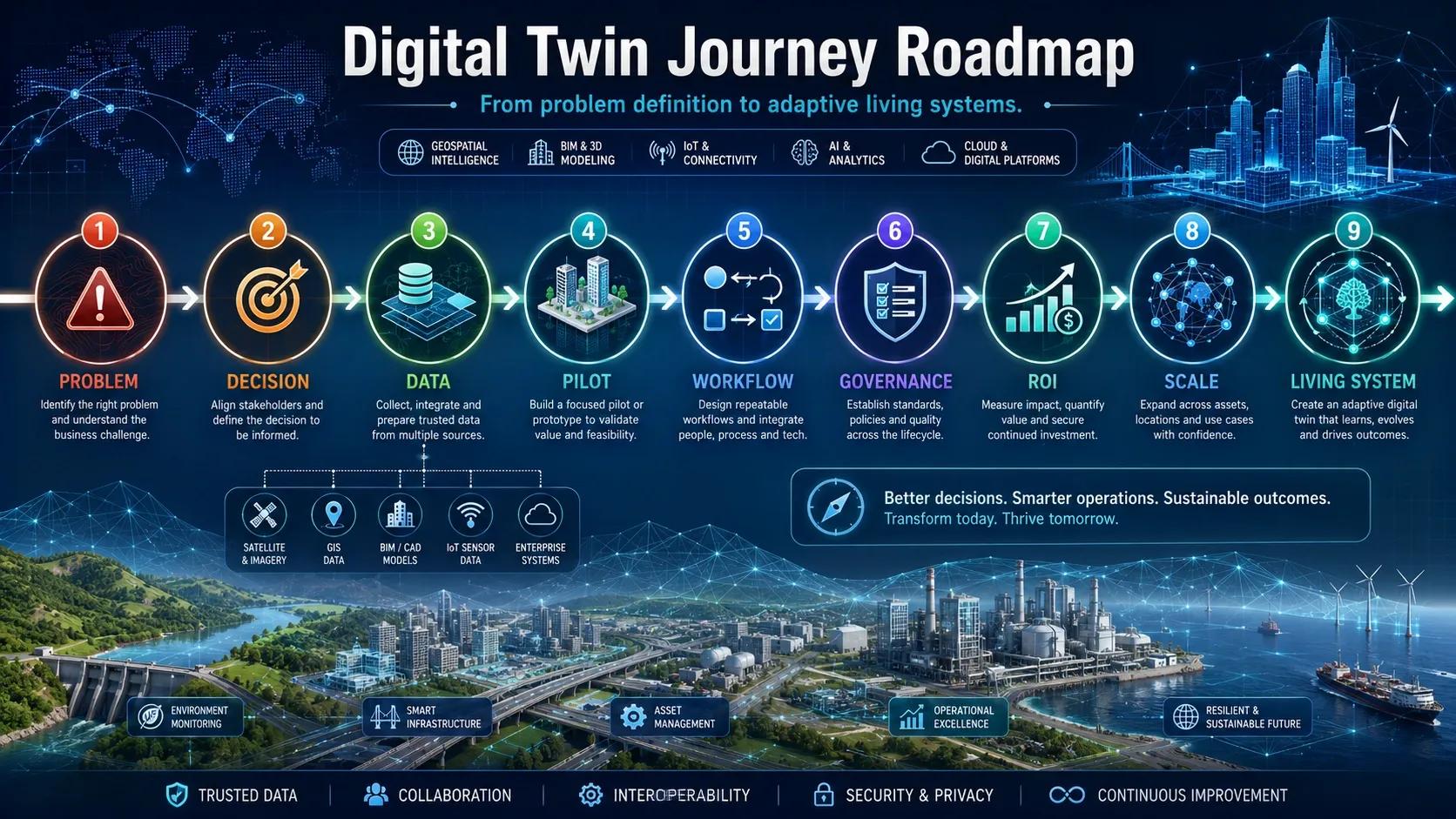
A Digital Twin journey should not begin with the question:
“Which platform should we buy?”
It should begin with a more practical question:
“Which decision do we want to improve?”
Introduction: The End of the Series, Beginning of the Journey
Over the last 59 days, we explored Digital Twins from multiple angles:
concepts and fundamentals
BIM, GIS, IoT, AI, XR, and GeoAI
sector-specific applications
ROI and KPIs
governance and data privacy
organizational readiness
the future of living systems
Now, on Day 60 , the goal is to bring everything together into a practical roadmap.
Because after all the discussion, one thing becomes clear:
A Digital Twin is not just a 3D model.
It is not just a dashboard.
It is not just IoT data.
It is not just AI.
It is not just visualization.
A Digital Twin is a decision system that connects the physical world with data, intelligence, workflows, and action.
But many organizations still struggle with where to begin.
Should they start with BIM?
Should they start with GIS?
Should they start with IoT?
Should they start with AI?
Should they start with a full platform?
Should they begin with one pilot?
The answer is simple:
Start small, but start correctly.
The Core Principle: Decision First, Technology Second
The biggest mistake in Digital Twin adoption is starting with technology before defining the decision.
Organizations often say:
👉 We need a Digital Twin.
👉 We need a 3D dashboard.
👉 We need IoT integration.
👉 We need AI analytics.
But they do not always define:
👉 Which operational decision will improve?
👉 Who will use the insight?
👉 What action will follow?
👉 What business value will be created?
👉 How will success be measured?
A Digital Twin should not be built for display.
It should be built for decision impact.
So the first step in the journey is not platform selection.
The first step is decision identification.
Step 1: Identify the Business Problem
Start by identifying a real business or operational problem.
Examples:
high maintenance cost
frequent equipment failures
poor asset visibility
delayed inspections
weak disaster preparedness
inefficient energy usage
poor logistics coordination
lack of infrastructure monitoring
fragmented project data
slow decision-making
compliance reporting challenges
safety risk in field operations
The problem should be specific.
Instead of saying:
👉 “We want a smart city Digital Twin.”
Say:
👉 “We want to reduce flood response time in vulnerable urban zones.”
Instead of saying:
👉 “We want a factory Digital Twin.”
Say:
👉 “We want to reduce unplanned downtime in critical production lines.”
Specific problems create measurable Digital Twin projects.
Step 2: Define the Decision to Improve
Every Digital Twin use case should be connected to a decision.
For example:
Problem - Decision to Improve
Frequent asset failures - Which asset should be inspected first?
Flood risk - Which areas need early warning and response?
Energy waste - Which systems should be optimized?
Road damage - Which road segment should be repaired first?
Warehouse delays - Which bottleneck is affecting movement?
Poor healthcare access - Where should new facilities be planned?
Construction delay - Which activity is creating schedule risk?
This is where Digital Twin planning becomes practical.
The organization moves from:
👉 “What can we visualize?”
to
👉 “What decision can we improve?”
That shift determines ROI.
Step 3: Map the Required Data
Once the decision is clear, identify the data required to support it.
A Digital Twin may require:
BIM models
GIS layers
IoT sensor data
satellite imagery
drone data
LiDAR or point cloud data
ERP data
CMMS data
SCADA data
field inspection records
maintenance history
weather data
demographic data
mobility data
environmental data
But not every use case needs every dataset.
The goal is not to collect maximum data.
The goal is to collect the right data.
For example, a flood management Twin may need rainfall forecast, terrain model, drainage network, river levels, land use, population exposure, and road accessibility.
A factory asset Twin may need machine data, maintenance history, production load, quality records, operator alerts, and spare parts availability.
Data should follow the decision.
Step 4: Assess Data Readiness
Before building the Twin, check whether the required data is reliable.
Ask:
Is the data available?
Is it accurate?
Is it updated?
Who owns it?
Can it be accessed?
Is it in usable format?
Does it have location reference?
Does it have time stamps?
Can it be integrated with other systems?
Are privacy and security controls required?
This step is critical.
A Digital Twin built on poor data will produce poor decisions.
Data readiness is not a technical formality.
It is the foundation of trust.
Step 5: Choose the Right Pilot
Do not begin with the most complex use case.
Begin with the most valuable and achievable use case.
A good pilot should have:
a clear problem
measurable outcomes
available data
committed users
manageable scope
business relevance
potential to scale
Examples of strong pilots:
predictive maintenance for one asset class
flood risk dashboard for one urban zone
energy optimization for one campus
road condition monitoring for one corridor
warehouse movement visibility for one facility
construction progress monitoring for one project
utility outage prediction for one network segment
The purpose of the pilot is not to prove that Digital Twin technology exists.
The purpose is to prove that the Twin can improve a real decision.
Step 6: Build the Minimum Viable Digital Twin
Start with a Minimum Viable Digital Twin.
This means building only what is necessary to support the first use case.
A Minimum Viable Digital Twin may include:
one asset category
one geography
one operational workflow
limited but reliable data layers
basic visualization
simple analytics
clear alerts
defined user roles
measurable KPIs
This avoids over-engineering.
The Twin should grow with learning.
Do not try to build the entire enterprise Twin on day one.
Build one useful Twin first.
Then expand.
Step 7: Connect Insights to Workflows
A Digital Twin creates value only when insights lead to action.
If the system detects risk, what happens next?
Does it generate a work order?
Does it alert a field team?
Does it notify a supervisor?
Does it update a maintenance plan?
Does it trigger an inspection?
Does it recommend a route?
Does it escalate a compliance issue?
Without workflow integration, the Digital Twin becomes another dashboard.
The roadmap must include action pathways.
Every alert should have an owner.
Every insight should have a next step.
Every recommendation should connect to a decision process.
Step 8: Define Governance and Privacy Rules
As soon as a Digital Twin starts using real-world data, governance becomes necessary.
This includes:
data ownership
access control
privacy compliance
cybersecurity
model validation
audit logs
consent or notice where required
data retention policies
source reliability
update responsibility
AI accountability
For GeoAI-powered Twins, governance also includes geospatial data sensitivity, licensing, accuracy, and sharing permissions.
For worker or citizen movement data, governance becomes even more important.
The rule is simple:
If the Twin influences decisions, it must be trusted.
If it uses sensitive data, it must be governed.
Step 9: Measure ROI from the Beginning
Digital Twin ROI should not be calculated only at the end.
It should be designed into the project from the start.
Define success metrics such as:
downtime reduction
inspection time reduction
faster response time
fewer failures
reduced energy consumption
improved asset utilization
reduced rework
better compliance reporting
improved safety
faster decision-making
lower maintenance cost
improved service coverage
Also track decision-related metrics:
time to detect
time to decide
time to act
decision accuracy
avoided incidents
workflow closure rate
user adoption
ROI is not only financial.
It can also include resilience, safety, compliance, sustainability, and public service impact.
Step 10: Scale with Architecture, Not Just Ambition
Scaling a Digital Twin requires more than expanding the pilot.
It requires architecture.
The organization should define:
reusable data models
integration standards
API strategy
governance framework
security architecture
user management
cloud or on-premise strategy
data update processes
analytics pipeline
enterprise system integration
change management approach
support and maintenance model
Many pilots fail to scale because they were built as isolated experiments.
A scalable Digital Twin should be designed as part of a broader enterprise or ecosystem architecture.
Step 11: Build Organizational Capability
Technology alone is not enough.
Organizations need capability across:
leadership
data management
GIS
BIM
IoT
AI and analytics
cybersecurity
operations
maintenance
finance
governance
field teams
change management
A Digital Twin is cross-functional by nature.
It cannot be owned only by IT.
It cannot be owned only by operations.
It cannot be owned only by innovation teams.
It must become a shared organizational capability.
Step 12: Move Toward Continuous Improvement
A Digital Twin journey does not end at go-live.
That is where the real journey begins.
After implementation, organizations should continuously ask:
Is the Twin still accurate?
Are users adopting it?
Are decisions improving?
Are workflows closing faster?
Are models learning from feedback?
Are data pipelines reliable?
Are governance rules working?
Are new use cases emerging?
Is ROI being tracked?
A mature Digital Twin should evolve over time.
It should move from visualization to monitoring, prediction, prescription, and eventually adaptive intelligence.
This is the journey from Digital Twin to living system.
A Practical 90-Day Starting Roadmap
For organizations beginning today, a practical 90-day roadmap can look like this:
First 30 Days: Discover and Define
identify business problem
define decision to improve
map stakeholders
assess available data
evaluate current workflows
identify risks and constraints
define pilot scope
agree on KPIs
Next 30 Days: Design and Build
prepare data layers
build minimum viable Twin
integrate key systems
configure dashboards and alerts
define roles and access
establish governance rules
test workflows with users
Final 30 Days: Validate and Scale Plan
run pilot with real users
measure decision improvement
capture feedback
refine models and workflows
document ROI
identify scale opportunities
prepare next-phase roadmap
This 90-day approach keeps the project practical.
It allows the organization to learn quickly, reduce risk, and build confidence before scaling.
Indian Context
India has strong potential to adopt Digital Twins across infrastructure, cities, utilities, logistics, agriculture, manufacturing, healthcare, and disaster management.
But the journey must be practical.
Many Indian organizations already have pieces of the puzzle:
GIS data
BIM models
IoT systems
ERP platforms
SCADA systems
satellite data
field surveys
mobile apps
public datasets
operational records
The opportunity is to connect these pieces into decision systems.
For India, Digital Twin adoption should focus on:
measurable use cases
trusted spatial data
cost-effective pilots
open and interoperable architecture
governance from the beginning
workflow integration
capacity building
scalable implementation models
The goal should not be to build Digital Twins for presentation.
The goal should be to build Digital Twins that improve infrastructure, resilience, productivity, safety, sustainability, and public service delivery.
Final Synthesis of the 60-Day Series
Across this series, the message has remained consistent:
A Digital Twin is not a technology trend.
It is a new way of connecting the physical and digital world for better decisions.
It brings together:
👉 BIM for asset intelligence
👉 GIS for spatial context
👉 IoT for real-time sensing
👉 AI for prediction
👉 GeoAI for location-based intelligence
👉 XR for interaction
👉 workflows for action
👉 governance for trust
👉 ROI metrics for value
👉 organizational readiness for scale
The journey begins with one problem.
It grows through one decision.
It scales through architecture, governance, and adoption.
And it matures into living systems that continuously learn from reality.
Conclusion
The Digital Twin journey does not require every organization to start big.
But it does require every organization to start right.
Start with a real problem.
Define the decision.
Map the data.
Build a focused pilot.
Connect insights to workflows.
Measure value.
Govern responsibly.
Scale with architecture.
Improve continuously.
That is the roadmap.
The future belongs to organizations that do not simply digitize assets, but build intelligence around them.
The question is no longer:
👉 Should we explore Digital Twins?
The question is:
👉 Which decision should we improve first?
That is where the Digital Twin journey truly begins.