Most construction errors aren’t caused by bad intent.
They’re caused by misalignment between what was designed and what was built , noticed too late.
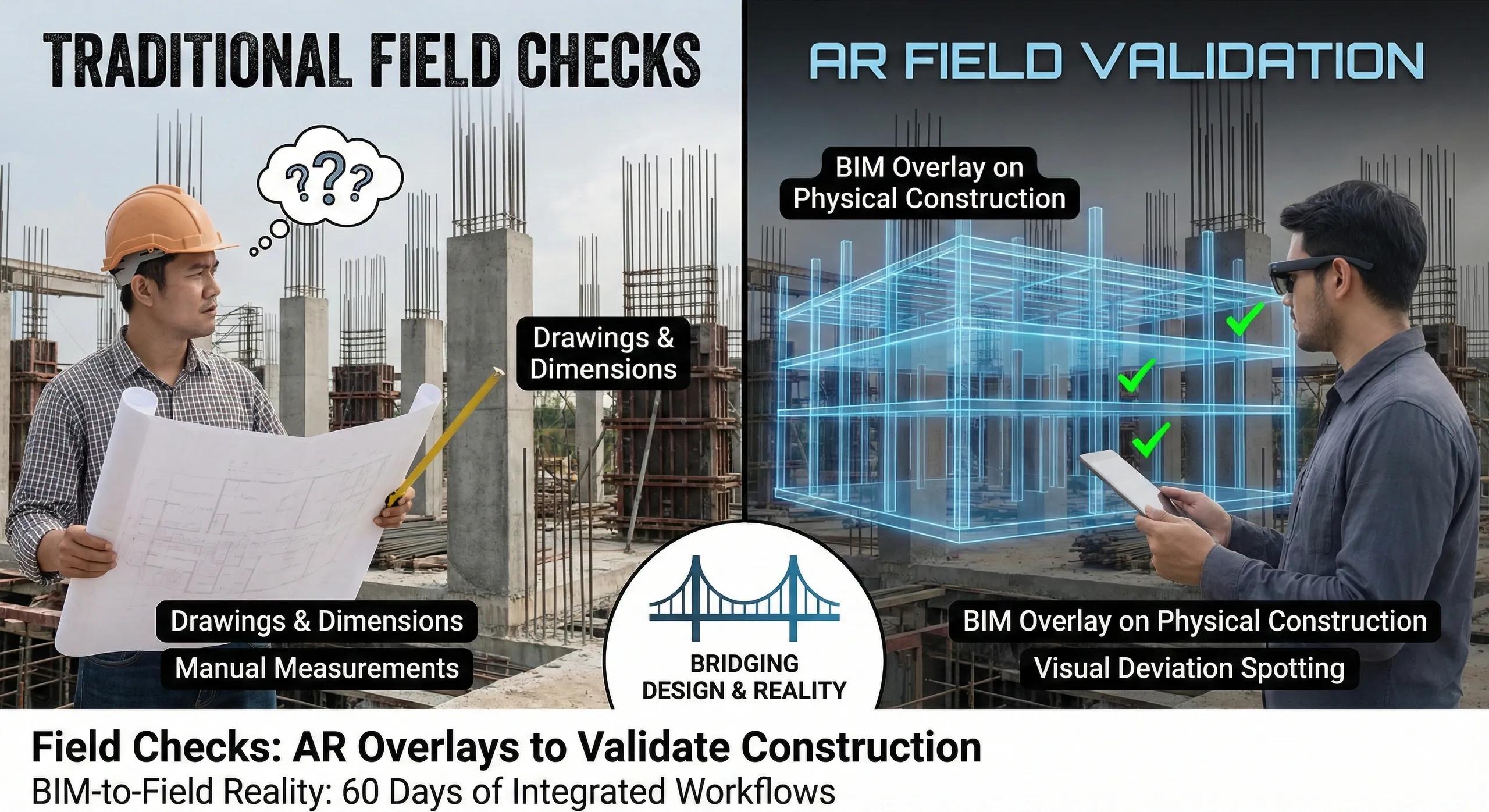
Traditionally, field checks rely on:
Drawings and dimensions
Manual measurements
Interpretation and experience
Augmented Reality (AR) changes this by allowing teams to see the design in the real world, at the real location, before it becomes permanent .
1. Why Traditional Field Checks Fall Short
Conventional checks struggle because:
Drawings require interpretation
Dimensions don’t reveal spatial conflicts
Errors surface after installation
By the time something “looks wrong,” it’s already expensive.
2. What AR Field Validation Really Is
AR validation is not visualization for demos.
It enables:
Overlaying BIM models on physical construction
Comparing design intent with actual placement
Spotting deviations visually, not numerically
It answers one critical question instantly:
Does this match what was designed, right here, right now?
3. Where AR Adds Immediate Value
AR overlays work best for:
Structural element positioning
MEP routing and clearances
Embed and opening verification
Equipment placement checks
Access and maintenance zones
These are areas where small errors create big downstream problems.
4. Accuracy vs Usability Trade-off
AR is not a replacement for survey-grade verification.
Its strength is:
Fast visual confirmation
Early detection of gross deviations
Improved confidence before installation
AR complements precision tools, it doesn’t replace them.
5. Spatial Alignment Is the Foundation
AR works only if:
Models are correctly georeferenced
Site control points are reliable
Device tracking is stable
Without spatial discipline, AR becomes misleading rather than helpful.
6. Why AR Changes Site Conversations
Instead of debating:
“I think this is off by 50 mm”
Teams can see:
The intended position
The actual construction
The gap, clearly
This reduces argument and accelerates decisions.
7. India Context: Practical Advantages
On Indian sites:
Skill levels vary
Language barriers exist
Time pressure is constant
AR:
Reduces dependency on drawings
Improves shared understanding
Helps supervisors validate work quickly
Visual truth scales better than verbal explanation.
8. Common Pitfalls to Avoid
AR fails when:
Models are outdated
Alignment is ignored
Expectations of millimeter accuracy are set
It’s used as a novelty, not a workflow
AR must be embedded into field routines , not showcased occasionally.
9. AR as a Preventive Tool
The real value of AR is not correction, it’s prevention .
When teams check before building:
Rework drops
Confidence increases
Quality stabilizes
Problems are avoided instead of managed.
10. A Simple AR Rule
If you can’t visually validate it before construction, you’ll probably fix it after.
Conclusion
AR overlays turn BIM into a field verification assistant .
They:
Bridge design and reality
Surface errors early
Improve site communication
Reduce rework and delay
AR doesn’t replace experience.
It amplifies it, at the right moment .