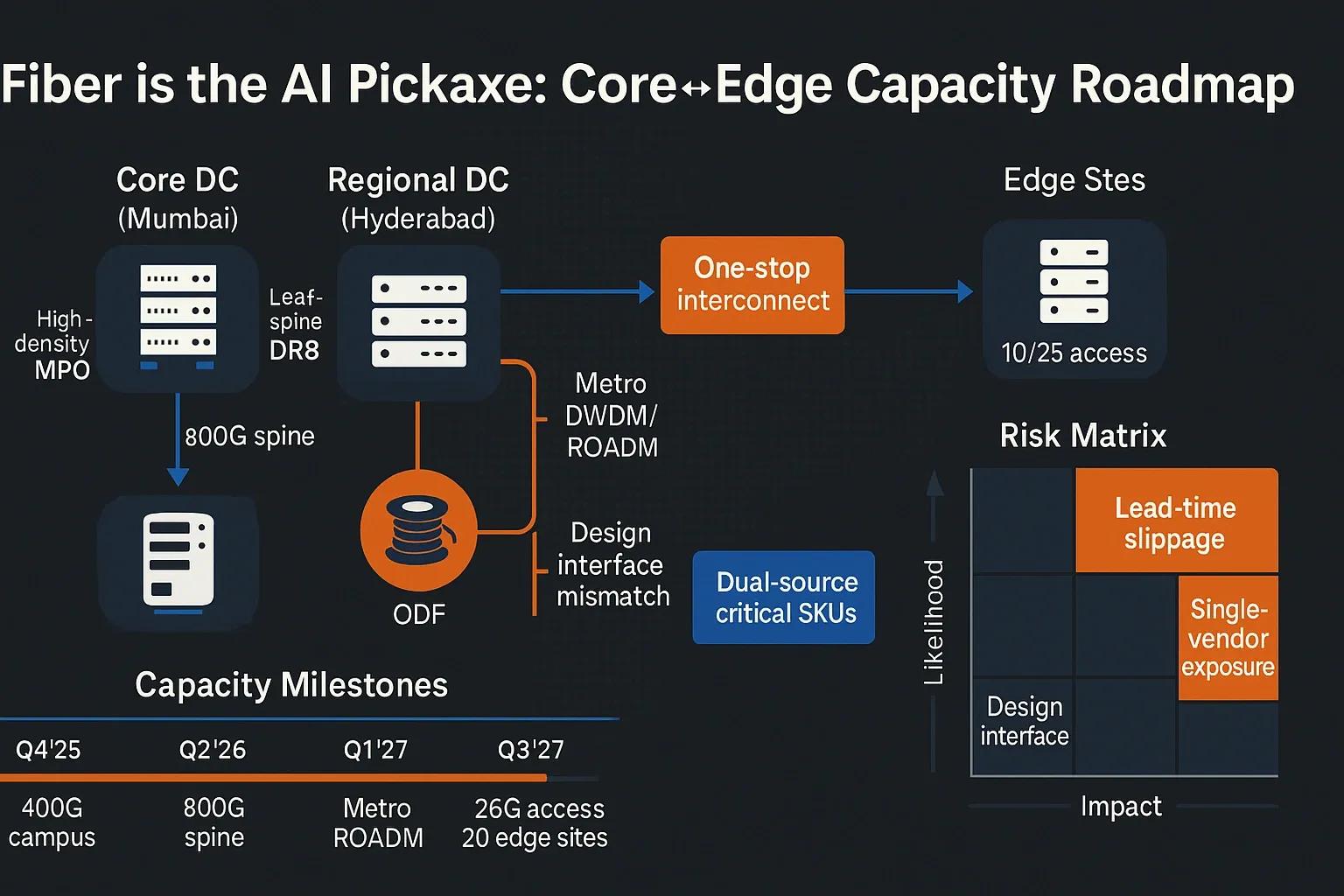
Amphenol’s $10.5B purchase of CommScope’s Connectivity & Cable Solutions (CCS) business is the clearest signal yet: fiber interconnect is the pickaxe of the AI gold rush. When interconnect consolidates, bill-of-materials (BOMs), delivery risk, and campus/DC designs shift, especially in India, where 5G backhaul fiberization and a record data-center pipeline are running in parallel.
1) The deal in one line, and why it matters
What happened: Amphenol agreed to acquire CommScope’s CCS unit (fiber & copper cabling, connectivity, and telecom infrastructure) for ~$10.5B; closing expected in H1 2026. It follows CommScope’s Feb 3, 2025 sale of its Outdoor Wireless Networks (OWN) + DAS businesses to Amphenol.
Why it matters: Interconnect breadth + scale under one umbrella can simplify sourcing for hyperscale, colocation, and telco rollouts, from high-density MPO trunks in data centers to fiber-rich backhaul at towers.
2) Fiber is the AI pickaxe
AI edge build-outs drive explosive growth in 400G/800G leaf-spine, high-density MPO, and metro DWDM rings to move hot and warm data between core DCs, regional DCs, and edge POPs. A tighter Amphenol portfolio post-acquisition could mean:
SKU simplification across connectors, cassettes, trunks, and ODFs.
Tighter interoperability from campus to metro (fewer vendor interfaces to validate).
Supply leverage during long-lead fiber and connector cycles.
3) India context: DC growth + fiberization push
Data centers: India is on track to add ~795 MW of capacity by 2027, taking total capacity to ~1.8 GW, a 77% surge driven by AI and cloud. This is capex-heavy in both power and interconnect.
Backhaul fiberization: As of March 2025, 46.09% of base stations are fiberized, good progress, but still short of what dense 5G/edge needs.
NBM 2.0 + BharatNet: The Government launched National Broadband Mission (NBM) 2.0 in Jan 2025 to accelerate universal high-speed access; by Mar 2025, India had 42.13 lakh route-km of OFC and 2,18,347 Gram Panchayats service-ready under BharatNet. These programs expand the dark-fiber and RoW backbone that AI workloads will lean on.
4) What changes for buyers (DCs, campuses, telcos)
Upsides
One-stop interconnect : easier BOMs from ODF to trunks to panels.
Fewer interface mismatches : reduced field-fit issues at scale.
Better leverage : price + delivery windows when scaling multiple regions.
Watch-outs
Single-vendor exposure : consider dual-source for critical SKUs.
Lead-time concentration : large orders can elongate queues during surges.
Backward compatibility : verify connector standards (MPO-12 vs MPO-16, SR4 vs DR8 optics, bend-insensitive specs).
“Would you consolidate to one interconnect vendor for speed, or keep multi-vendor for resilience?”
5) Playbook for data-center mapping & campus upgrades
A. Map first, then buy
Geospatial DC-to-edge map: Plot core DCs, regional DCs, and top-20 edge sites; overlay existing ducts, OPGW routes, and leased dark-fiber options.
Capacity waypoints: Q4’25 400G campus, Q2’26 800G spine, Q1’27 metro ROADM ring, tie each to ODF density and cross-connect counts.
Rights-of-Way (RoW): Lock permissions early; piggyback on NBM 2.0 corridors where viable.
B. Campus bill-of-materials tips
Standardize high-density MPO trunks, factory-tested.
Use bend-insensitive fiber in tight trays, and pre-terminated cassettes for speed.
Reserve panels for future 800G/1.6T optics; validate polarity.
Document OTDR baselines per segment before turn-up.
C. Telco rollout accelerators
Prioritize tower-cluster fiberization near data-center regions.
Leverage OPGW on power corridors for hard geographies.
Use metro ROADM to add/re-route edge capacity without truck rolls.
6) Use case (illustrative): Mumbai core ↔ Hyderabad regional ↔ tier-2 edge
Objective: Serve low-latency inference to Western + Southern India while keeping egress costs predictable.
Design: Core DC (Mumbai): Leaf-spine 800G-ready , dual ODF rows, metro dark-fiber ring. Regional DC (Hyderabad): 400G SR8 campus upgrade; high-density MPO trunks. Edge POPs (Nagpur, Surat, Coimbatore): 10/25G access , 100G backhaul; local caching.
Milestones: Q4’25 400G campus; Q2’26 800G spine; Q1’27 ROADM; Q3’27 25G access at top-20 edge sites.
Risk controls: Dual-source top 10 SKUs; pre-book long-lead fiber; pre-integrate cassettes/panels; OTDR + QA gates.
7) Benefits & ROI (what to expect)
Faster time-to-turn-up: Pre-terminated MPO + unified catalog cuts install time by 20–30% (typical field experience).
Lower rework: Fewer connector types and polarity errors.
Capacity you can plan: Defined quarter-by-quarter interconnect milestones that align with GPU rack landings.
Resilience: Multi-path metro rings + edge-site diversity reduce localized outage impact.
8) Bottom line
GPUs get headlines; fiber gets AI to users. The Amphenol–CommScope move concentrates interconnect capability just when India needs it, during a simultaneous surge in data-center builds and 5G fiberization. Use this window to harden your campus/DC designs, lock long-lead interconnect, and map a core-to-edge topology you can grow for the next five years.
Citations (key facts)
Amphenol to acquire CommScope CCS for ~$10.5B; expected close H1 2026 ; prior OWN/DAS sale closed Feb 3, 2025 .
DC growth in India to ~1.8 GW by 2027 ; +795 MW added.
46.09% of BTSs fiberized (Mar 2025).
NBM 2.0 launched Jan 17, 2025 ; BharatNet/OFC progress (Mar 2025).