Most facilities inherit BIM models…
and then stop using them.
Not because BIM lacks value but because operations don’t work in drawings . They work in dashboards, alerts, and tasks. Facility Management (FM) dashboards built from BIM data are what convert design intelligence into operational control .
1. Why BIM Often Dies After Handover
BIM adoption collapses in operations because:
Models are heavy and complex
Information is hard to retrieve
FM teams need status, not geometry
Data lives across multiple systems
The problem isn’t BIM; it’s how BIM is exposed to operations .
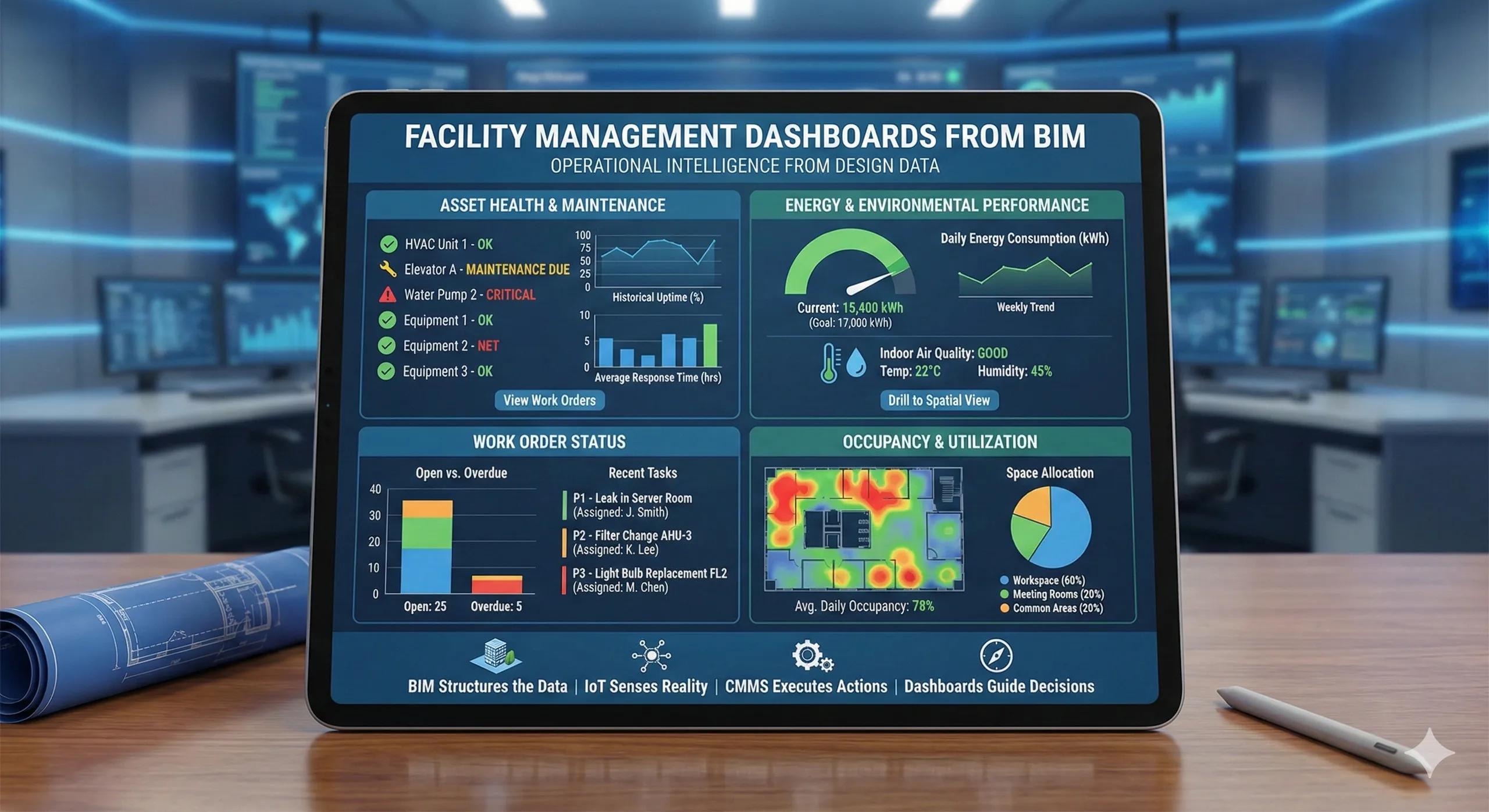
2. What an FM Dashboard Really Is
An FM dashboard is not a 3D viewer.
It is a decision surface that:
Aggregates asset, sensor, and work-order data
Shows system health and priorities
Links back to spatial context only when needed
BIM provides structure. Dashboards provide clarity.
3. What BIM Contributes to FM Dashboards
When BIM is the backbone:
Assets are spatially located
Systems are logically grouped
Dependencies are visible
Changes are traceable
Dashboards stop being abstract spreadsheets and become context-aware control panels .
4. Core Dashboard Views That Matter
Effective FM dashboards typically include:
Asset health and maintenance status
Open vs overdue work orders
Energy and environmental performance
Occupancy and utilization
Compliance and inspection status
The key is role-based views , not one screen for everyone.
5. Geometry on Demand, Not Always On
Operations don’t need constant 3D.
Best practice:
Default to KPIs and alerts
Drill down to BIM only when investigating
Use geometry to explain not overwhelm
This keeps dashboards fast and usable.
6. Integration with CMMS / CAFM Systems
BIM dashboards succeed when:
Work orders sync with CMMS
Asset IDs are consistent
Sensor data feeds live status
Changes reflect back into the model
BIM becomes the system of record , not the system of work.
7. India Context: Practical Value
In Indian facilities:
Asset documentation varies widely
FM teams manage large portfolios
Cost and uptime sensitivity is high
Dashboard-driven FM:
Improves response time
Reduces dependence on individuals
Supports data-backed decisions
8. Common Mistakes to Avoid
FM dashboards fail when:
They mirror design views
Data ownership is unclear
Asset tagging is inconsistent
Too much detail is shown
Operations value signal over completeness .
9. Dashboards as the Face of the Digital Twin
For most users:
The dashboard is the digital twin
If dashboards are slow, confusing, or untrusted, the twin fails—regardless of how good the model is.
10. A Simple FM Dashboard Rule
If a facilities manager can’t answer “what needs attention today” in 30 seconds, the dashboard isn’t working.
Conclusion
Facility Management dashboards are where BIM finally becomes operational intelligence .
When done right:
BIM structures the data
IoT senses reality
CMMS executes actions
Dashboards guide decisions
BIM doesn’t need to be everywhere in FM.
It just needs to be exactly where decisions are made .