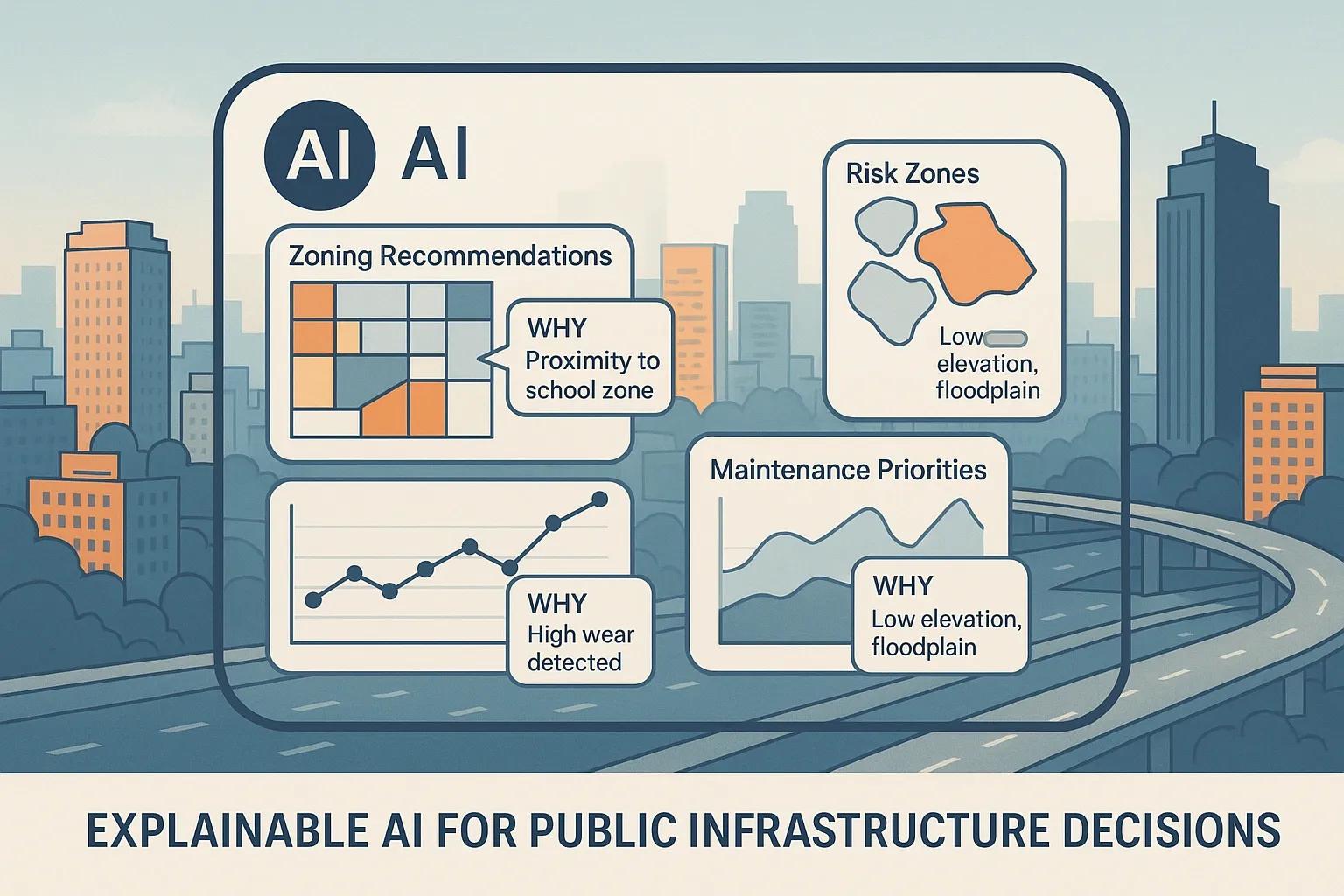
Artificial Intelligence (AI) is increasingly being integrated into public infrastructure planning, design, operation, and maintenance. From optimizing traffic signals and managing water distribution to predicting road maintenance needs and guiding urban development, AI has become a crucial decision-making tool for governments. However, as these systems grow more complex, the "black-box" nature of many AI models creates concerns around transparency, accountability, and trust, especially in public-sector applications where decisions affect millions of citizens.
Enter Explainable AI (XAI), a subfield of AI that seeks to make the behavior and decisions of complex algorithms understandable to human users. This article explores the role of XAI in public infrastructure projects, why it matters for government use, and how to design AI systems that are both high-performing and transparent.
Why Transparency Matters in Public Infrastructure AI
Governments operate under public scrutiny and are accountable for how they allocate resources and make infrastructure decisions. When AI systems are used to:
Prioritize road repairs,
Allocate public housing,
Manage disaster response logistics, or
Optimize energy distribution,
...stakeholders, including citizens, auditors, and policymakers, need to understand how and why certain decisions were made. Lack of transparency can lead to:
Legal challenges if decisions appear discriminatory or arbitrary.
Public distrust if AI is perceived as opaque or biased.
Operational risks if government staff cannot diagnose or explain system outputs.
Reduced adoption of AI technologies in sensitive domains due to fear of unpredictability.
Thus, explainability is not optional. It is essential for compliance with regulations, stakeholder trust, and long-term success of AI applications in the public domain.
What Is Explainable AI (XAI)?
Explainable AI refers to methods and techniques that make the outputs of AI systems understandable to humans without requiring them to understand the full model complexity.
There are two main categories:
Intrinsic Interpretability : Models that are naturally transparent (e.g., decision trees, linear regression).
Post-hoc Explainability : Techniques that explain complex models (like deep neural networks or ensemble models) after training.
Common XAI methods include:
Feature importance ranking (e.g., SHAP, LIME),
Counterfactual explanations (what would need to change to produce a different result),
Visualizations of decision paths,
Rule extraction or surrogate models.
For infrastructure applications, the right balance needs to be struck between model accuracy and interpretability.
Applications of XAI in Public Infrastructure
1. Urban Planning and Zoning
AI models assist in predicting population growth, land use patterns, and transportation needs. XAI allows planners to trace predictions back to key variables like proximity to transit, zoning regulations, or historical growth rates.
Use Case : An urban planner can justify a rezoning proposal by showing that the model heavily weighted access to green space and schools, factors in line with policy objectives.
2. Predictive Maintenance
Governments use AI to predict failure in roads, bridges, pipelines, and public transit systems. With XAI, engineers can understand which sensor data (e.g., vibration, load, corrosion level) most influenced a failure prediction.
Use Case : When recommending early bridge maintenance, the system highlights high strain readings over time, enabling faster, targeted response and easier justification of funding.
3. Disaster Response and Resilience Planning
AI systems analyze satellite imagery, weather models, and historical data to predict flood zones, fire risks, or evacuation needs. Explainable models help emergency planners trust the system’s prioritization.
Use Case : In flood management, the model shows that topography, rainfall forecast, and soil absorption capacity were the top risk indicators, guiding sandbagging and evacuation decisions.
4. Smart Traffic Management
AI-driven traffic control systems adjust signals based on real-time traffic flows. XAI enables traffic engineers to understand why a certain route was de-prioritized or why signal timing was adjusted.
Use Case : A city council reviewing complaints about congestion can be shown that the system prioritized emergency vehicle routes during peak hours.
Challenges in Adopting XAI for Public Infrastructure
Complexity of Data Inputs : Infrastructure models often take diverse data sources, geospatial data, sensor readings, weather inputs, which makes interpretability harder.
Trade-off Between Accuracy and Interpretability : Simpler models may be easier to explain but less accurate. Striking the right balance is key.
Lack of Standard Frameworks : Public agencies lack standardized protocols for evaluating explainability in procurement and implementation.
Data Bias and Fairness : Even explainable systems can be biased if trained on flawed data. XAI should be combined with bias detection tools.
Stakeholder Literacy : Not all stakeholders understand AI or its explanations. Explanations must be tailored to different audiences, engineers, administrators, and citizens.
Design Principles for Explainable AI in Government Use
Human-Centered Explanations : Tailor the explanation based on the user role, technical teams need detailed metrics, while policymakers may prefer high-level summaries.
Contextual Relevance : Explanations should link model decisions to real-world factors and regulations.
Transparency-by-Design : Bake explainability into the model architecture from the start rather than as an afterthought.
Auditability : Ensure logs, model parameters, and training datasets are accessible for audit.
Feedback Integration : Allow users to provide feedback on explanations and use it to improve the system over time.
Tools and Technologies Supporting XAI in Infrastructure
SHAP (SHapley Additive exPlanations) : Widely used for feature importance.
LIME (Local Interpretable Model-Agnostic Explanations) : Explains individual predictions.
Google’s What-If Tool : For counterfactual and fairness analysis.
Microsoft’s InterpretML : Combines multiple explainability methods for both black-box and transparent models.
IBM AI Explainability 360 : Open-source toolkit for interpretability.
These tools are increasingly being adapted for geospatial and infrastructure domains with plugins for GIS platforms and urban modeling tools.
Regulatory and Ethical Considerations
In India and globally, digital public infrastructure is gaining traction, but regulatory clarity around AI is still evolving. The Digital Personal Data Protection Bill (2023) in India emphasizes data governance but does not yet mandate AI explainability.
Globally, the EU AI Act and OECD AI Principles stress transparency, accountability, and human oversight. Public sector deployments should anticipate future regulations by adopting voluntary explainability standards now.
Conclusion: Building Trustworthy AI for Infrastructure
Explainable AI is not just a technical feature, it’s a foundational requirement for ethical, effective, and accountable public infrastructure systems. As governments continue to embrace AI for smarter cities and resilient systems, explainability will be the bridge that connects technological capability with citizen trust.
By designing transparent systems, documenting logic and data, and communicating clearly with stakeholders, public agencies can ensure that AI serves the public interest, not just as a powerful engine, but as a comprehensible and auditable tool for sustainable development.