Real-time intelligence does not come from collecting more data.
It comes from responding to the right event at the right moment.
Introduction: Phase 5 Continuation
In Day 51, we discussed AI-Driven Autonomous Digital Twins and how the future is moving toward controlled autonomy.
But autonomy cannot work if systems are slow, batch-driven, or dependent on manual updates.
Autonomous Digital Twins need an architecture that can react as reality changes.
That is where event-driven architecture becomes important.
Instead of asking systems to periodically check what changed, event-driven systems respond when something happens.
A sensor crosses a threshold.
A machine changes state.
A vehicle enters a zone.
A flood level rises.
A maintenance task closes.
A work order is delayed.
Each of these becomes an event.
And in a mature Digital Twin, events are not just recorded.
They trigger intelligence, decisions, and actions.
What Is Event-Driven Architecture?
Event-driven architecture is a system design approach where software components communicate through events.
An event means:
👉 something meaningful has happened.
Examples:
asset temperature exceeded limit
pump vibration increased
truck reached warehouse gate
energy demand crossed threshold
flood sensor detected rising water
equipment status changed from active to fault
work order moved from open to completed
In traditional systems, one application often asks another system for updates.
In event-driven systems, the system announces changes as they happen.
This enables real-time response.
Why This Matters for Digital Twins
A Digital Twin is only useful if it stays aligned with reality.
But reality changes continuously.
If the Digital Twin updates only periodically, it becomes delayed.
And delayed intelligence often leads to delayed decisions.
Event-driven architecture helps Digital Twins stay alive by enabling:
real-time data updates
faster anomaly detection
automated workflows
live decision triggers
continuous feedback loops
This is the foundation for real-time intelligence.
The Core Shift: From Data Pipelines to Event Streams
Traditional Digital Twin thinking often focuses on data pipelines.
Data is collected, processed, stored, analyzed, and visualized.
That still matters.
But in real-time operations, the question becomes:
👉 What event needs immediate attention?
Not every data point requires action.
But some events do.
For example:
a temperature reading of 42°C may be normal
a rapid increase from 35°C to 42°C in 3 minutes may be an event
a temperature rise combined with vibration change may be a critical event
The intelligence lies not only in the data.
It lies in identifying the meaningful change.
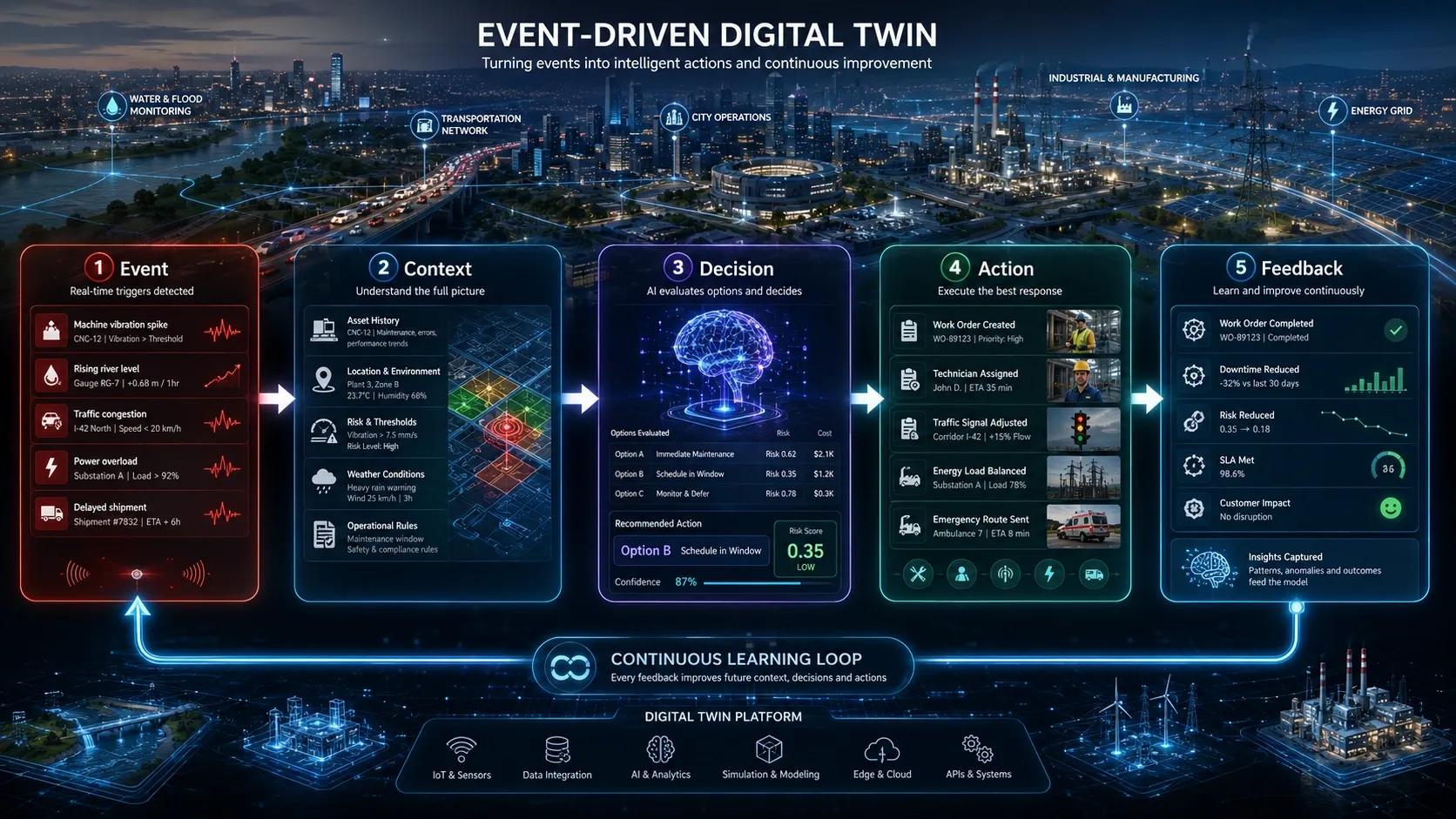
The Event-Driven Digital Twin Flow
A mature event-driven Digital Twin follows this loop:
👉 Event → Context → Decision → Action → Feedback
1. Event
Something changes in the physical or operational system.
Example:
A bridge sensor detects abnormal vibration.
2. Context
The Digital Twin checks the event against:
asset history
location
operating conditions
maintenance records
weather
risk thresholds
This prevents overreaction.
3. Decision
The system determines what should happen next.
This may include:
alert
recommendation
task creation
escalation
automatic action
4. Action
The event triggers action through:
CMMS
ERP
SCADA
field apps
emergency response systems
5. Feedback
The outcome returns to the Digital Twin.
The system learns:
was the alert valid?
was the action completed?
did performance improve?
should thresholds be adjusted?
This is how the twin becomes more intelligent over time.
Why Event-Driven Systems Are Different from Dashboards
Dashboards show information.
Event-driven systems trigger action.
That is the difference.
A dashboard says:
👉 “Something changed.”
An event-driven Digital Twin says:
👉 “Something changed, here is the context, here is the required action, and here is who owns it.”
This is where Digital Twins move from observation to operational intelligence.
Practical Example: Smart Facility
A sensor detects abnormal energy usage in a building zone.
In a traditional system:
data appears on dashboard
someone reviews it later
action depends on manual follow-up
In an event-driven Digital Twin:
energy spike becomes an event
system checks occupancy data
verifies HVAC status
identifies likely cause
creates inspection task
assigns technician
tracks resolution
measures energy savings
The event becomes a closed-loop workflow.
Practical Example: Flood Management
A rainfall forecast shows heavy rainfall in a catchment.
At the same time:
river level rises
reservoir capacity is high
drainage sensors show blockage
Individually, these are data points.
Together, they form a high-risk event.
The Digital Twin can:
simulate flood spread
trigger early warning
notify authorities
recommend reservoir release
highlight evacuation zones
This is not passive monitoring.
This is event-driven resilience.
Key Components of Event-Driven Digital Twins
1. Event Sources
These may include:
IoT sensors
SCADA systems
field apps
ERP updates
weather APIs
satellite feeds
CCTV/video analytics
mobile location data
2. Event Broker
This is the layer that receives and distributes events.
It ensures events reach the right systems at the right time.
3. Event Processing Layer
This layer filters and analyzes events.
It identifies:
normal events
abnormal events
correlated events
critical events
4. Context Engine
This adds meaning.
It checks the event against:
asset registry
spatial context
historical trends
operational constraints
business rules
5. Decision Engine
This determines the next action.
It may trigger:
alert
recommendation
work order
automated control
escalation workflow
6. Feedback Layer
This captures outcomes.
It allows the Digital Twin to improve.
Where Most Implementations Fail
1. Treating Every Signal as an Event
Not every data point needs attention.
If every signal becomes an alert, users stop responding.
2. No Context Layer
An event without context becomes noise.
A vibration spike may be normal during planned operation but critical during idle state.
3. No Workflow Connection
If events do not trigger action, they remain notifications.
4. Poor Event Governance
Organizations must define:
which events matter
who owns them
what actions are allowed
when escalation is required
5. No Feedback Loop
Without feedback, the system cannot learn which events were useful, false, or missed.
Event-Driven Architecture and Autonomous Twins
Autonomous Digital Twins need event-driven architecture.
Why?
Because autonomy depends on timely response.
If a system must wait for a scheduled report, it cannot act in real time.
Event-driven design enables:
faster sensing
faster interpretation
faster action
faster learning
This is why event-driven architecture becomes the nervous system of autonomous Digital Twins.
Indian Context
In India, event-driven Digital Twins can be highly relevant for:
smart cities
flood warning systems
power distribution
rail safety
highways
manufacturing
telecom networks
urban infrastructure
Many systems already collect data.
The next maturity step is turning data into events that trigger action.
For example:
water level rise → early warning workflow
transformer overload → maintenance action
traffic congestion → signal adjustment
road damage detection → repair task
machine anomaly → work order
This is where Digital Twins become operationally useful.
Benefits of Event-Driven Digital Twins
reduced decision latency
faster response
better automation
fewer missed signals
improved operational coordination
stronger resilience
better ROI through action-oriented workflows
Conclusion
Real-time intelligence is not about watching data move faster.
It is about knowing which events matter and acting on them in time.
Event-driven architecture gives Digital Twins the ability to:
👉 sense change
👉 understand context
👉 trigger decisions
👉 execute actions
👉 learn from outcomes
This is the path from real-time data to real-time intelligence.
And it is one of the foundations of autonomous Digital Twins.