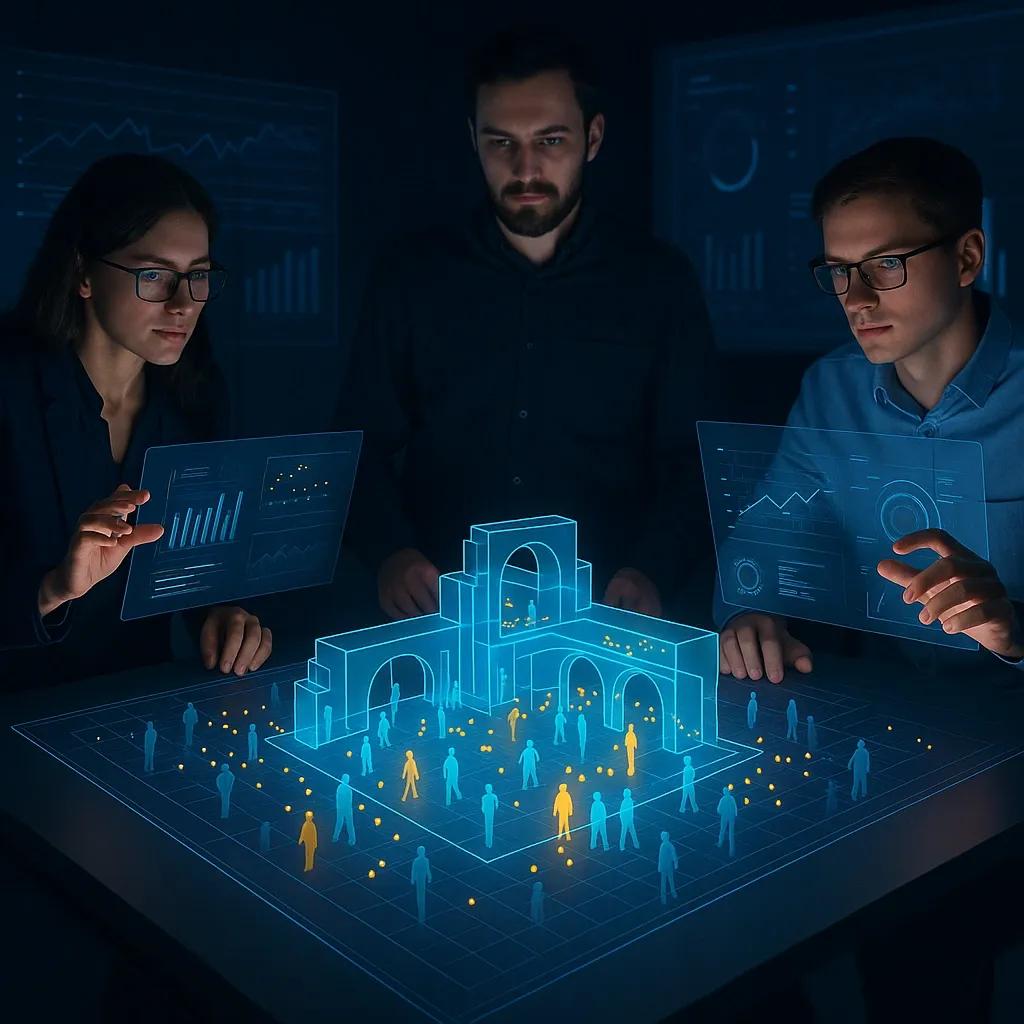
The convergence of entertainment and spatial technology marks one of the most transformative shifts in the creative industries today. The recent collaboration between Meow Wolf , an immersive arts collective, and Worldbuildr , a digital twin and simulation platform, signals how the entertainment sector is embracing spatial computing to design, test, and refine experiences before they are ever built. This collaboration illustrates a broader movement: immersive venues are no longer just artistic; they are data-driven, operationally optimized, and technically precise.
The Evolution: From Stage Design to Spatial Simulation
Entertainment design once relied on blueprints, models, and human intuition. Today, it’s increasingly shaped by digital twins, virtual replicas of physical spaces that allow creators to simulate guest interactions, crowd flows, lighting dynamics, and acoustic behavior in real time.
The Meow Wolf–Worldbuildr partnership is emblematic of this shift. By integrating simulation into its creative process, Meow Wolf can model how thousands of visitors might move through an installation, how sound travels across interconnected rooms, and how line-of-sight impacts immersion. Before a single wall is built, the experience is tested digitally, reducing guesswork, construction waste, and rework costs.
Worldbuildr’s platform leverages spatial analytics, physics engines, and AI-driven behavioral models to predict outcomes. This enables creators to iterate virtually, leading to faster prototyping and more reliable operational outcomes once the physical venue opens.
From Las Vegas to Denver , entertainment spaces are evolving into living laboratories where simulation meets storytelling.
The Technology Stack Powering Immersive Entertainment
The foundation of these collaborations lies in spatial computing , which unites several key technologies:
3D Scanning and Mapping: LiDAR and photogrammetry tools are used to capture precise spatial data. This creates a realistic digital twin of the venue for simulation and design.
Digital Twins and Simulation Engines: Platforms like Worldbuildr, Unreal Engine, and Unity enable real-time rendering and environmental testing. Designers can visualize audience movement, lighting transitions, and stage visibility at various occupancy levels.
IoT and Sensor Integration: Once the venue is operational, IoT devices collect data on visitor density, temperature, energy use, and equipment status, feeding back into the twin for performance optimization.
AI and Predictive Analytics: Machine learning models analyze behavioral data to predict guest flow, queue times, and maintenance requirements, allowing operators to preemptively adjust conditions.
Together, these layers transform an art installation or theme park into a smart entertainment ecosystem , one that learns, adapts, and evolves based on user interactions.
The Business Logic: Why Entertainment Needs Spatial Tech
Beyond creativity, spatial technology offers measurable business value.
Operational Efficiency: Simulating visitor flows helps reduce congestion and optimize staffing. Theme parks, museums, and immersive theaters can test multiple scenarios before launch.
Cost and Time Savings: By detecting design flaws early in the virtual model, companies can cut construction costs by 10–20% and reduce project delivery time by up to 30%.
Experience Optimization: Real-time feedback loops help maintain audience engagement levels and ensure safety and comfort.
Sustainability: Virtual prototyping reduces material waste and energy use in the design phase, aligning with ESG goals.
In Meow Wolf’s case, these efficiencies translate into faster deployment cycles and higher ROI on creative capital. By linking simulation data with visitor analytics, the company can continuously refine the physical installation long after launch.
From Art to Algorithm: Designing Emotion Through Data
Spatial technology doesn’t replace artistic vision, it amplifies it. Digital twins offer a sandbox where imagination can be validated against physical constraints. For example:
Acoustic modeling ensures that soundscapes remain immersive without overwhelming visitors.
Thermal mapping predicts comfort levels based on crowd density and HVAC configurations.
Pathfinding algorithms simulate visitor decision-making, revealing how design cues guide or confuse.
This interplay between data and design is where the future of entertainment lies: art that feels spontaneous but is meticulously engineered for impact. The Meow Wolf–Worldbuildr project demonstrates how simulation can enhance not just logistics but storytelling itself, turning venues into responsive, living experiences.
Industry Momentum: Expanding Beyond Art Installations
The entertainment sector’s embrace of spatial tech extends far beyond artistic collectives.
Disney Imagineering uses digital twins to test ride safety and optimize maintenance schedules.
Universal Studios leverages real-time simulations for crowd management and energy efficiency.
Live Nation experiments with XR-based venue visualization to reimagine stage layouts for touring artists.
According to Allied Market Research , the global spatial computing market , covering digital twins, AR/VR, and simulation, will surpass $620 billion by 2032 , growing at a 24.4% CAGR . The entertainment segment, once a niche use case, is now among the top three drivers of adoption, alongside manufacturing and real estate.
Implications: The Future of Immersive Operations
As spatial technologies mature, entertainment companies are beginning to think like engineers. The venue of tomorrow will be:
Continuously simulated: Digital twins will run in parallel with the physical venue, adjusting operations dynamically.
AI-curated: Experience elements, music, visuals, and interactivity, will adapt in real time based on visitor profiles.
Collaboratively designed: Artists, data scientists, and spatial technologists will co-create environments that are both emotionally rich and operationally efficient.
This shift redefines roles in the creative ecosystem. Set designers become experience engineers. Data scientists join creative teams. Artistic direction merges with systems thinking.
Outlook: Designing the “Playable World”
The entertainment industry is entering what some call the “Playable World” era, where every environment, from theme parks to retail showrooms, becomes interactive and adaptive. Spatial technology will underpin this evolution, enabling venues that respond dynamically to human presence and emotion.
As the Meow Wolf–Worldbuildr deal shows, immersive entertainment is no longer improvised, it’s instrumented . The most successful creators will be those who understand both the narrative and the network, merging creativity with computation to deliver experiences that are as intelligent as they are inspiring.
The question isn’t whether entertainment will use digital twins, it’s how deeply they’ll integrate them into the creative DNA of every project. Those who adopt early will not just entertain audiences; they’ll engineer wonder.