Opening Reflection
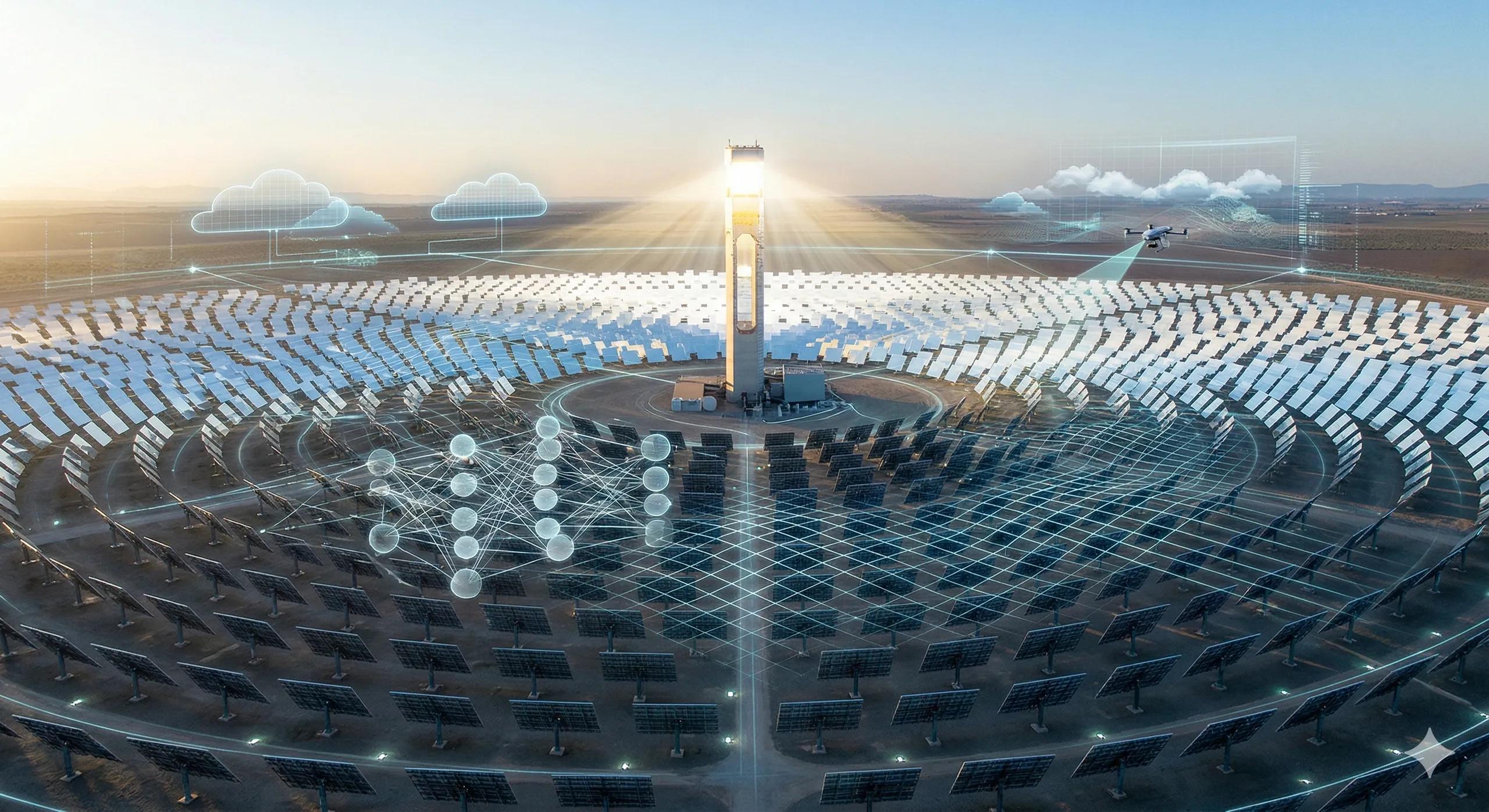
What if a solar plant didn’t just generate energy but actively reasoned about how to generate it better, every second?
Context: The Shift from Static Assets to Spatial Intelligence Systems
The global push toward renewable energy has accelerated investments in solar infrastructure. Yet, not all solar technologies operate at the same level of intelligence.
While photovoltaic systems convert sunlight into electricity directly, Concentrated Solar Power (CSP) introduces a different paradigm, one that depends on precision, coordination, and real-time decision-making across thousands of moving components.
At the center of this evolution is Heliostat Field Control (HFC) Optimization , a domain where geospatial intelligence, digital twins, and AI converge to transform solar plants into dynamic, adaptive systems.
The Deeper Question: Are We Designing Energy Systems… or Teaching Them to Think?
Traditionally, infrastructure has been engineered for predictability.
But renewable energy systems operate in environments that are inherently unpredictable, cloud movement, atmospheric distortion, seasonal variations.
So the question is no longer: How do we design efficient systems?
It is: How do we design systems that can continuously adapt to spatial and environmental uncertainty?
Spatial Intelligence Perspective: A Solar Plant as a Geospatial Robot
A CSP plant is not just an energy asset, it is a coordinated spatial system .
Thousands of heliostats (mirrors) must:
Track the sun with high precision
Align their reflections onto a single receiver
Maintain a controlled thermal distribution (flux map)
This introduces a critical challenge:
The system must optimize not just position, but interaction across space.
Key Spatial Intelligence Layers:
1. Geometry of Efficiency
Mirrors are affected by: Cosine Loss (angle of sunlight) Blocking & Shadowing (interference between mirrors)
Geospatial algorithms define optimal layouts across seasons
This is not static planning, it’s dynamic spatial optimization
2. Closed-Loop Optical Calibration
Traditional calibration was manual and periodic
Now: UAVs and cameras capture real-time reflection data Digital twin compares as-built vs as-designed Automated corrections adjust mirror alignment
3. Dynamic Cloud Gating
Satellite imagery + local sky sensors feed real-time data
AI predicts cloud movement across the field
Mirrors are pre-adjusted to maintain thermal consistency
This is where the shift becomes clear:
The system is no longer reacting, it is anticipating.
Real-World Implication: Stability Becomes a Data Problem
In CSP plants, the biggest operational risk is not energy generation, it’s thermal instability .
Uneven heat distribution → structural damage
Sudden flux drops → turbine inefficiency
Overconcentration → material failure
Historically, these were engineering problems.
Now, they are data interpretation problems .
A well-designed digital twin integrates:
Geospatial layouts
BIM-based structural models
IoT sensor feeds
Satellite-derived environmental inputs
The result is a system that can:
Predict thermal stress before it occurs
Adjust mirror targeting proactively
Maintain consistent energy output
Insight: From Visualization to Autonomous Control
Many digital twin implementations stop at visualization.
They show what is happening but do not influence what happens next.
HFC optimization represents the next step:
From monitoring → to decision systems
From dashboards → to autonomous adjustments
Here, the digital twin is not just a mirror of reality.
It becomes a control layer for reality .
This aligns with a broader industry transition:
Assets are no longer “operated”
They are continuously optimized through spatial intelligence
Closing Reflection
A CSP plant with HFC optimization is not just producing energy.
It is constantly negotiating with its environment, sunlight, clouds, geometry, and time.
And in doing so, it reveals something deeper:
The future of infrastructure is not about building better systems.
It is about building systems that understand the space they exist in.