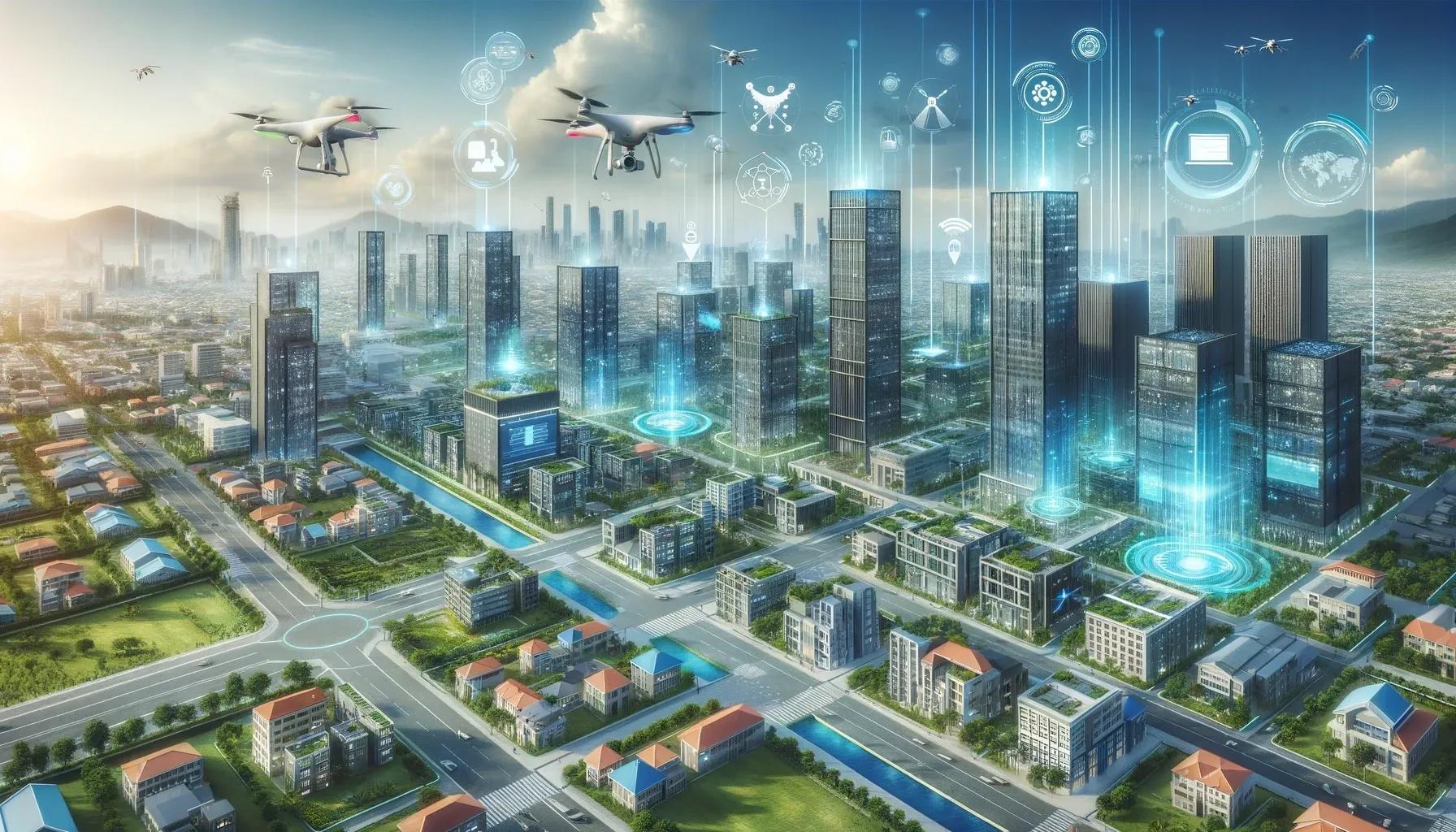
In the swiftly evolving landscape of geospatial and building information modeling (GeoBIM), the integration of emerging technologies such as Artificial Intelligence (AI) and the Internet of Things (IoT) is not just an innovation but a transformative shift. This article delves into how these technologies are reshaping GeoBIM, offering a glimpse into a future where the synergy between spatial intelligence and advanced computing is not just a possibility but an everyday reality.
AI: A New Frontier in GeoBIM
AI, with its capability to process vast amounts of data, learn patterns, and make predictions, is revolutionizing GeoBIM. One of the most significant impacts is in the realm of predictive analytics. AI algorithms can analyze historical geospatial data combined with BIM models to predict future scenarios. For instance, in urban planning, AI can forecast the impact of new constructions on traffic flow, environmental conditions, and even socio-economic dynamics.
Moreover, AI enhances the accuracy and efficiency of spatial data analysis. Machine learning algorithms, a subset of AI, can automate the extraction of insights from geospatial data, reducing human error and increasing productivity. For example, AI can be employed to detect changes in land use patterns or to monitor infrastructure health by analyzing satellite imagery and sensor data.
IoT: Adding a Dimension of Connectivity
IoT brings a new dimension to GeoBIM by embedding connectivity and real-time data collection into the physical world. IoT devices like sensors and beacons can be integrated into buildings and infrastructure, providing a continuous stream of data regarding their status and performance. This real-time data is invaluable for proactive maintenance, energy management, and ensuring safety standards.
In the context of smart cities, IoT devices can be integrated into urban infrastructure, providing real-time insights into traffic patterns, environmental conditions, and public safety. When this real-time data is overlaid with BIM models, it provides a dynamic, multi-dimensional view of urban spaces, enhancing decision-making and urban management.
The Synergy of AI and IoT in GeoBIM
The true potential of GeoBIM is realized when AI and IoT are used in tandem. AI algorithms can analyze the vast streams of data generated by IoT devices, extracting actionable insights. This synergy enables predictive maintenance of infrastructure, where AI predicts potential issues based on real-time data from IoT sensors, facilitating timely interventions.
In environmental monitoring, AI can process data from IoT sensors to track environmental changes, predict trends, and guide sustainable practices. For instance, AI can analyze data from sensors monitoring air quality, water levels, or soil conditions, providing crucial information for environmental conservation and disaster management.
Beyond AI and IoT: The Future of GeoBIM
While AI and IoT are at the forefront, other emerging technologies are also contributing to the evolution of GeoBIM. For instance, augmented reality (AR) and virtual reality (VR) are enhancing visualization and interaction with geospatial data. AR can overlay BIM models onto physical spaces, aiding in design, construction, and maintenance. VR, on the other hand, can create immersive simulations for planning and training purposes.
Blockchain technology also has potential applications in GeoBIM, especially in the realm of data integrity and security. Blockchain can provide a secure, immutable record of geospatial data transactions, ensuring transparency and trust in data sharing among stakeholders.
The integration of AI and IoT into GeoBIM is not just a technological advancement but a paradigm shift. It heralds a future where spatial intelligence is interwoven with advanced computing, bringing about unprecedented efficiency, accuracy, and sustainability in spatial planning and management. As these technologies continue to evolve and intertwine, the possibilities for GeoBIM are boundless, paving the way for smarter, more sustainable, and more resilient urban and environmental ecosystems.
In conclusion, the emerging trends in GeoBIM, spearheaded by AI and IoT, are more than just technological breakthroughs; they are the building blocks of a smarter, more interconnected, and more sustainable future. As these technologies continue to advance and integrate, the potential of GeoBIM to revolutionize urban and environmental management is immense, promising a future where human-centric and eco-friendly development is not just envisioned but actualized.