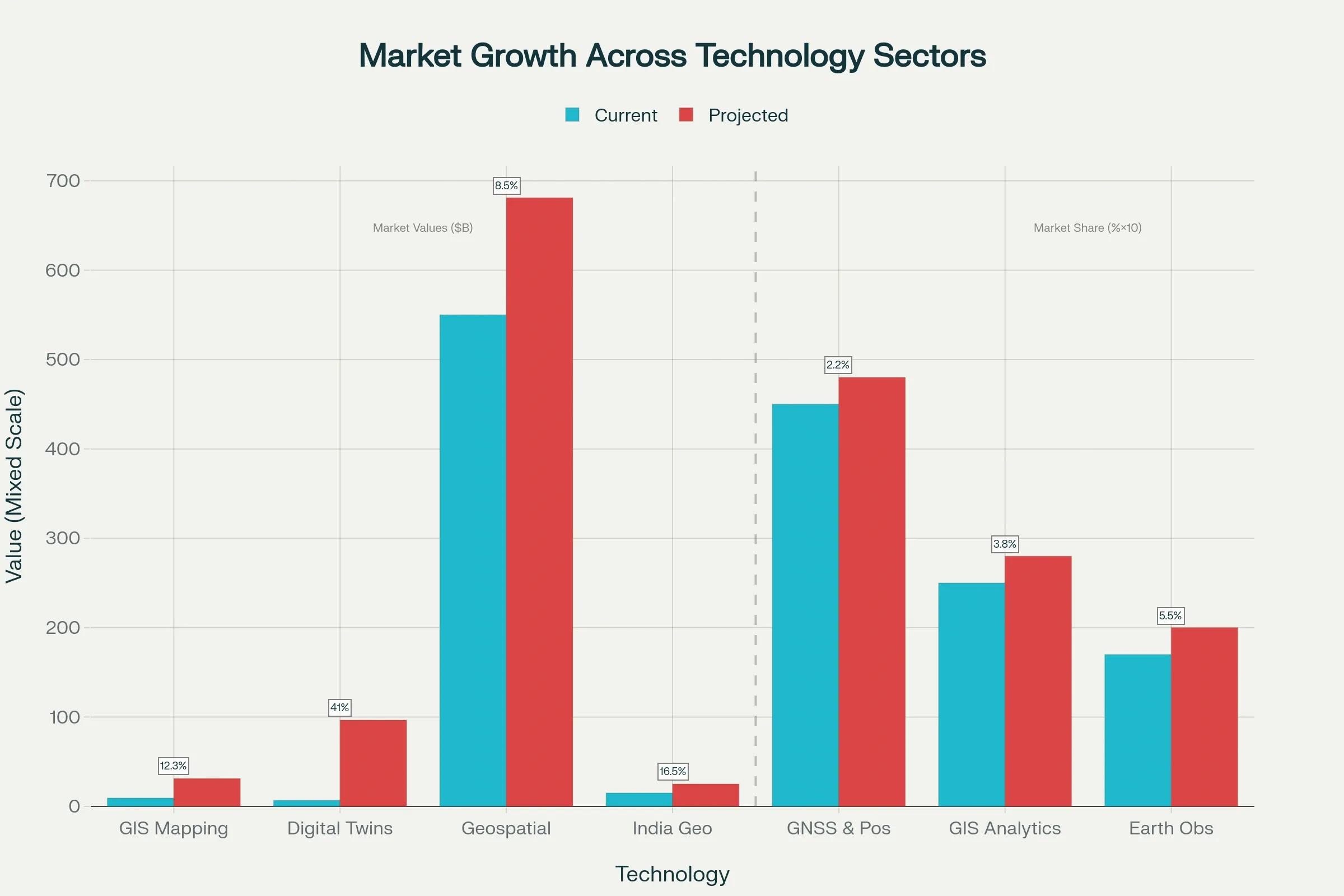
The emerging technological landscape is experiencing an unprecedented convergence that's fundamentally transforming how businesses operate in geospatial technology, Building Information Modeling (BIM), Digital Twins, and Extended Reality (XR) sectors. Recent market analyses reveal a remarkable acceleration in adoption rates, with the global digital twins market projected to surge from $6.75 billion in 2021 to $96.49 billion by 2029, representing a staggering 41% compound annual growth rate. This exponential growth signals a paradigm shift that forward-thinking businesses cannot afford to ignore.
The Technology Integration Revolution
The convergence of Artificial Intelligence (AI), Internet of Things (IoT), cloud computing, blockchain, and XR technologies is creating unprecedented opportunities for businesses operating in spatial data and digital modeling sectors. GeoAI, which combines AI capabilities with geospatial data, is enabling groundbreaking advancements in automated feature extraction, predictive analytics, and real-time decision-making. Companies leveraging this integration are reporting significant operational improvements, with some achieving delivery time reductions of up to 90 days in complex projects.
The integration extends beyond individual technologies to create comprehensive ecosystems. For instance, IoT-enabled sensors are generating massive volumes of real-time spatial data that, when processed through AI algorithms, provide dynamic and actionable insights for urban planning, infrastructure management, and environmental monitoring. This technological synergy is particularly transformative for businesses in the geospatial sector, where the global GIS mapping market is expected to grow from $9.4 billion in 2024 to $31.2 billion by 2030, representing a robust 12.3% CAGR.
Business Impact Across Core Sectors
Geospatial Technology Transformation
The geospatial industry is experiencing a fundamental shift from product-centric to solutions-oriented approaches, with GNSS & Positioning hardware commanding a 45% market share , followed by GIS & Spatial Analytics at 25%. Businesses are leveraging advanced geospatial analytics for critical applications including disaster response, urban planning, infrastructure development, and precision agriculture.
Cloud GIS solutions are democratizing access to powerful spatial analysis tools, enabling organizations of all sizes to extract actionable insights without requiring deep technical expertise. This democratization is particularly significant in emerging markets, with India's geospatial market projected to reach Rs 25,000 crore by 2025, growing at a 16.5% CAGR.
BIM and Digital Twin Integration Evolution
The construction industry is witnessing a revolutionary transformation through the integration of BIM with Digital Twin technology. Approximately 29% of manufacturers have already implemented digital twin strategies, with budgets increasingly shifting toward predictive maintenance and plant simulation. This adoption is driven by tangible business benefits, including enhanced visibility across project lifecycles and significant reductions in non-productive activities.
Current data indicates that 35% of construction professionals spend time on non-productive activities including information searching, conflict resolution, and rework management. Digital twin implementations are directly addressing these inefficiencies by providing real-time monitoring capabilities and enabling proactive decision-making through "what-if" scenario testing.
XR Technology Maturation
Extended Reality technologies are transitioning from experimental applications to business-grade implementations. The technology is proving particularly valuable for remote assistance, training, and work instruction applications rather than just headset deployments. Organizations are aligning content pipelines to convert CAD/BIM data into lightweight XR assets, enabling immersive collaboration experiences that significantly improve project understanding and stakeholder engagement.
Strategic Business Implications and Opportunities
The convergence of these technologies presents several strategic opportunities for businesses:
Enhanced Operational Efficiency : Organizations implementing integrated technology stacks are experiencing substantial improvements in project delivery times and resource utilization. The integration of AI-powered analytics with spatial data enables automated monitoring and streamlined facility management, reducing operational overhead while improving accuracy.
Predictive Capabilities : Businesses are moving beyond reactive maintenance models to predictive strategies enabled by digital twin technology. Real-time sensor data combined with machine learning algorithms allows organizations to anticipate equipment failures, optimize energy consumption, and extend asset lifecycles.
Collaborative Innovation : XR integration with BIM platforms is revolutionizing stakeholder collaboration by providing immersive visualization experiences that enhance project understanding and reduce miscommunication-related delays.
Market Growth and Investment Trends
The financial outlook for these sectors remains exceptionally robust. The global geospatial market is expected to reach $681 billion by 2025, driven by increasing demand for location-based services and spatial analytics. Simultaneously, the construction technology sector is experiencing unprecedented investment in AI-driven solutions, with generative AI transforming design processes and enabling smarter project planning.
Cloud computing adoption in geospatial applications is accelerating, offering scalable processing capabilities and reducing infrastructure costs. Organizations are increasingly leveraging cloud-native solutions that integrate with AI-driven geospatial APIs, enabling real-time, high-precision insights without requiring in-house technical expertise.
Implementation Challenges and Risk Mitigation
Despite the tremendous opportunities, businesses face several implementation challenges. Data complexity, hardware requirements, and standardization issues remain significant barriers to seamless technology integration. Organizations must develop comprehensive change management strategies and invest in employee training to maximize technology adoption benefits.
The successful implementation of these integrated technologies requires careful planning around data infrastructure, security protocols, and scalability considerations. Businesses should prioritize establishing robust data foundations and implementing appropriate risk controls before scaling their technology initiatives.
Future-Proofing Strategic Recommendations
To capitalize on these emerging trends, businesses should:
Develop Integrated Technology Roadmaps : Create comprehensive strategies that leverage multiple technology convergences rather than implementing isolated solutions.
Invest in Data Infrastructure : Establish scalable, secure data platforms capable of supporting real-time analytics and cross-platform integration.
Build Strategic Partnerships : Collaborate with specialized technology providers to accelerate implementation timelines and reduce technical risks.
Focus on Employee Development : Invest in training programs that prepare teams for technology-enhanced workflows and decision-making processes.
Conclusion
The convergence of AI, IoT, cloud computing, and XR technologies is creating unprecedented opportunities for businesses in geospatial, BIM, Digital Twins, and XR sectors. Organizations that embrace these integrated technology approaches while addressing implementation challenges strategically will be best positioned to capitalize on the significant market growth projected through 2025 and beyond.
The key to success lies not in adopting individual technologies, but in creating comprehensive, integrated solutions that leverage the synergistic benefits of technological convergence. As these markets continue their rapid expansion, the businesses that invest thoughtfully in technology integration today will define the industry standards of tomorrow.