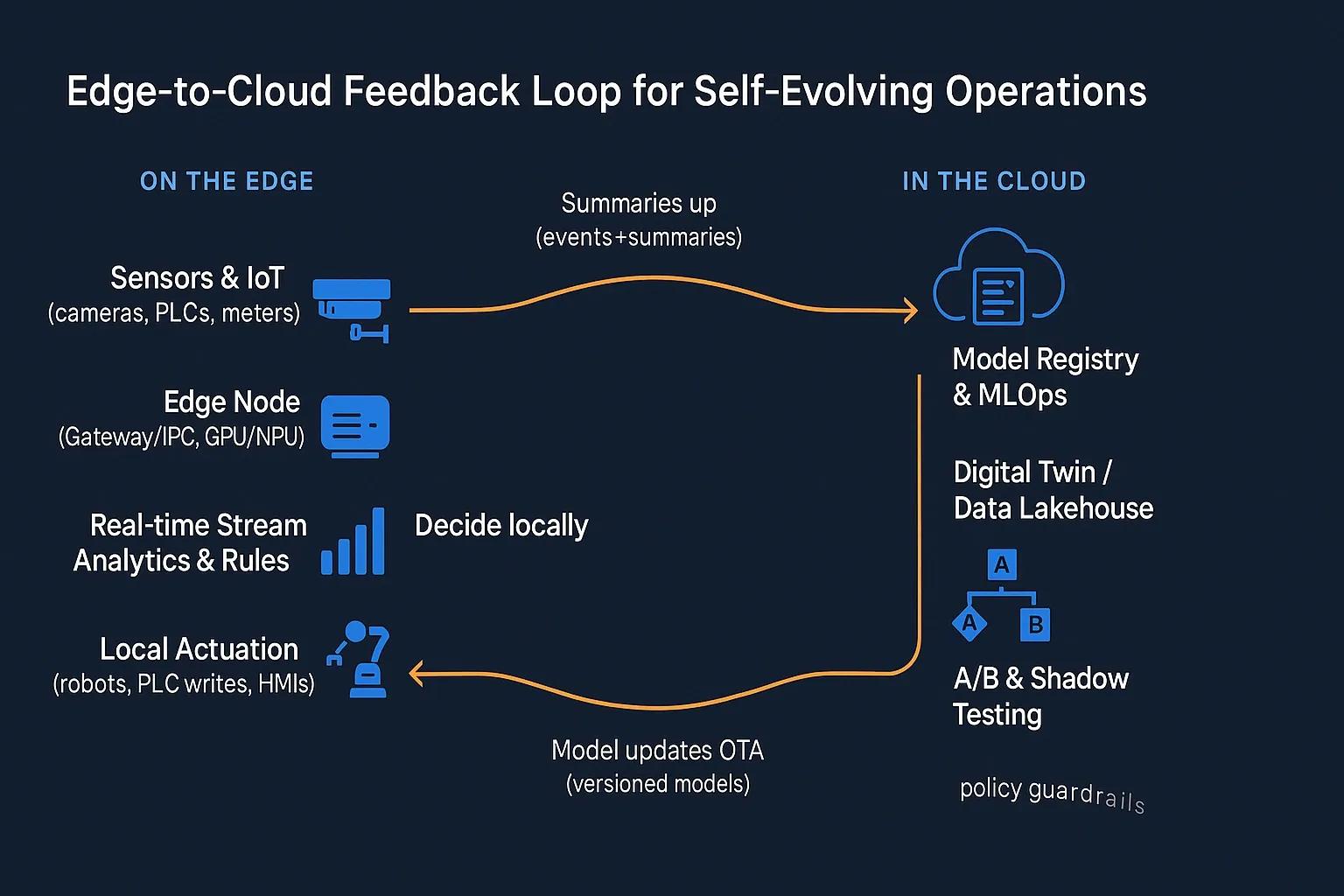
Edge computing and real-time analytics are converging with IoT to close the gap between sense → decide → act . For Indian manufacturing clusters, logistics corridors, and smart-city programs, this shift means lower latency, less bandwidth dependency, and safer data handling on-premises, while still improving centrally. This article explains the architecture, the pitfalls, and a practical path to deploy a self-evolving system: decisions at the edge, continuous learning in the cloud, and over-the-air (OTA) updates back to the edge.
Why edge + real-time analytics now
Latency matters: Quality, safety, and throughput decisions often need single digit to sub-100 ms responses.
Data gravity & cost: Sending raw video, telemetry, or PLC signals to the cloud is expensive and slow.
Privacy & resilience: Keeping sensitive data local simplifies compliance and keeps plants running even when connectivity blips.
Model drift is real: Conditions change; models must be retrained and redistributed continuously.
“Would you adopt a hybrid edge–cloud design today or wait for full 5G/private-5G coverage? Why?”
The reference architecture (hybrid by design)
On the Edge (factory, warehouse, roadside unit): Sensors/IoT: Cameras, vibration, temperature, meters, RFID/UWB. Edge node: Industrial PC/gateway with GPU/NPU; runs stream processing, rules, and compact ML models. Local actuation: PLC writes, robot commands, HMI alerts, no round-trip to the cloud for critical loops .
In the Cloud (central improvement): Model registry & MLOps: Versioning, lineage, A/B and shadow tests. Digital twin/data lakehouse: Context model, time-series, and events for analysis and simulation. Governance: Policies for data retention, privacy, OTA rollout gates, and audit.
Feedback loop: Edge emits summaries/events, plus small, curated snippets for labeling. Cloud retrains/validates → promotes a new model → OTA rollout with phased canaries. Edge nodes auto-adopt based on policy and health checks.
Implementation blueprint
Phase 0: Select a “needle-mover” use case
Clear business metric (scrap, downtime, SLA breach, incident rate).
One site, one line/zone, a few sensors to start.
Define latency SLO , privacy constraints, and rollback criteria.
Phase 1: Pilot on the edge
Build a minimal stream pipeline: ingest → feature → detect → act.
Ship a compact model (or even rules first) to meet the latency target.
Instrument everything: per-decision latency, false alarms, operator interventions.
Keep data local; export only events and small samples.
Phase 2: Close the loop
Stand up model registry, CI/CD for models, and A/B or shadow testing.
Establish human-in-the-loop labeling for tricky cases.
Automate OTA with canary rollout to a subset of edge nodes.
Phase 3: Scale & harden
Add more lines/sites; templatize provisioning.
Introduce resilience: local buffering, offline mode, auto-heal.
Bake in governance: approvals, audit trails, and policy-as-code.
Three concrete use cases
1) Manufacturing , Vibration + vision for early fault detection
Edge: Sensor fusion on spindle motors and camera checks on surface defects. Inference triggers a micro-pause and tool change suggestion in <100 ms.
Cloud: Aggregates labeled fault signatures per SKU and material batch; retrains and promotes model weekly.
Outcome: Fewer unplanned stoppages; tighter process windows; operators trust alerts because latency and false positives are controlled.
2) Logistics , Cold-chain integrity
Edge: Reefer gateway reads temp/humidity, door sensors, and GPS. Real-time rules trigger driver alerts within seconds of threshold breach.
Cloud: Route-level analytics, seasonal drift detection, SLA heatmaps; pushes refined thresholds per route/product.
Outcome: SLA adherence rises; claims drop; fewer “silent” excursions.
3) Smart Infrastructure , Adaptive traffic signaling
Edge: Camera + radar estimates flow and near-misses; controller adjusts phases locally.
Cloud: City-wide KPIs, incident replay, policy experiments; validated policies OTA to signals.
Outcome: Lower congestion at peak; better safety at known blackspots.
Common challenges, and what works
Connectivity is spiky: Design offline-first ; buffer locally; sync events, not raw feeds.
Model drift: Schedule periodic re-validation; use shadow tests; monitor precision/recall per site.
Device sprawl: Standardize gateways; immutable builds; zero-touch provisioning; fleet health dashboards.
Security & privacy: Separate control from data planes; least-privilege tokens; sign models; encrypt at rest/in transit.
Change management: Treat models like code; approvals; training for operators; visible rollbacks.
Benefits & ROI (how to measure)
Latency reduction: From seconds to sub-100 ms for critical loops.
Bandwidth savings: 60–95% lower upstream traffic by filtering at the edge.
Higher uptime/throughput: Early interventions prevent cascading failures.
Quality gains: Fewer defects and rework; tighter process control.
Compliance by design: Sensitive media stays on-prem; only metadata leaves.
Predictable scaling: Add sites by cloning a proven template.
Conclusion
Self-evolving environments are practical today: decide locally, learn centrally, and update continuously. Start small with a high-impact loop, measure outcomes, and scale with standardized tooling. The payoff is simple, faster, safer, cheaper decisions where work actually happens.