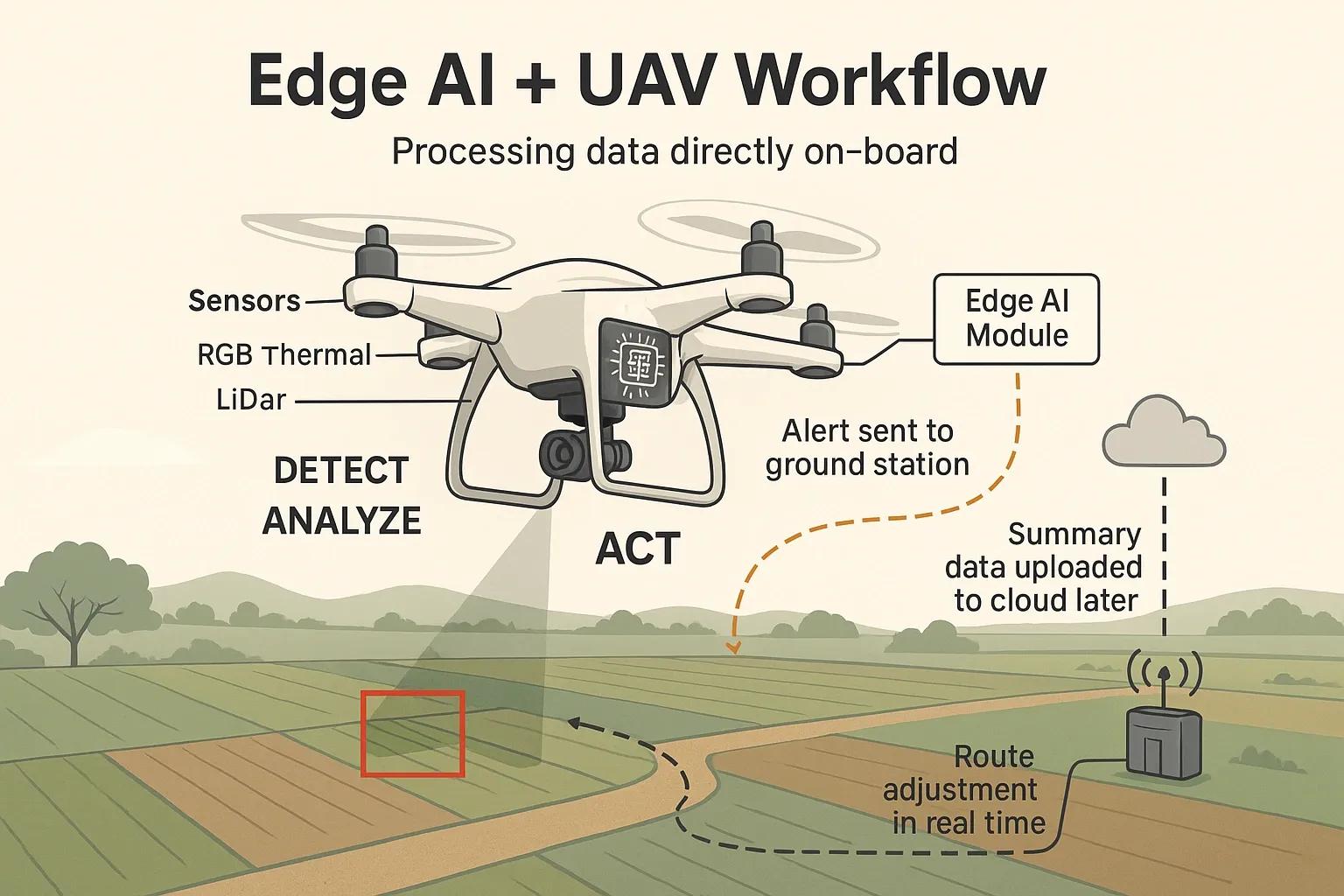
In today's data-driven world, speed and accuracy are crucial for effective field operations, especially in sectors like infrastructure inspection, agriculture, disaster response, and security. Traditional UAV (Unmanned Aerial Vehicle) systems rely on cloud-based processing, which introduces latency and demands stable network connectivity. The integration of Edge Artificial Intelligence (Edge AI) with UAVs transforms this paradigm by enabling data processing directly on the drone itself. This article explores the architecture, advantages, challenges, and real-world applications of deploying Edge AI on UAVs to support real-time, on-site decision making.
1. What Is Edge AI in the Context of UAVs?
Edge AI refers to the deployment of machine learning models on edge devices (in this case, UAVs), allowing them to process data locally without needing constant cloud interaction. This enables:
Real-time data analysis
Instant anomaly detection
Autonomous action triggers
The UAV becomes more than a flying sensor, it becomes an autonomous analytics platform.
2. System Architecture: Edge AI + UAV
A typical Edge AI-enabled UAV system includes:
Sensor Suite : RGB cameras, thermal cameras, LiDAR, multispectral sensors
Edge Processor : Onboard GPU/TPU-based devices like NVIDIA Jetson, Intel Movidius, or Google Coral
Inference Engine : Optimized AI models for object detection, segmentation, classification
Communication Module : 4G/5G, LoRa, or Wi-Fi for sending critical alerts to base stations
Storage and Navigation : Local SSD for short-term storage GPS and IMU for autonomous navigation
This setup allows the UAV to capture, process, and act on data in flight, without waiting for cloud-based processing.
3. Benefits of Edge AI-Enabled UAV Systems
a. Low Latency Decision Making
By processing data locally, edge-enabled UAVs drastically reduce the time between data capture and decision execution. For example, detecting a structural crack or intruder can trigger immediate action without needing to wait for cloud validation.
b. Reduced Bandwidth Usage
Instead of transmitting raw data (which is bandwidth-heavy), the UAV sends only critical insights or compressed summaries, saving on transmission costs and making operations viable in remote areas.
c. Increased Autonomy
Edge AI enables semi-autonomous or fully autonomous missions where drones can change routes, prioritize targets, or abort missions based on real-time inference, ideal for time-sensitive use cases like fire detection or search and rescue.
d. Operational Continuity in No-Connectivity Zones
For areas without mobile or internet coverage, such as forests, offshore platforms, or conflict zones, Edge AI ensures that drone missions can still deliver meaningful results without needing live connectivity.
4. Use Cases Across Sectors
a. Infrastructure Inspection
Bridges, towers, pipelines : Edge AI detects corrosion, cracks, or missing bolts using real-time image classification.
Action : Drone hovers longer over the damage zone or notifies the crew immediately with GPS-tagged snapshots.
b. Precision Agriculture
Crop health monitoring : NDVI data from multispectral sensors is processed onboard to detect stressed plants or pests.
Action : Drone adjusts spraying zones or alerts farmers about areas needing intervention.
c. Disaster Management
Damage mapping : After earthquakes or floods, drones assess structural safety or identify survivors.
Action : Real-time classification helps first responders prioritize areas with visible damage or movement.
d. Wildlife and Poaching Surveillance
Anomaly detection : Unusual human movement in protected areas is flagged using onboard vision analytics.
Action : Sends alerts with timestamp and geolocation to forest rangers, even when offline.
e. Construction Monitoring
Progress analytics : Drones compare current construction layouts with BIM models using visual AI.
Action : Flags deviations, updates project management dashboards with progress stats.
5. Core AI Models Used at the Edge
To run on limited compute, models must be lightweight and optimized. Common models include:
YOLOv5 Nano / Tiny YOLO : For fast object detection
MobileNetV2 : For classification with minimal resources
UNet / DeepLab : For semantic segmentation (road/path detection)
Custom CNNs : Tailored to detect defects, anomalies, or custom targets
These models are trained offline and deployed after quantization or pruning to fit edge compute constraints.
6. Challenges in Deploying Edge AI on UAVs
Challenge - Description
Compute Constraints - UAVs have limited power and processing capacity; model optimization is key.
Thermal Management - Edge processors generate heat; active/passive cooling solutions are required.
Power Management - Running both compute and sensors reduces drone flight time. Efficient load balancing is essential.
Model Generalization - Models trained in controlled environments may underperform in real-world conditions. Continual learning strategies help.
Regulatory Compliance - In some regions, real-time surveillance and autonomous decision-making raise privacy or airspace concerns.
7. Hybrid Edge-Cloud Approach
In some applications, a hybrid approach works best:
Edge AI handles real-time classification, alert generation, and navigation decisions.
Cloud AI performs deeper post-mission analytics, trend detection, and retraining based on collected data.
This synergy balances the need for speed on-site and depth off-site.
8. Future Trends
Swarm Intelligence : Multiple drones sharing insights over mesh networks for collaborative decision-making.
Federated Learning : Drones update AI models without sending raw data to the cloud, improving privacy and efficiency.
Edge AI Chips Evolution : More powerful, energy-efficient chips are enabling complex models to run directly on UAVs.
Synthetic Data Training : AI models pre-trained using synthetic environments to boost model robustness.
9. Real-World Example: Edge AI in Solar Farm Inspection
A drone equipped with an edge processor and thermal + RGB cameras flies over a solar farm. It detects:
Hotspots (using thermal imagery)
Physical damage or debris (via object detection)
Panel misalignment (via geometric comparison)
Onboard AI filters out false positives, sends geotagged alerts to the maintenance team, and optimizes flight paths to focus on suspicious zones.
This reduces inspection time from hours to minutes and cuts down the need for multiple flights or manual analysis.
10. Conclusion
Edge AI integrated with UAVs marks a significant shift in field data operations, empowering teams with on-the-spot intelligence that leads to faster, more informed decisions. Whether in agriculture, inspection, or emergency response, the ability to process and act on data locally is proving essential in environments where connectivity is unreliable, decisions are time-critical, and autonomy improves efficiency.
As edge computing hardware matures and AI models become leaner and smarter, Edge AI-powered drones will become standard in operational toolkits, reshaping how industries monitor, react, and optimize in real time.