Not every decision can wait for the cloud.
Some decisions must happen at the site, near the asset, and at the moment of risk.
Introduction: Phase 5 Continuation
In Phase 5, we are exploring the future direction of Digital Twins.
So far, we discussed:
AI-driven autonomous Digital Twins
event-driven architectures
Digital Twins with XR
Now we move to a critical layer for real-world operations:
Edge AI and On-Site Decision Systems
As Digital Twins become more operational, one question becomes important:
👉 Where should intelligence live?
Should every signal go to the cloud?
Should every decision wait for central processing?
Or should some decisions happen directly at the edge?
In many industries, the answer is clear:
👉 time-sensitive decisions must happen close to the physical system.
That is where Edge AI becomes important.
What Is Edge AI?
Edge AI means running AI models and decision logic close to where data is generated.
This could be:
on-site servers
industrial gateways
smart cameras
IoT edge devices
UAVs
sensors
machines
local control systems
Instead of sending every data point to the cloud, the edge system can process information locally and act quickly.
Why Edge AI Matters for Digital Twins
Digital Twins depend on live data.
But live data is not always enough.
In operational environments, the system must sometimes decide immediately.
Examples:
machine vibration crosses a safety threshold
worker enters a restricted zone
flood sensor detects sudden water rise
traffic congestion forms at a junction
power load spikes in a microgrid
gas leak is detected in a plant
If every signal waits for cloud processing:
👉 decision latency increases.
Edge AI reduces this delay.
It allows the system to detect, decide, and respond locally.
The Core Shift: From Central Intelligence to Distributed Intelligence
Traditional systems often depend on central platforms.
Data flows upward.
Dashboards analyze.
Teams decide.
Actions flow downward.
But in real-time operations, this model can be slow.
Edge AI enables distributed intelligence.
This means:
the cloud manages strategy
the edge manages immediate response
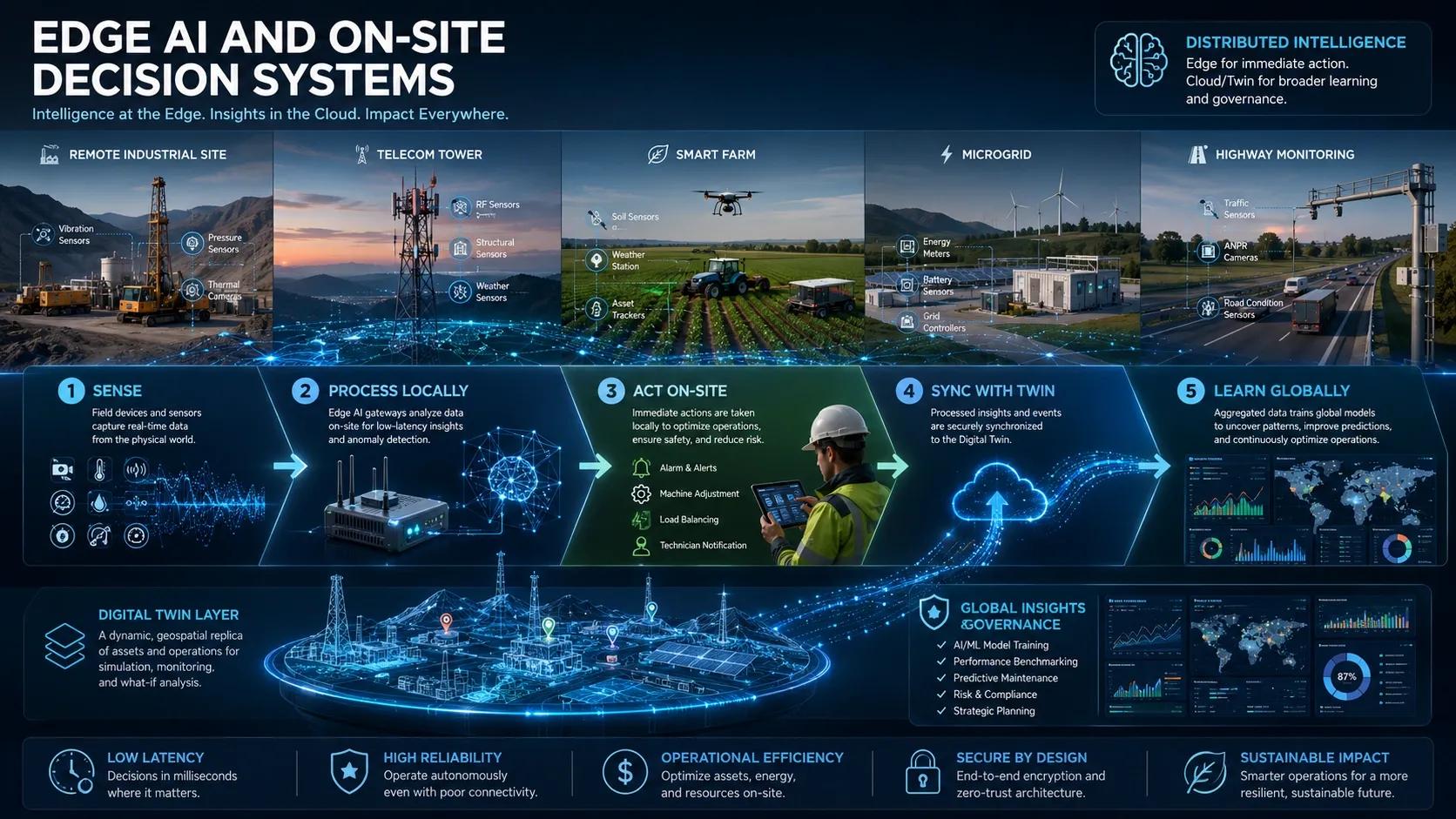
the Digital Twin connects both layers
This is not cloud versus edge.
It is cloud plus edge.
Cloud vs Edge: What Should Live Where?
Cloud is better for:
long-term analytics
large-scale model training
enterprise reporting
historical trend analysis
cross-site benchmarking
strategic planning
Edge is better for:
low-latency decisions
safety-critical alerts
local automation
offline operation
real-time anomaly detection
bandwidth-sensitive environments
A mature Digital Twin architecture uses both.
Practical Example: Industrial Safety
A worker enters a restricted zone inside a manufacturing plant.
A cloud-only system may:
detect the event
send data to central server
process the alert
notify supervisor
But even a few seconds of delay may matter.
An Edge AI system can:
detect the worker locally through camera or tag data
verify zone rules
trigger local alarm
notify supervisor
update the Digital Twin
The immediate safety response happens on-site.
The Digital Twin still records, analyzes, and learns from the event.
Practical Example: Smart Microgrid
A rural microgrid experiences a sudden load spike.
Cloud-based analytics may help with:
forecasting
long-term optimization
energy planning
But Edge AI can respond immediately by:
balancing local load
prioritizing critical systems
switching storage modes
preventing outage
This is especially valuable where connectivity is limited or unstable.
Where Edge AI Creates Value
1. Faster Decision-Making
Edge AI reduces the time between:
👉 signal → decision → action
This is critical in:
safety
manufacturing
energy
transportation
disaster response
2. Reduced Bandwidth Dependency
Not all data needs to travel to the cloud.
Edge systems can filter:
noise
normal conditions
repeated signals
and send only meaningful events.
3. Better Resilience
If cloud connectivity fails, local systems can continue operating.
This is important for:
remote sites
mines
farms
ports
energy systems
disaster zones
4. Local Context Awareness
On-site systems can respond based on:
local rules
asset state
operational conditions
immediate risk
This makes responses more relevant.
5. Improved Privacy and Security
Sensitive data can be processed locally.
Only required insights or events may be sent to the cloud.
This is useful in:
healthcare
defense
industrial systems
critical infrastructure
The Edge AI Digital Twin Loop
A practical loop looks like this:
👉 Sense → Process Locally → Act On-Site → Sync with Twin → Learn Globally
This creates a hybrid intelligence model.
The edge handles immediate decisions.
The cloud and Digital Twin handle learning, governance, and long-term optimization.
Where Most Implementations Fail
1. Treating Edge as Only Hardware
Edge AI is not just installing devices.
It requires:
local models
decision rules
data governance
update mechanisms
cybersecurity
monitoring
2. No Synchronization with the Digital Twin
If the edge acts locally but does not update the Digital Twin:
👉 the central model becomes incomplete.
Every local action must feed back into the system.
3. Poor Model Maintenance
Edge models can become outdated.
They must be:
updated
validated
monitored
recalibrated
Otherwise, local decisions become unreliable.
4. Weak Cybersecurity
Edge devices are physically distributed and often exposed.
They need:
authentication
encryption
secure updates
access control
tamper protection
5. No Clear Decision Boundaries
Not every decision should happen at the edge.
Organizations must define:
what the edge can decide
what needs human approval
what must go to the cloud
what must be escalated
The Governance Question
Edge AI introduces an important governance issue:
👉 If a local system acts automatically, who is accountable?
This is why edge decision systems must operate within:
approved rules
audit trails
human override options
clear escalation paths
safety limits
Edge autonomy must be controlled, not uncontrolled.
Indian Context
In India, Edge AI can be highly relevant because many operational environments face:
connectivity gaps
field-heavy operations
remote infrastructure
power variability
bandwidth limitations
real-time safety requirements
Use cases include:
highway monitoring
smart agriculture
industrial safety
power distribution
flood warning systems
mining operations
telecom towers
rural microgrids
For India, Edge AI can help Digital Twins become more practical, especially where cloud-only systems may not be enough.
Benefits of Edge AI in Digital Twins
faster response
lower decision latency
improved resilience
reduced bandwidth cost
better local autonomy
stronger safety outcomes
better continuity during connectivity loss
Conclusion
The future of Digital Twins will not be fully centralized.
It will be distributed.
Cloud intelligence will remain important for strategy, learning, and scale.
But on-site intelligence will become critical for speed, safety, and resilience.
Edge AI helps Digital Twins move closer to the physical world.
It allows systems to:
👉 sense locally
👉 decide faster
👉 act on-site
👉 learn globally
That is how Digital Twins become real-time operational systems.