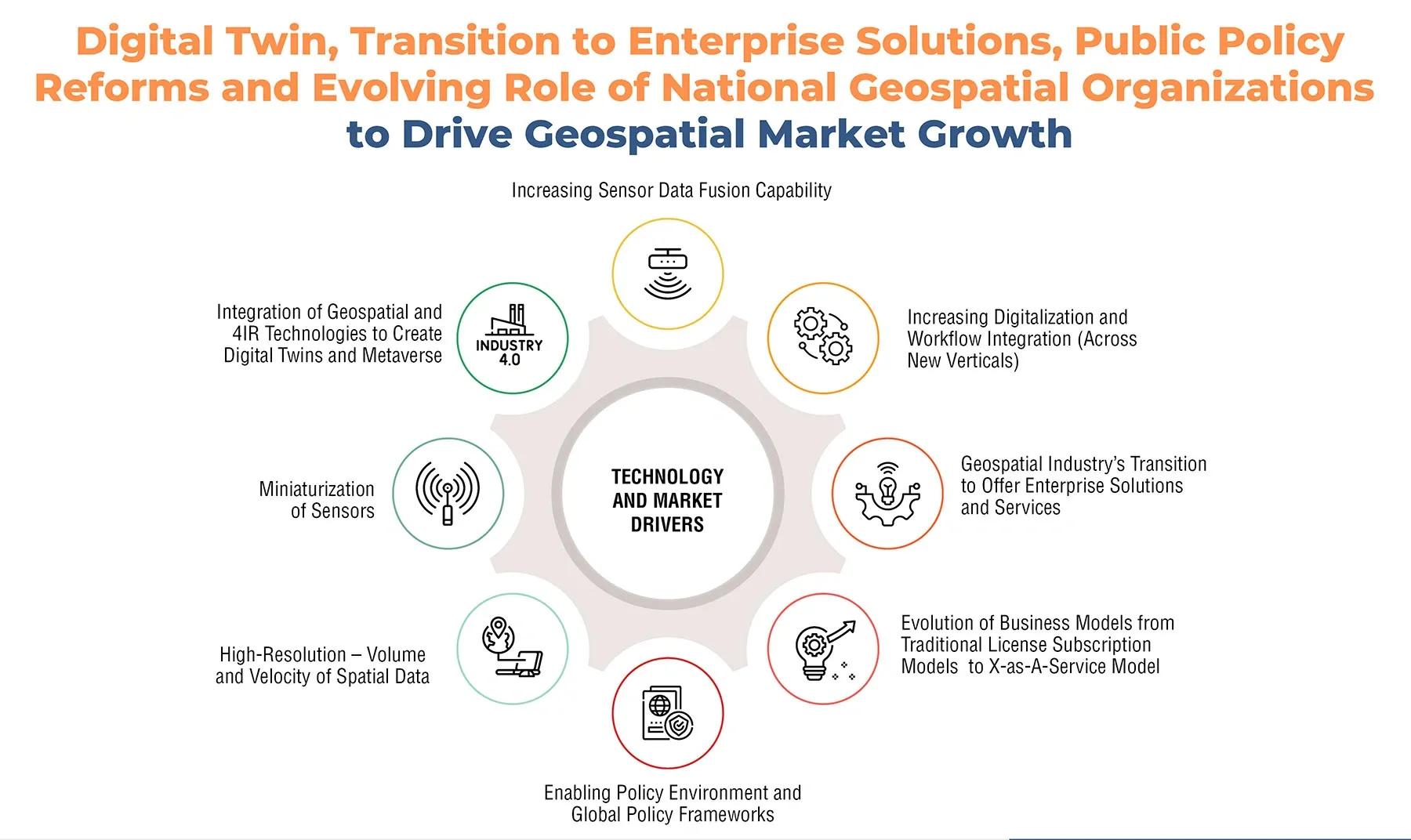
The world has been witnessing a dramatic revolution in technology, exemplified by rapid advances in digitalization and the emergence of Fourth Industrial Revolution (4IR) technologies. A new report published by Geospatial World underscores the driving forces underpinning the geospatial market's surge, highlighting key aspects such as the increasing sensor data fusion capabilities, the integration of geospatial and 4IR technologies, the miniaturization of sensors, and more. This article provides a reflective examination of these transformative technologies and the implications they hold for the global geospatial industry.
Sensor Data Fusion and Miniaturization
The burgeoning capability of sensor data fusion forms a cornerstone of the recent growth in the geospatial market. Sensor fusion technology has created a breakthrough in improving the reliability, robustness, and precision of geospatial data collection, ensuring that comprehensive and accurate geospatial intelligence is generated. This is achieved by integrating and processing diverse data from a multitude of sensors, enhancing data quality, and providing a more coherent picture of the environment.
Parallel to the fusion capability is the ongoing miniaturization of sensors. Sensor miniaturization allows the embedding of these devices into different platforms, thereby increasing their accessibility, applicability, and scope for innovation. Miniaturized sensors can be deployed across various industries, from agriculture and transportation to public health and defense, heralding new opportunities for the geospatial industry.
Digital Twins and the Integration with 4IR Technologies
Another technological breakthrough influencing the geospatial market's trajectory is the advent and maturation of digital twin technology. Digital twins, alongside the integration with 4IR technologies, serve as the linchpin for establishing virtual realities such as the metaverse. By creating an accurate digital representation of a physical object or system, digital twins offer unprecedented insights into real-world processes, fostering predictive analysis and proactive decision-making.
Moreover, the seamless blend of geospatial technology with 4IR underpins the concept of Industry 4.0. This integration is facilitating the rise of digital twins and the metaverse, propelling the industry into an era of high-resolution spatial data where volume and velocity of data take precedence.
Transition to Enterprise Solutions and New Business Models
One cannot overlook the geospatial industry's shift towards offering enterprise solutions and services. Driven by growing digitalization and workflow integration across new verticals, this transition demonstrates the sector's willingness to adapt to evolving market demands. Enterprises now look to geospatial solutions as a means of achieving better operational efficiency and enhancing strategic decision-making, a trend that is likely to continue given the increasing digitalization of industries.
Coupled with this transition is the evolution of business models. The industry is gradually moving away from traditional license subscription models towards X-as-a-Service models. This shift embodies a more flexible, scalable, and cost-effective approach that better aligns with the requirements of modern businesses, thereby bolstering the potential growth of the geospatial market.
Enabling Policy Environment and Global Frameworks
Public policy reforms and the evolving role of national geospatial organizations have also played a crucial role in driving the geospatial market's growth. An enabling policy environment allows for the growth of the geospatial industry, encourages innovation, and attracts investment. Moreover, national geospatial organizations have taken on increasingly significant roles, catalyzing the development of comprehensive global policy frameworks that support the wider use of geospatial technologies.
In conclusion, the interplay of technological innovation, evolving business models, and a supportive policy environment is a potent mix that promises to spur the growth of the global geospatial industry. As the industry continues to embrace these transformative changes, the future of geospatial technology promises to be more exciting, offering unprecedented opportunities for businesses, governments, and society at large.