Digital twins make that possible. They are virtual replicas of real-world systems (cities, sectors, programs) that ingest live and historical data, run scenarios, and predict outcomes. For India’s public policy ecosystem, rich in Digital Public Infrastructure (Aadhaar, UPI, DigiLocker), geospatial data, and increasing IoT coverage, policy digital twins can reduce risk, improve equity, and speed delivery. This article explains how they work, what to build, and where to start.
What is a Policy Digital Twin?
A policy digital twin is a calibrated, computational model of a public system that mirrors behavior of people, assets, and institutions under different rules. It supports “what-if” experiments: change a subsidy, add a congestion fee, tighten an emission norm, or stage vaccine clinics differently, and estimate effects on cost, access, environment, and compliance.
Core components
1. Data Layer
Administrative data (beneficiary records, program transactions)
Geospatial data (census, roads, land use, exposure)
DPI/transactional logs (with strong privacy controls)
Sensors/IoT, surveys, satellite imagery
Data quality, lineage, and consent management
2. Model Layer
System dynamics for stocks/flows (e.g., traffic, hospital beds)
Agent-based models for heterogeneous behavior (households, firms)
Econometric/causal models for policy attribution
ML for short-term prediction and anomaly detection
Calibration against historical events; validation on hold-out periods
3. Simulation & Experimentation
Scenario runner with adjustable levers and constraints
A/B or multi-arm experiments across districts/wards
Sensitivity analysis + uncertainty bands to avoid false precision
4. Decision, Value & Governance
KPIs across cost, equity, environment, reliability, adoption
Explainability, bias testing, audit trails
Privacy-by-design aligned to the Digital Personal Data Protection Act, 2023
Clear roles for ownership, review, and deployment
How It Works (Step-by-Step)
Define the outcome and levers. Example: reduce peak congestion by 20% using pricing, bus frequency, and parking policy.
Assemble and clean data. Integrate traffic counts, transit feeds, OD matrices, weather, land use, and compliance history.
Choose the model mix. Use system dynamics for flow; agent-based for traveler choice; ML for near-term demand.
Calibrate. Replay a past policy (e.g., festival restrictions) and match observed vs simulated outcomes.
Run scenarios. Explore low/medium/high levers, budget limits, and enforcement assumptions.
Stress test. Vary uptake, economic growth, or extreme weather to see robustness.
Publish a policy brief. Summarize value, trade-offs, confidence intervals, and a rollout plan with monitoring hooks.
Deploy + learn. Instrument the real rollout, stream outcomes back into the twin, and improve.
Example 1 , Urban Mobility: Congestion Pricing
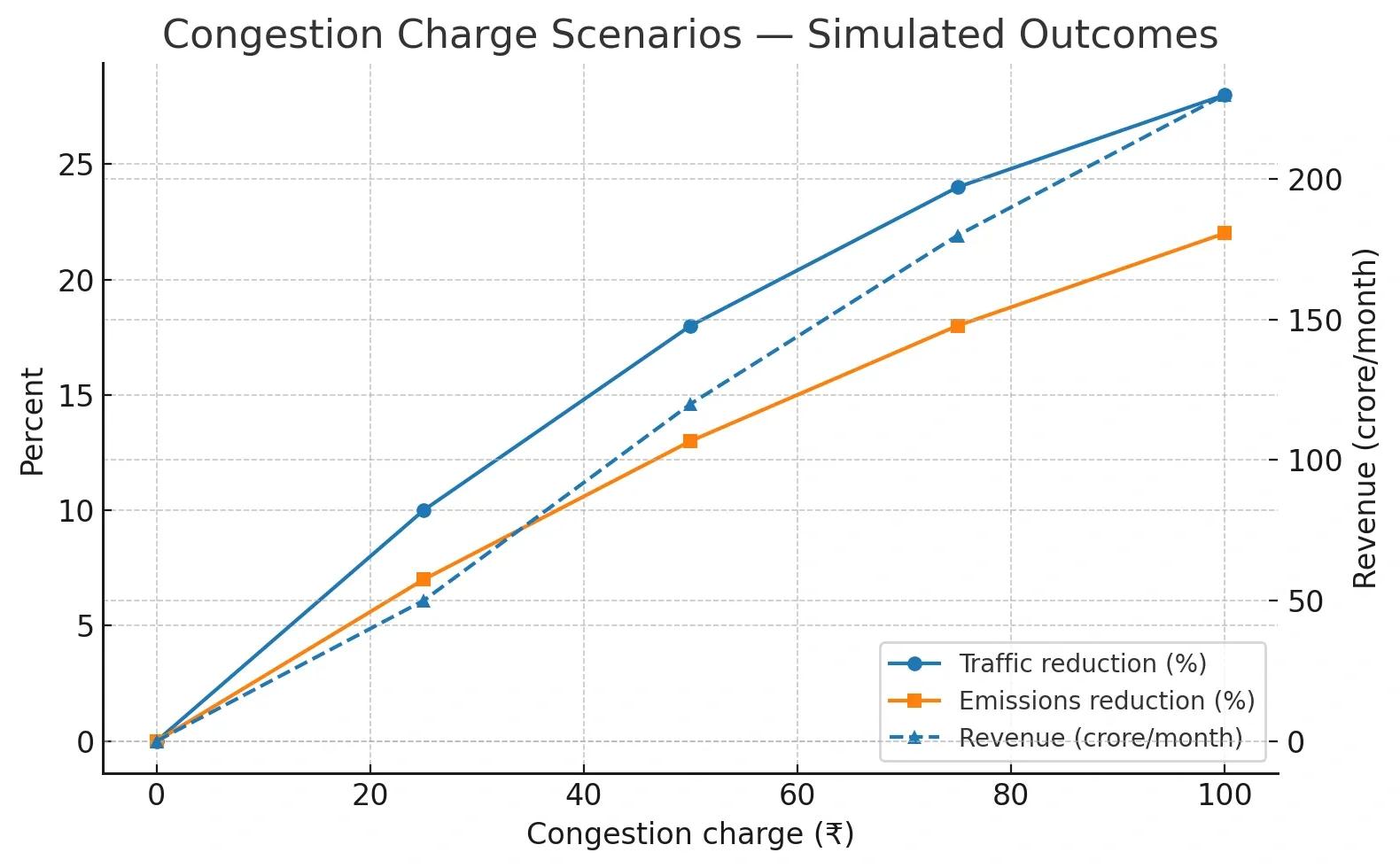
A city twin tests per-entry charges at ₹0, ₹25, ₹50, ₹75, and ₹100 in the core. It projects traffic and emissions reductions and monthly revenue.
Insights
Traffic and emissions drop non-linearly as charges rise; diminishing returns appear past a threshold.
Revenues grow then plateau as demand shifts.
Equity can be improved by earmarking revenue for buses and last-mile services in low-income areas.
Would you start with a modest charge and ramp up, or stage a pilot in one corridor with strong transit alternatives?
Example 2 , Social Protection: Smarter Targeting
For a subsidy (e.g., clean cooking fuel or housing support), the twin compares three targeting methods and quantifies leakage (ineligible receiving benefits) and exclusion (eligible left out).
Takeaway
Rule-based filters are simple but leaky.
Proxy-means tests reduce leakage but still miss deserving households.
Geo-ML targeting (combining geospatial deprivation indices with verified admin data) cuts both leakage and exclusion, with transparent audit trails.
Architecture You Can Reuse
Map the solution to a simple Digital Twin Pyramid :
Top , Triggers → Outcomes/OKRs: Policy drivers (growth, inclusion, safety) mapped to measurable targets.
Middle , Root Drivers: Data & AI; Process & Automation; Digital Models (BIM/geospatial/twins); Experience; Platforms; People & Change.
Base , Invisible Core (Power & Control): Governance, security/privacy, data mgmt, cloud/IaC, integration (APIs/events), observability/SRE, DevSecOps, FinOps, risk/compliance.
This keeps engineering disciplined while giving policy teams a clear line of sight from levers to value.
Benefits & ROI (Why This Matters)
Lower policy risk: Surface unintended effects before rollout.
Faster delivery: Shorten cycles from idea → pilot → scale.
Better equity: Quantify distributional impacts by location and demographic.
Transparent trade-offs: Make costs and externalities explicit.
Continuous learning: Real-world telemetry refines the twin over time.
Implementation Tips (India Context)
Start small. Pick one program and one KPI (e.g., reduce queue time at urban clinics by 30%).
Use available DPI. Leverage anonymized, consent-managed logs and open geospatial layers.
Instrument pilots. Collect just enough new data to close calibration gaps.
Build explainability in. Simple dashboards with counterfactuals help non-technical stakeholders.
Governance first. Establish data sharing agreements, retention limits, and privacy safeguards from day one.
Conclusion
Digital twins won’t replace policy judgment. They improve it. By simulating realistic behaviors and constraints, they help governments choose designs that are effective, fair, and financially sound, and then learn from real-world outcomes to get better with each iteration.