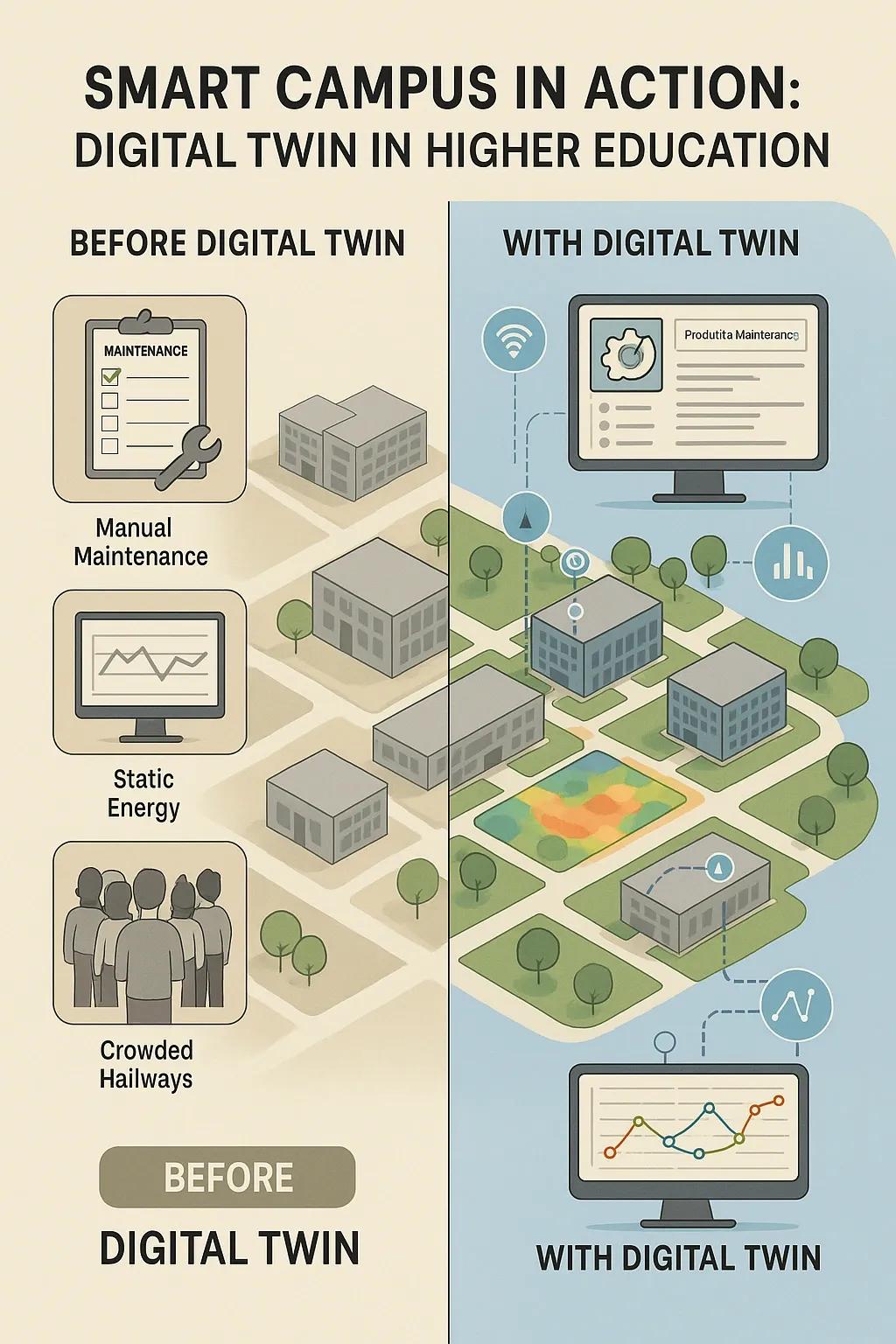
Higher education institutions are increasingly operating like complex enterprises, with sprawling campuses housing academic buildings, laboratories, dormitories, sports facilities, and utilities. Managing these diverse assets efficiently requires real-time insights, predictive maintenance, and data-driven decision-making. This is where Digital Twin technology is making a transformative impact.
A Digital Twin is a dynamic virtual model of a physical object, process, or system that uses real-time data and simulation to mirror and optimize its real-world counterpart. When applied to higher education campuses, Digital Twins provide an integrated view of operations, enabling proactive energy management, smart footfall tracking, and predictive maintenance strategies. This article explores the technical dimensions and operational benefits of deploying Digital Twins in higher education infrastructure.
1. The Need for Digital Twins in Campus Management
Universities and colleges manage infrastructure that is not only vast in scale but also varied in function. Traditional building management systems (BMS) and facility operations often fall short in:
Responding dynamically to fluctuating student and staff movement.
Coordinating energy usage across different functional zones.
Identifying early signs of maintenance issues across buildings and utility systems.
With the growing push toward smart campuses, sustainability mandates, and improved student experience, Digital Twins offer a path to integrated infrastructure intelligence.
2. Core Components of a Campus Digital Twin
A campus-level Digital Twin typically integrates multiple data streams and systems into a unified platform. Key components include:
3D Geospatial Models : Accurate representations of buildings, utilities, and outdoor spaces using GIS, BIM, and LiDAR data.
IoT Sensor Networks : Devices embedded across facilities to capture real-time data on temperature, energy consumption, occupancy, air quality, and more.
Data Integration Layer : Middleware that aggregates data from BMS, IoT, SCADA systems, and enterprise software (like CAFM or CMMS).
AI & Simulation Engines : Algorithms to run predictive analytics for asset lifecycle, energy optimization, and behavior modeling.
User Interfaces & Dashboards : Customizable portals for facility managers, administrators, and planners to visualize and interact with the twin.
3. Energy Management Through Digital Twins
Energy consumption is one of the largest operational expenses in higher education. Digital Twins enable institutions to analyze, simulate, and optimize energy use at both micro (room or building) and macro (campus-wide) levels.
Use Cases:
Dynamic Load Balancing : Using real-time occupancy data, HVAC and lighting systems can be automatically adjusted to minimize energy waste.
Solar and Renewable Integration : Simulate how solar panels or microgrids can offset energy demand at different times of day or seasons.
Anomaly Detection : Identify unusual energy spikes indicating equipment faults or inefficiencies.
Technical Workflow:
IoT sensors track energy metrics across substations, HVAC, and lighting systems.
Data flows into the twin for visualization and AI-based pattern analysis.
Automated control loops or recommendations are generated for facilities teams.
4. Footfall Monitoring and Space Optimization
With thousands of students, faculty, and visitors navigating campus facilities daily, understanding foot traffic patterns is critical for optimizing space usage, improving safety, and enhancing student experience.
Applications:
Smart Timetabling : Aligning class schedules with building occupancy to reduce congestion and optimize space.
Emergency Evacuation Planning : Simulating crowd movement under various scenarios for safer evacuation designs.
Facility Utilization Metrics : Identifying underutilized rooms or overburdened pathways for redesign or resource allocation.
Technologies Involved:
Video analytics and thermal imaging cameras.
Wi-Fi and Bluetooth beacon tracking.
Integration with access control and timetable systems.
Footfall data is mapped onto spatial models in Digital Twin, enabling facility planners to take informed actions.
5. Predictive and Condition-Based Maintenance
Reactive maintenance in large campuses leads to increased downtime and cost overruns. Digital Twins allow for predictive maintenance, where issues are identified and resolved before failure occurs.
Key Features:
Condition Monitoring : Sensors detect vibrations, temperature, humidity, and other parameters of critical equipment like HVAC units, elevators, or water pumps.
Lifecycle Simulation : AI models estimate the remaining useful life of assets based on historical and real-time data.
Maintenance Scheduling : Dynamic scheduling of work orders based on asset priority and availability of maintenance personnel.
Integrating with CMMS, Digital Twins provide a digital log of each asset’s health and maintenance history, reducing administrative overhead and extending asset lifespan.
6. Integration with Campus Planning and Sustainability Goals
Digital Twins can be integrated with long-term campus planning initiatives:
Carbon Footprint Calculation : Track emissions from buildings and utilities, enabling compliance with sustainability benchmarks like LEED or India’s ECBC (Energy Conservation Building Code).
Retrofitting Simulations : Model the impact of building renovations, insulation changes, or HVAC upgrades before actual implementation.
Smart Infrastructure Investments : Use digital simulations to prioritize infrastructure investments based on ROI, usage patterns, and sustainability impact.
7. Implementation Considerations
Implementing a Digital Twin in a higher education campus requires careful planning and stakeholder engagement.
Key Steps:
Data Standardization : Consolidate disparate datasets (CAD, GIS, BIM, IoT) into interoperable formats using standards like IFC, CityGML, or SensorThings API.
Modular Deployment : Start with a pilot area (e.g., library or administrative building) and scale up in phases.
Cybersecurity : Protect sensitive infrastructure and personal data with robust access controls, encryption, and data governance.
Training and Change Management : Equip facilities staff and IT teams with training to manage and interpret digital twin systems.
8. Case Example: Smart Campus at NTU Singapore
Nanyang Technological University (NTU) in Singapore is a prime example. Their EcoCampus initiative uses a Digital Twin to monitor over 200 buildings. Outcomes include:
26% energy savings through AI-based HVAC optimization.
Real-time occupancy analytics for space management.
Simulation models for carbon reduction strategies.
This illustrates the ROI and operational efficiency achievable through digital twin adoption.
Conclusion
Digital Twins are redefining how higher education institutions manage infrastructure. From optimizing energy use and tracking footfall to enabling predictive maintenance and long-term campus planning, Digital Twins offer a powerful, data-driven approach to campus management. As Indian and global universities face rising operational costs and sustainability demands, adopting Digital Twin technology can position them at the forefront of innovation while delivering tangible operational and environmental benefits.