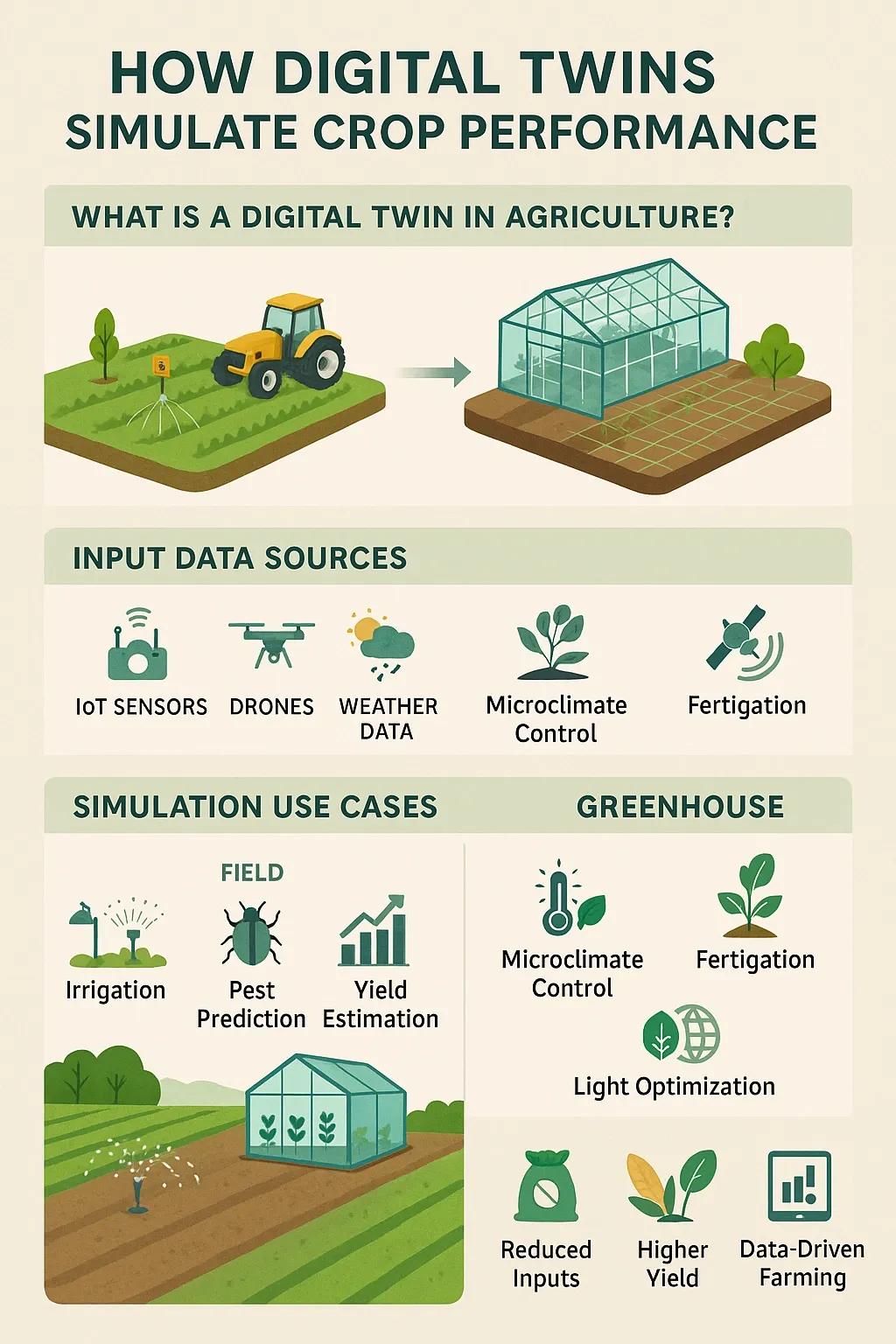
Digital transformation is reshaping agriculture, and digital twin technology stands at the forefront of this evolution. By simulating the physical environment of crops in real-time, digital twins enable farmers, agronomists, and researchers to make data-driven decisions that improve yield, reduce resource usage, and increase resilience to climate variability. This article explores how digital twins are being applied in agriculture, especially in open fields and greenhouses, to simulate crop performance and optimize inputs.
What Are Digital Twins in Agriculture?
A digital twin is a virtual model that mirrors a physical object or system in real-time using sensor data, AI models, and simulations. In agriculture, a digital twin replicates the conditions of a crop field or greenhouse, incorporating environmental, biological, and operational data to simulate how crops grow under varying conditions. These simulations allow for predictive insights and scenario testing that were previously difficult to achieve at scale.
Digital twins in agriculture combine geospatial data, remote sensing, IoT sensors, AI/ML models, and domain-specific agronomy knowledge. The result is a virtual testbed for real-world farming decisions.
Components of an Agricultural Digital Twin
Sensor Networks and IoT Soil moisture sensors, weather stations, nutrient monitors, and drone imagery feed real-time data into the digital twin. In greenhouse settings, even more granular data, like temperature, humidity, and CO₂ levels, are captured to control the microclimate.
Geospatial and Satellite Data Earth Observation (EO) data helps map field boundaries, monitor biomass, and detect anomalies. Combining this with on-ground data enriches the digital model's accuracy.
AI and Crop Growth Models Machine learning algorithms process large datasets to predict growth cycles, disease risk, and yield. These models learn from historical and real-time data to fine-tune decisions.
Simulation Engines Simulation frameworks test “what-if” scenarios, such as different irrigation schedules, planting densities, or fertilizer regimes, and project their impact on yield and resource consumption.
Use Cases: Field vs. Greenhouse Digital Twins
1. Field-Based Digital Twins
In open-field farming, digital twins focus on optimizing yield per hectare while dealing with unpredictable external factors like weather and pests.
Applications:
Precision Irrigation: Simulate water requirements across different zones and apply irrigation only where needed, saving water and energy.
Variable Rate Application: Use simulations to define site-specific input recommendations for fertilizers and pesticides, reducing overuse.
Predictive Yield Modeling: Estimate harvest quantities based on weather forecasts, historical data, and current crop health.
Climate Resilience: Evaluate how crops will respond to drought, floods, or temperature extremes. Helps in selecting climate-smart crops.
Example: In India, integrating digital twins with satellite-based crop monitoring platforms is helping sugarcane farmers improve water productivity and reduce losses from unpredictable monsoons.
2. Greenhouse Digital Twins
In greenhouses, environmental factors can be tightly controlled. Digital twins simulate internal dynamics and help automate control systems for optimal conditions.
Applications:
Microclimate Optimization: Simulate and adjust air flow, temperature, and light exposure dynamically.
Resource Efficiency: Fine-tune water and nutrient dosing through fertigation systems to minimize waste.
Pest and Disease Prevention: Detect early-stage risks using image recognition and simulation-based risk modeling.
Yield Maximization: Explore different crop cycle strategies, pruning schedules, or lighting conditions to increase output.
Example: In the Netherlands, large greenhouse tomato producers use digital twins to simulate different LED light recipes and their effects on photosynthesis, leading to energy-efficient yield improvements.
Benefits of Crop Simulation via Digital Twins
Input Optimization: Simulating crop performance under various input conditions allows farmers to reduce fertilizer, pesticide, and water usage without compromising yield.
Data-Driven Decisions: Real-time monitoring combined with predictive analytics supports timely interventions and improves operational efficiency.
Reduced Risk: Virtual testing of different agronomic strategies lowers the risk of costly on-ground experimentation.
Scalability and Customization: From smallholder farms to industrial greenhouses, digital twins can be adapted to scale and crop type.
Sustainability: Efficient use of resources contributes to environmentally sustainable farming practices aligned with global goals like SDG 2 (Zero Hunger) and SDG 13 (Climate Action).
Challenges in Adoption
Despite its potential, digital twin technology in agriculture faces several barriers:
Data Quality and Standardization: Inconsistent sensor data and lack of interoperability between systems can affect simulation reliability.
Cost of Deployment: High initial investment in sensors, software, and cloud infrastructure may deter small and medium farmers.
Digital Literacy and Training: Farmers and technicians need support to understand and act upon simulation insights effectively.
Connectivity in Rural Areas: Reliable internet access is critical for real-time data transmission and model updates, which can be a challenge in remote regions.
Future Outlook: What’s Next?
Integration with Genomics and Breeding: Digital twins can simulate how different genotypes perform under specific environmental conditions. This will help plant breeders and agri-tech firms in selecting optimal varieties for particular geographies.
AI-Driven Prescriptive Farming: Beyond simulation, AI models will increasingly generate prescriptive actions, like when and how much to irrigate or spray, reducing human guesswork.
Edge Computing and On-Farm Analytics: Processing data closer to the source using edge devices will reduce latency and ensure timely recommendations in the field.
Carbon Tracking and Sustainability Metrics: Digital twins will play a role in validating carbon sequestration claims and sustainable farming practices, essential for accessing green financing and carbon credits.
Conclusion
Digital twins are becoming powerful tools in agriculture, enabling virtual simulations that mirror real-world crop performance. From precision farming in open fields to automated climate control in greenhouses, these technologies are helping agriculture become more intelligent, resource-efficient, and climate-resilient.
For businesses and governments aiming to modernize agriculture and ensure food security, investing in digital twin platforms can deliver high ROI through increased yield, optimized resource use, and better adaptation to climate risks. As the technology matures and becomes more affordable, we can expect to see widespread adoption, especially in countries like India, where scalable, efficient farming practices are urgently needed.