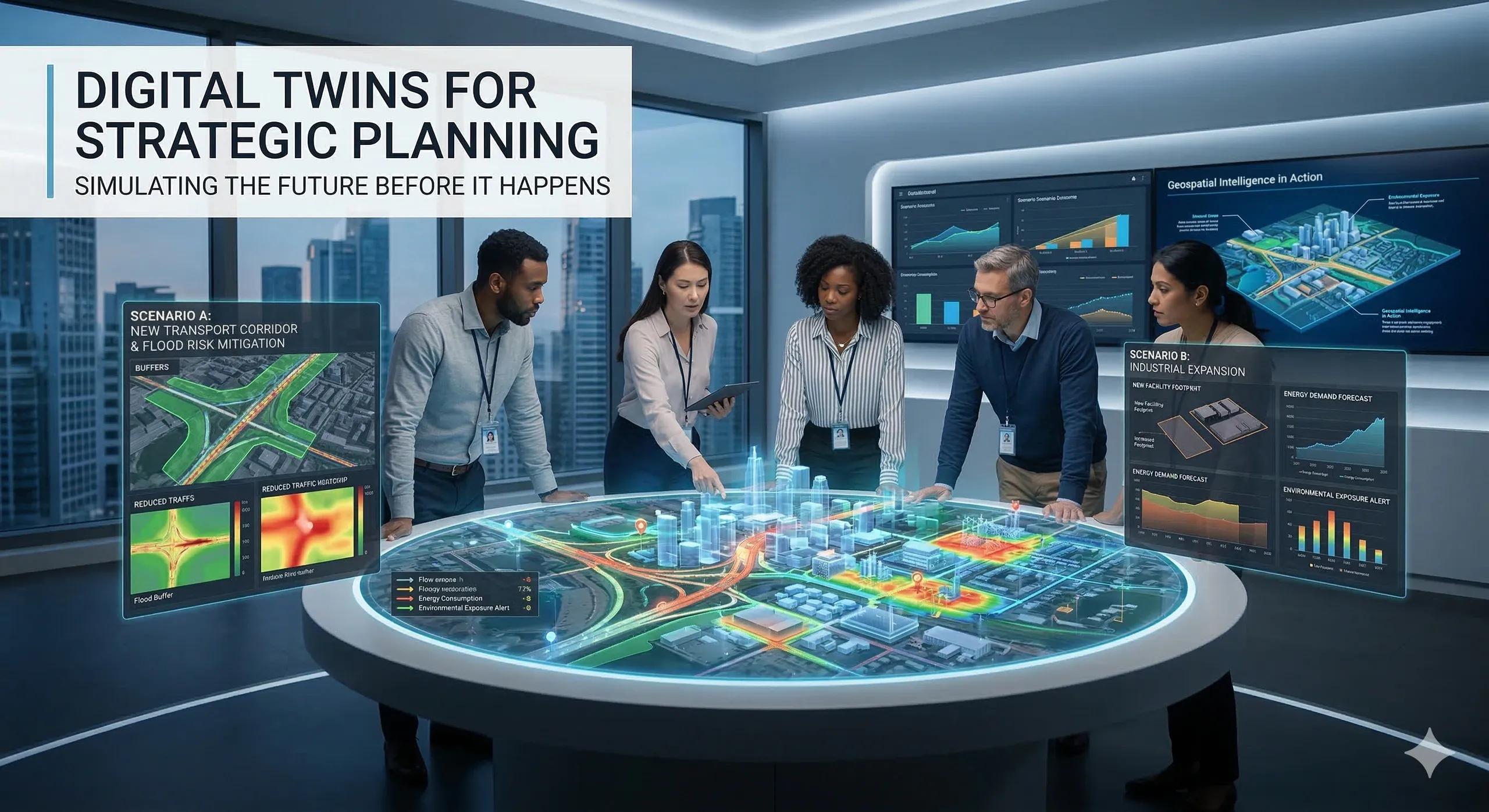
What If Decisions Could Be Tested Before They Are Made?
Most strategic decisions are made with limited visibility.
Cities approve infrastructure projects based on forecasts.
Industries expand capacity based on demand projections.
Governments design policies based on historical trends.
But once a decision is implemented in the physical world, reversing it becomes expensive and sometimes impossible.
This is where a new capability is changing the planning landscape:
Digital Twins.
Digital twins allow organizations to simulate future scenarios before committing resources in the real world.
What Is a Strategic Digital Twin?
A digital twin is a dynamic digital representation of a physical system.
Unlike static models, digital twins integrate multiple data streams to represent how systems behave over time.
For strategic planning, digital twins can combine:
geospatial data
infrastructure networks
environmental conditions
operational performance metrics
economic activity
This allows decision-makers to explore how different scenarios could affect real-world systems .
Why Simulation Matters for Strategic Decisions
Large infrastructure or investment decisions often involve long-term consequences.
Examples include:
building transport corridors
developing industrial zones
expanding energy infrastructure
planning urban growth
Traditional planning relies heavily on projections.
Digital twins enable scenario-based evaluation , where planners can simulate potential outcomes before implementation.
This reduces uncertainty and improves decision quality.
How Digital Twins Support Strategic Planning
Digital twins enable several important capabilities.
1️⃣ Scenario Simulation
Planners can test multiple scenarios such as:
population growth
climate impacts
infrastructure disruptions
economic expansion
This helps evaluate which strategies remain resilient under changing conditions.
2️⃣ System Interdependency Analysis
Infrastructure systems interact with each other.
Transport networks influence logistics.
Energy systems support industry.
Water infrastructure sustains cities.
Digital twins help visualize how these systems interact and where vulnerabilities exist.
3️⃣ Real-Time Monitoring
When connected to sensors and operational data, digital twins can provide continuous insights into system performance.
This allows planners to move from static planning to adaptive management .
4️⃣ Predictive Decision Support
Digital twins can integrate predictive models that forecast future conditions.
Examples include:
traffic demand
energy consumption
climate risk scenarios
supply chain disruptions
These insights help decision-makers prepare for future uncertainties.
A Practical Illustration
Consider a city evaluating the construction of a new transport corridor.
A digital twin of the urban system could simulate:
future traffic flows
changes in land use patterns
impact on surrounding neighborhoods
flood risk along the corridor
Instead of relying only on static studies, planners can observe how the system behaves under different scenarios.
Digital Twins and Spatial Intelligence
Digital twins rely heavily on geospatial foundations.
Geographic data provides the spatial structure upon which simulation models operate.
This includes:
terrain and land-use data
infrastructure networks
environmental exposure layers
population distribution patterns
Without spatial context, digital twins cannot accurately represent real-world systems.
Geospatial intelligence therefore forms the backbone of digital twin environments .
The Monetization Bridge
As infrastructure systems grow more complex, governments and enterprises are adopting digital twin platforms built on geospatial data to simulate infrastructure performance, test policy decisions, analyze climate exposure, and evaluate investment scenarios before implementation. These systems help decision-makers reduce risk and design more resilient strategies.
Looking Ahead
In the coming years, digital twins will become increasingly important for:
infrastructure investment planning
climate adaptation strategies
urban development policies
supply chain resilience
national infrastructure management
Instead of reacting to events, organizations will increasingly simulate the future before acting .
Closing Insight
Strategic planning has always involved uncertainty.
Digital twins do not eliminate uncertainty, but they make it visible.
And when uncertainty becomes visible, decisions become more informed.