Many organizations are interested in Digital Twins, but the first confusion often begins with language.
Should we start with a POC ?
Should we run a pilot ?
Should we build an MVP ?
Or should we directly invest in a full Digital Twin platform ?
These terms are often used interchangeably, but they are not the same.
Choosing the wrong starting point can create unnecessary cost, confusion, delays, or unrealistic expectations. A POC may be too small to prove business value. A full platform may be too expensive before readiness is clear. An MVP may work well for software validation but may not cover operational adoption. A pilot may prove value, but only if the scope is defined properly.
That is why organizations need to understand the difference before they begin.
A Digital Twin journey should start at the right level of commitment, risk, cost, and expected outcome.
Why the Starting Point Matters
A Digital Twin is not just a software tool. It connects assets, data, systems, workflows, users, and decisions.
That means the first step must match the organization’s current maturity.
If the organization is still unsure about the use case, a full platform may be premature.
If the use case is clear but data is not ready, a POC may help test technical feasibility.
If the use case is clear, users are identified, and minimum viable data is available, a pilot may be the best starting point.
If the organization wants to build a reusable product or internal capability, an MVP may be appropriate.
If there is strong business alignment, budget, data maturity, governance, and scaling need, then a full platform may be justified.
The question is not: Which one sounds more impressive?
The better question is:
Which starting point reduces risk and moves us toward measurable value?
What Is a POC?
A POC, or Proof of Concept, is used to test whether something is technically possible.
In a Digital Twin context, a POC may answer questions such as:
Can we connect sensor data to a 3D model?
Can BIM and GIS data be integrated?
Can a specific asset be monitored in real time?
Can a dashboard display live operating parameters?
Can AI detect anomalies from available data?
Can a spatial layer support a specific analysis?
Can data from ERP or CMMS be consumed by the twin?
A POC is useful when there is technical uncertainty.
It is usually limited in scope, short in duration, and focused on feasibility rather than business transformation.
For example, a port authority may run a POC to test whether equipment movement data can be visualized on a geospatial map. A factory may run a POC to check whether vibration data from one machine can support anomaly detection. A campus may run a POC to test whether BIM and IoT data can be connected in a single dashboard.
A POC is not meant to prove full ROI.
It proves possibility.
When Should You Choose a POC?
A POC is suitable when:
the technology integration is uncertain,
data availability is unclear,
stakeholders need to see feasibility,
the organization wants to test a concept before investing more,
the use case is still being refined,
there is no strong operational commitment yet.
A POC should be used carefully.
It should not be mistaken for implementation success.
A POC can show that something works technically, but it may not show whether users will adopt it, whether workflows will change, or whether ROI will be achieved.
That is why a successful POC should quickly lead to a more structured pilot or MVP.
What Is a Pilot?
A pilot is a controlled implementation in a real operational setting.
Unlike a POC, a pilot is not only about technical feasibility. It is about testing practical value.
A Digital Twin pilot should answer questions such as:
Does the solution improve a real decision?
Can users work with it?
Can the data support operational needs?
Are alerts meaningful?
Are workflows aligned?
Can benefits be measured?
What gaps appear before scaling?
A pilot usually involves real users, real assets, real workflows, and measurable outcomes.
For example, a manufacturing company may run a Digital Twin pilot for predictive maintenance on one critical production line. A city may run a flood monitoring pilot in one risk-prone zone. A road agency may test road condition monitoring on one corridor. A building owner may test HVAC optimization in one facility.
A pilot is often the most practical starting point when the organization already has a defined problem and wants to prove operational value.
When Should You Choose a Pilot?
A pilot is suitable when:
the business problem is clear,
the users are identified,
minimum viable data is available,
the organization wants measurable outcomes,
leadership wants evidence before scaling,
one facility, asset group, or process can be selected,
the solution needs to be tested in real operations.
The strength of a pilot is that it creates evidence.
It helps the organization understand what works, what does not, what needs improvement, and what will be required for scale.
A good pilot should be focused enough to deliver, but meaningful enough to prove value.
What Is an MVP?
An MVP, or Minimum Viable Product, is the first usable version of a product or solution that delivers core functionality to users.
In a Digital Twin context, an MVP may include:
a basic asset model,
selected data connections,
simple dashboards,
user login and roles,
basic alerts,
one or two workflows,
minimum analytics,
a simple reporting layer,
limited integration with enterprise systems.
An MVP is especially useful when the organization wants to build a reusable Digital Twin application or internal product.
For example, a company developing a Digital Twin platform for multiple warehouses may first build an MVP for one warehouse with core asset visibility, movement tracking, alerts, and reports. A real estate group may build an MVP for one building before standardizing the solution across its portfolio. A utility may build an MVP for one asset class before expanding to the full network.
An MVP is not just a demo. It should be usable.
But it is not the final product.
It is the first working version that can be improved based on user feedback.
When Should You Choose an MVP?
An MVP is suitable when:
the organization wants to develop a reusable solution,
the use case is clear enough to build core functionality,
users can test and give feedback,
the solution will evolve over time,
there is a product roadmap,
the organization wants speed without building everything at once.
An MVP works well when the goal is progressive development.
It allows teams to launch quickly, learn from users, improve features, and avoid overbuilding.
However, an MVP still needs clarity. If the use case is vague, the MVP may become a collection of disconnected features.
What Is a Full Digital Twin Platform?
A full Digital Twin platform is a larger-scale implementation designed to support multiple assets, systems, users, workflows, dashboards, analytics, and decision processes.
It may include:
enterprise asset data model,
BIM-GIS integration,
IoT and real-time data integration,
ERP, CMMS, SCADA, or other system connections,
role-based access,
dashboards and analytics,
simulation capabilities,
AI or predictive models,
mobile access,
alert and workflow management,
governance and security,
reporting and compliance tools,
scalability across sites, assets, or departments.
A full platform is not just a technology layer. It becomes part of the organization’s operating environment.
This level requires stronger planning, budget, governance, and long-term commitment.
When Should You Choose a Full Platform?
A full platform is suitable when:
the organization has strong leadership alignment,
business outcomes are clearly defined,
multiple use cases are ready,
data maturity is reasonably strong,
governance and ownership are clear,
budget is available for both CapEx and OpEx,
integration needs are known,
the solution must scale across sites, assets, or departments.
A full platform can create major value, but it should not be the default starting point for every organization.
If readiness is weak, a full platform may become expensive and underused.
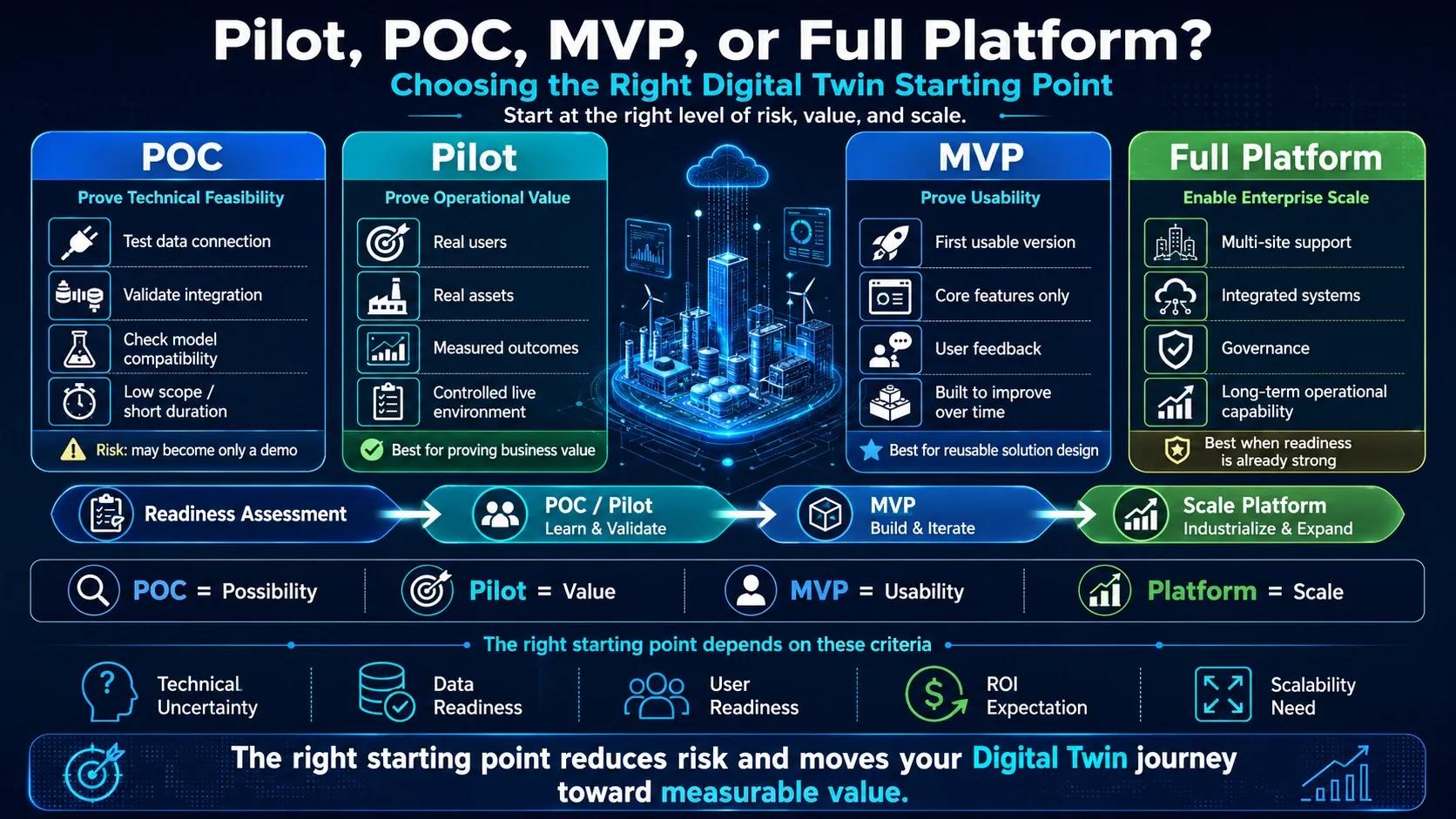
The Difference in One View
Starting Point - Main Purpose - Best For - Risk if Misused
POC - Prove technical feasibility - Uncertain technology or data connection - May become a demo without business value
Pilot - Prove operational value - Clear use case in a controlled real setting - May fail if scope or metrics are unclear
MVP - Build first usable version - Reusable product or solution roadmap - May become feature-heavy without focus
Full Platform - Scale enterprise capability - Mature organization with multiple use cases - May become costly and underused if readiness is weak
This distinction helps organizations avoid confusion.
A POC proves possibility.
A pilot proves value.
An MVP proves usability.
A platform enables scale.
How to Choose the Right Starting Point
Organizations can use a simple decision logic.
Choose a POC if:
You are still asking:
Can this data be connected?
Can this integration work?
Can this model be created?
Can this analytics logic be tested?
Can the technology support the idea?
A POC is about technical confidence.
Choose a Pilot if:
You are asking:
Can this improve a real operational decision?
Can users adopt it?
Can we measure value?
Can we test it on one asset, site, or process?
Can this become the basis for scaling?
A pilot is about operational confidence.
Choose an MVP if:
You are asking:
Can we build the first usable version?
Can users interact with it?
Can we gather feedback?
Can we create a repeatable product?
Can we improve it over multiple releases?
An MVP is about product confidence.
Choose a Full Platform if:
You are asking:
Can we scale across multiple use cases?
Can this become part of enterprise operations?
Do we have governance, data, users, and budget?
Can we support long-term operation?
Can the platform integrate across the organization?
A platform is about enterprise confidence.
A Practical Digital Twin Starting Path
For many organizations, the best path is not to jump directly to a full platform.
A more practical path is:
Readiness Assessment → POC or Pilot → MVP → Scale Platform
But the sequence depends on maturity.
If there is high technical uncertainty, start with a POC.
If the problem and data are clear, start with a pilot.
If the goal is a reusable solution, structure the pilot as an MVP.
If multiple pilots have already proven value, move toward a full platform.
The key is to avoid overcommitting too early.
Common Mistakes to Avoid
Mistake 1: Calling Every Small Project a POC
Many organizations call every early implementation a POC. But if real users, real workflows, and measurable outcomes are involved, it may actually be a pilot.
Using the right term helps set the right expectations.
Mistake 2: Expecting ROI from a Technical POC
A POC may prove that integration is possible. It may not prove business ROI.
ROI should be evaluated through a pilot or operational MVP.
Mistake 3: Building a Full Platform Before Readiness
This can lead to high cost, low adoption, and unclear value.
A platform should come after readiness, use-case clarity, and data confidence.
Mistake 4: Running a Pilot Without Success Metrics
A pilot must define what success means.
Otherwise, the organization may finish the pilot without knowing whether to scale.
Mistake 5: Treating MVP as a Poor Version of the Final Product
An MVP is not a low-quality product.
It is a focused first version that delivers core value and improves through feedback.
What Should Be Measured?
Each starting point should have different success measures.
For a POC, measure:
technical feasibility,
data connectivity,
model compatibility,
integration performance,
proof of concept validity.
For a pilot, measure:
decision improvement,
user adoption,
workflow fit,
time saved,
downtime reduced,
inspection efficiency,
energy savings,
operational visibility,
ROI indicators.
For an MVP, measure:
user engagement,
feature usefulness,
feedback quality,
system usability,
release improvement,
repeatability.
For a full platform, measure:
scalability,
enterprise adoption,
integration coverage,
operational impact,
governance effectiveness,
total cost of ownership,
long-term ROI.
Measurement must match the stage.
This prevents unrealistic expectations.
The Right Starting Point Reduces Risk
Digital Twin projects fail when expectations, maturity, scope, and budget are misaligned.
A POC cannot carry the burden of enterprise ROI.
A pilot cannot succeed without users and metrics.
An MVP cannot work without product direction.
A full platform cannot create value without governance and adoption.
The right starting point reduces risk.
It helps the organization move step by step from uncertainty to confidence.
Technical confidence.
Operational confidence.
Product confidence.
Enterprise confidence.
That is the path toward scalable Digital Twin value.
Closing Thought
A Digital Twin journey does not need to begin with a large platform.
It needs to begin with the right starting point.
If the question is technical feasibility, start with a POC.
If the question is operational value, start with a pilot.
If the question is product usability, start with an MVP.
If the question is enterprise scale, plan for a platform.
The key is to match the approach with the organization’s readiness, use case clarity, data maturity, budget, and expected outcomes.
A Digital Twin should not start big just to look serious.
It should start correctly so that it can grow with confidence.