Most organizations say they are building a Digital Twin.
But very few can answer:
👉 What level are we actually at?
Introduction
Digital Twin is not a binary state, you either have it or you don’t.
It is a maturity journey .
Understanding where you stand helps answer:
What to build next
What to fix
What to expect in terms of ROI
The Core Problem: No Maturity Awareness
Many organizations:
Build partial systems
Call them Digital Twins
Expect full-scale outcomes
This leads to:
Misaligned expectations
Frustration
Perceived failure
👉 The issue is not capability, it is maturity mismatch
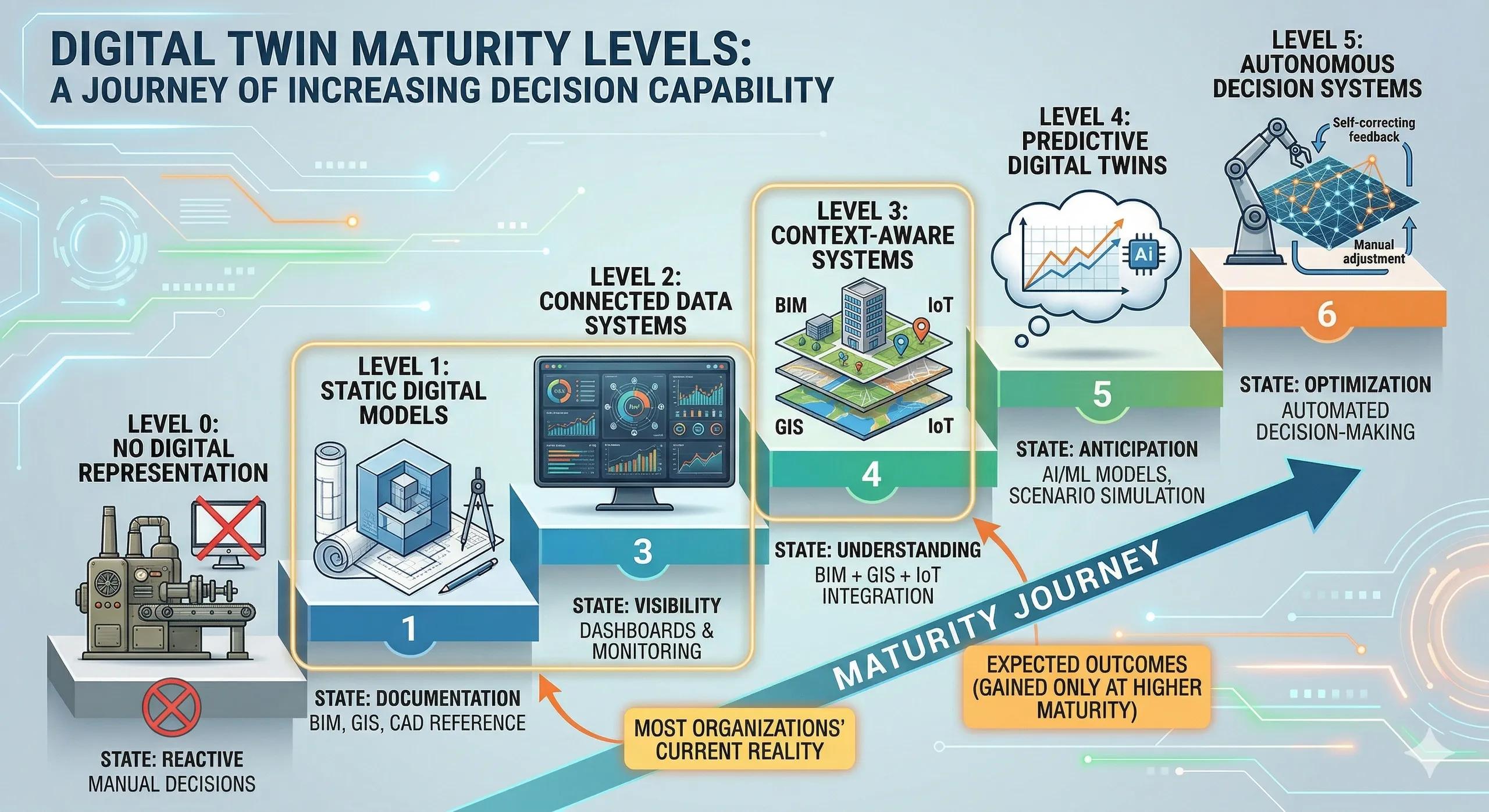
The Digital Twin Maturity Model
Level 0: No Digital Representation
Physical assets exist
No structured digital data
Decisions are manual
👉 State: Reactive
Level 1: Static Digital Models
BIM models, GIS maps, CAD drawings
Updated occasionally
Used for reference
👉 State: Documentation
Level 2: Connected Data Systems
Data from multiple sources integrated
Dashboards and monitoring systems
👉 State: Visibility
⚠️ Most organizations stop here and call it a Digital Twin
Level 3: Context-Aware Systems
Integration of BIM + GIS + IoT
Spatial and operational context included
Data aligned across systems
👉 State: Understanding
Level 4: Predictive Digital Twins
AI/ML models
Predictive analytics
Scenario simulation
👉 State: Anticipation
Level 5: Autonomous Decision Systems
Automated decision-making
Self-optimizing systems
Minimal human intervention
👉 State: Optimization
The Real Insight
Most organizations are between:
👉 Level 1 (Static Models)
and
👉 Level 2 (Dashboards & Monitoring)
But expect outcomes from:
👉 Level 4 (Predictive systems)
This gap is where projects fail.
Practical Example
Scenario: Infrastructure Monitoring
Level 1: BIM model of asset
Level 2: Dashboard showing sensor data
Level 3: Context-aware alerts (location + impact)
Level 4: Predicting failures before they occur
Level 5: Automatically triggering corrective actions
👉 Each level adds decision capability
Where Most Organizations Go Wrong
1. Skipping Levels
Trying to jump directly to AI without integration.
2. Overestimating Maturity
Believing dashboards equal Digital Twins.
3. Underestimating Integration Effort
Ignoring data and system alignment.
4. Lack of Roadmap
No clear path from current state to target state.
Ask Yourself
Are you building a Digital Twin, or are you still at the dashboard stage?
What a Better Approach Looks Like
1. Assess Current Level Honestly
Where are you today?
2. Define Target Level
What outcomes do you want?
3. Build Step-by-Step
Don’t skip maturity stages
4. Align with Use Cases
Each level should support real decisions
Indian Context
Many organizations in India:
Have strong Level 1 and Level 2 capabilities
Are starting to move toward Level 3
👉 The opportunity is to systematically progress , not rush
Benefits of Understanding Maturity
Realistic expectations
Better investment decisions
Structured implementation
Higher success rates
Clear ROI pathway
Conclusion
A Digital Twin is not a tool.
It is a journey of increasing decision capability .
The question is not: 👉 “Do you have a Digital Twin?”
But:👉 “What level are you operating at?”